| SERVICE ADJUSTMENT PROCEDURE |
CHECKING STEERING WHEEL FREE PLAY
| 1. |
Start the engine with the steering wheel in
the straight ahead position. Apply a force of 5 N (1.1 lb) to the
steering wheel in the peripheral
direction. |
| 2. |
Measure the play at the circumference of the
steering wheel.
|
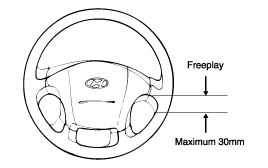
| 3. |
If the play exceeds the standard value,
inspect the contact of the steering shaft and tie rod ball
joints. |
CHECKING STEERING ANGLE
| 1. |
Place the front wheel on a turning radius
gauge and measure the steering angle.
|
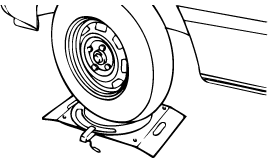
| 2. |
If the measured value is not within the
standard value. Adjust the linkage. |
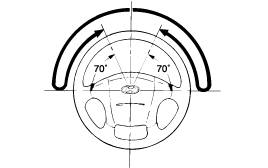
CHECKING STEERING WHEEL RETURN
Check the
steering wheel return and confirm the following points:
| 1. |
The force required to turn the steering wheel
and the wheel return should be the same for left and right for both
moderate turns and sharp turns. |
| 2. |
When the steering wheel is turned 90° and held
for a couple of seconds while the vehicle is being driven at 20-30
kph (12-19 mph), the steering wheel should return at least 70° from
the neutral position whenit is released.
|

CHECKING THE TIE ROD END BALL JOINT STARTING
TORQUE
| 1. |
Disconnect tie rod and
knuckle. |
| 2. |
More the ball joint studing circular motion
several times. |
| 3. |
Mount two nuts on the ball joint, and then
measure the ball joint starting torque.
|
| 4. |
If the starting torque exceeds the upper limit
of standard value, replace the tie rod
end. |
| 5. |
If the starting torque is below the lower
limit of the standard value, the ball joint may be reused unless it
has drag and excessive play. |
CHECKING POWER STEERING FLUID LEVEL
| 1. |
Position the vehicle on a level
surface. |
| 2. |
Start the engine. With the vehicle kept
stationary, turn the steering wheel several times continuously to
raise the fluid temperature from
50~60°C(122~140°F). |
| 3. |
With the engine at idle, turn the steering
wheel fully clockwise and counterclockwise several
times. |
| 4. |
Make sure that there is no foaming or
cloudiness in the reservoir fluid. |
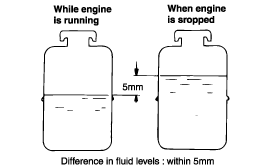
| 5. |
Stop the engine and check for any difference
in fluid level between a stationary and a running
engine.
|
REPLACING POWER STEERING FLUID
| 1. |
Jack up the front wheels and support with
rigid racks. |
| 2. |
Disconnect the return hose from the oil
reservoir and install a plug on the oil
reservoir. |
| 3. |
Connect a vinyl hose to the disconnected
return hose, and drain the oil into a
container. |
| 4. |
Disconnect the high-tension cable at the
ignition coil side. While operating the starter motor
intermittently, turn the steering wheel all theway to the left and
then to the right several times to drain the
fluid. |
| 5. |
Connect the return hoses securely, and then
fill the oil reservoir with the specified
fluid. |
| 6. |
Bleed the system.
Power steering fluid
type : PSF-3
Total quantity :
Approx 1.0 liter |
AIR BLEEDING
| 1. |
Disconnect the high tension cable, and while
operating the starting motor intermittently (for 15~20 seconds),
turn the steering wheel all theway to the left and to the right five
or six times.
|
| 2. |
Connect the high tension cable, and then start
the engine (idling). |
| 3. |
Turn the steering wheel to the left and then
to the right until there are no air bubbles in the oil
reservoir.
|
| 4. |
Confirm that the fluid is not milky, and that
the level is up to the specified position on the level
gauge. |
| 5. |
Confirm that there is little change in the
surface of the fluid when the steering wheel is turned left and
right.
|
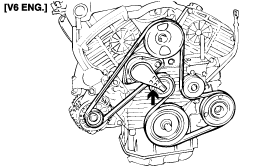
CHECKING POWER STEERING BELT TENSION
| 1. |
Press the V-belt applying a pressure of 98N
(10kg, 22lb) at the specified point, and measure the deflection to
confirm that it is within thestandard value range.
|
| 2. |
To adjust the belt tension, auto tensioner
does automatically adjust and obtain the standard value (V-6
ENG).
|
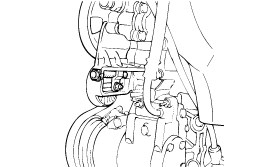
| 3. |
To adjust the belt tension, loosen the
tensioner adjusting bolt, and then retighten the bolts. (DOHC
ENG.)
|
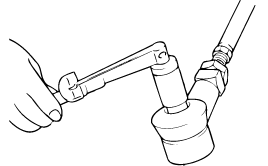
OIL PUMP PRESSURE TEST
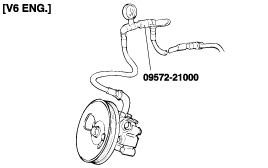
| 1. |
Disconnect the pressure hose from the oil
pump, and then connect the special tool between the oil pump and
pressure hose as illustrated. |
| 2. |
Bleed the air. Start the engine and turn the
steering wheel several times so that the fluid temperature rises to
approximately 50°C(122°F)operating
temperature. |
| 3. |
Set the engine speed to 1,000
rpm. |
| 4. |
Fully close and then fully open the shut-off
valve of the special tool and measure the fluid pressure to confirm
that it is within the standardvalue range.
|
| 5. |
Remove the special tools and then tighten the
pressure hose to the specified torque.
|
| 6. |
Bleed the
system. |