| INSPECTION |
For monitor, there are a
CCV and an air filter as the illustration.
| 1. |
Look for loose connections, sharp bends or
damage to the fuel vapor lines. |
| 2. |
Look for distortion, cracks or fuel
leakage. |
| 3. |
After removing the EVAP Canister, inspect for
cracks or damage.
|
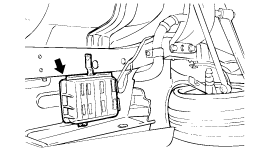
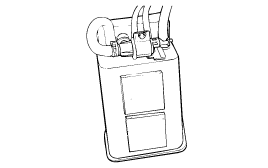
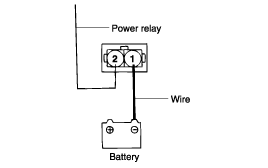
CHECK OF CANISTER CLOSE VALVE OPERATING
| 1. |
Connect the CCV pins to a wire as
shown. |
| 2. |
At idle, disconnect the CCV
connector. |
| 3. |
Inspect that CCV is close when attaching the
wire to (-) of battery. |
| 4. |
Inspect that CCV is open when detaching the
wire from (-) of battery.
|

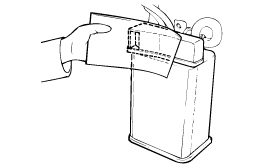
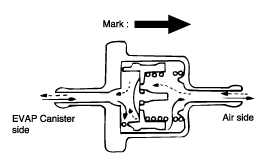
TWO-WAY VALVE
| 1. |
Inspect that air flows as
shown. |
| 2. |
Check to connect correctly such as the arrow
mark on the valve.
|
AIR FILTER
Look for distortion,
cracks.