| P |
|
DTC |
P0420 |
Main Catalyst
Efficiency Below Threshold (Bank
1) |
DESCRIPTION
The ECM uses
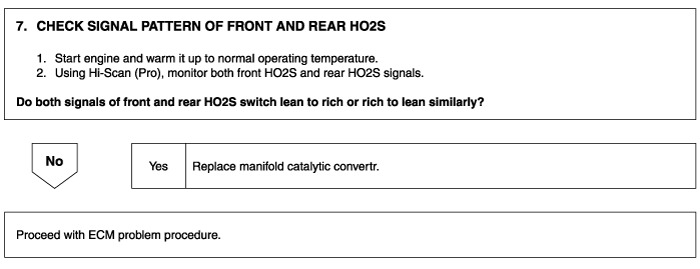
dual oxygen sensors to monitor the efficiency of the manifold catalytic
converter (warm-up catalytic converter). By monitoring the oxygen storage
capacity of a catalyst, its efficiency can be indirectly calculated. The
upstream (front) HO2S is used to detect the amount of oxygen in the
exhaust gas before it enters the catalytic converter. A low voltage
indicates high oxygen contents (lean air mixture). A high voltage
indicates low oxygen contents (rich air mixture).When the catalyst
efficiency drops, no chemical reaction takes place. This means the
concentration of oxygen will be the same rear as front. The output voltage
of the rear HO2S copies the voltage of the front HO2S.To monitor the
system, the lean-to-rich switches of front HO2S to rear HO2S is counted.
The ratio of rear switches to front switches is used to determine whether
the catalyst is operating properly. An effective catalyst will have fewer
rear switches than front switches, that is, a ratio closer to zero.
DTC DETECTING CONDITION
|
DTC
No |
Detecting Condition
& Limp Home |
Suspect
area |
|
P0420 |
Detecting
Condition
The signal ratio of front HO2S and rear HO2S
in a load and speed range > 0.7
? Enable Condition
- Catalyst temperature: 400~600°C
- Engine coolant temperature >
70°C
- Engine speed: 800~2500 RPM
- Air mass flow < 250mg/stroke
- Lambda control within its limit
- No misfire detected
- Not transient condition
- Time required: 171 lambda controller
cycles
Limp
Home
None |
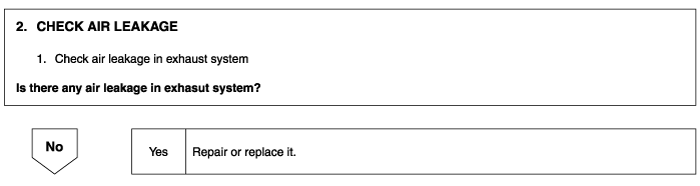
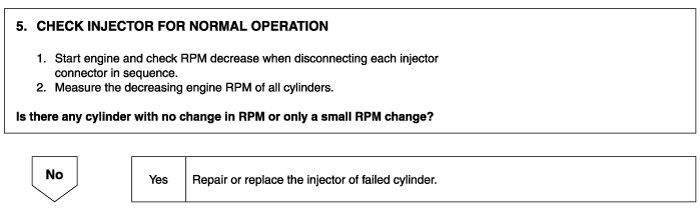
- Air leakage
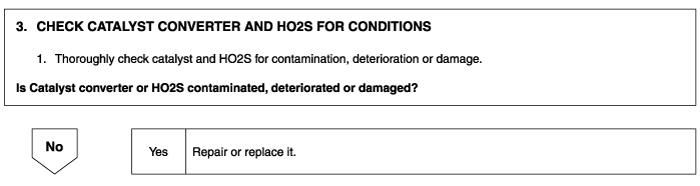
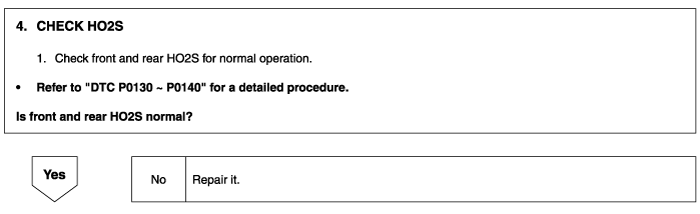
- HO2S
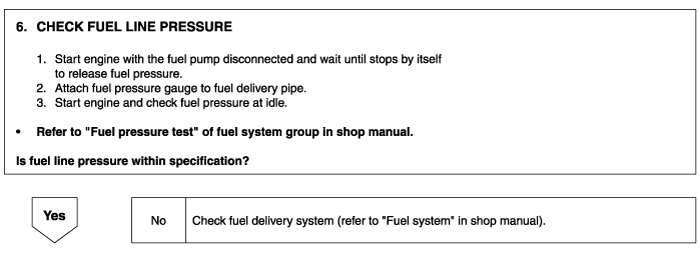
- Fuel delivery system
- Injector
- Catalytic converter
- ECM |
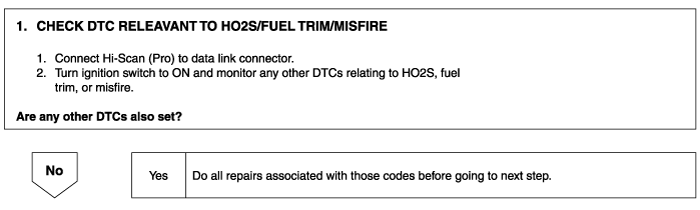
INSPECTION PROCEDURES