| FUEL SENDER REPLACEMENT [2.7
V6] |
| 1. |
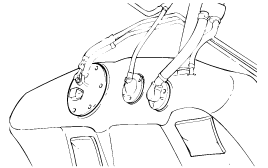
Remove the fuel tank cap to lower the fuel
tank's internal pressure. |
| 2. |
Open the trunk door and disconnect the fuel
pump connector, remove the fuelfeed and return line from the fuel
pump assembly. |
| 3. |
Remove the fuel pump installation screws, then
remove the fuel pump assemblyfrom the fuel
tank. |
| 4. |
Remove the fuel sender from the fuel pump
assembly. |
| 5. |
Inspect and replace, if
necessary.
|
FUEL FILTER REPLACEMENT [2.7 V6]
| 1. |
Reduce the internal pressure of the fuel lines
and hoses and perform the followingoperations.
| A. |
Disconnect the fuel pump harness
connector in the trunk room. |
| B. |
Start the engine and, after it stops,
turn the ignition switch to
OFF. |
| C. |
Disconnect the battery negative (-)
terminal. |
| D. |
Connect the fuel pump harness
connector.
| |
| 2. |
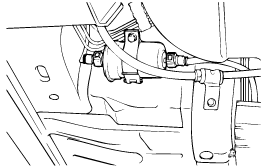
Remove the two fitting nuts while holding the
fuel filter nuts securely. |
| 3. |
Remove the fuel filter mounting bolts, and
then remove the fuel filter fromthe fuel filter clamp.
Tightening
torque
Fuel filter fitting nut :
25~35 Nm (250~350 kg•cm, 18~25
lb•ft)
|
|
| FUEL PUMP OPERATION CHECK [2.7
V6] |
| 1. |
Turn the ignition switch to
OFF. |
| 2. |
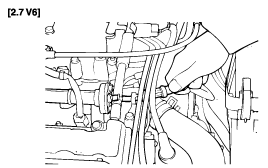
Apply battery voltage to the fuel pump drive
connector to check that the pumpoperates.
|
The fuel pump is an in-tank type and its
operating sound is hard to hear withoutremoving the fuel tank
cap. | |
| 3. |
Pinch the fuel hose to check that fuel
pressure is felt.
|
FUEL PRESSURE TEST [2.7 V6]
| 1. |
Reduce the internal pressure of the fuel pipes
and hoses by the followingprocedures
| A. |
Disconnect the fuel pump harness
connector after removing the rear seat
cushion. |
| B. |
Start the engine and after it stalls,
turn the ignition switch to the
OFFposition. |
| C. |
Disconnect the battery negative (-)
terminal. |
| D. |
Connect the fuel pump harness
connector.
| |
| 2. |
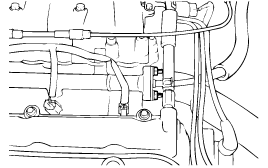
Remove the bolt connecting the fuel line to
the fuel filter.
|
Cover the hose connection with a shop
towel to prevent splashing of fuel causedby fuel residual
pressure in the fuel line.
| |
| 3. |
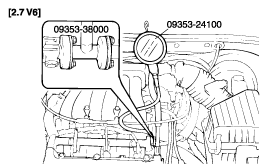
Using the fuel pressure gauge adapter, install
the fuel-pressure gauge tothe fuel filter. Tighten the bolt to the
specified torque.
Tightening
Torque
Fuel pressure gauge to fuel filter
:
25~35 Nm (250~350 kg•cm, 18~26
lb•ft)
|
|
| 4. |
Connect the battery's negative (-)
terminal. |
| 5. |
Apply battery voltage to the terminal for the
pump drive and activate thefuel pump: then, with fuel pressure
applied, check that there is no fuel leakagefrom the pressure gauge
or connection part. |
| 6. |
Start and run the engine at curb idle
speed. |
| 7. |
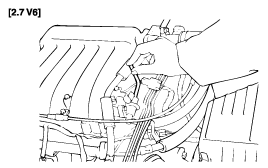
Disconnect the vacuum hose from the pressure
regulator, and plug the hoseend. Measure the fuel pressure at
idle.
Standard value
:
320 ~ 340 kPa (3.26 ~ 3.47 kg/cm², 37
psi)
|
|
| 8. |
Measure the fuel pressure when the vacuum hose
is connected to the pressureregulator.
Standard value
:
Approx. 255 kPa (2.57 kg/cm², 37
psi)
| |
| 9. |
If the results of the measurements made in
steps (7) and (8) are not withinthe standard value, use the table
below to determine the probable cause, andmake the necessary
repairs.
|
Condition |
Probable
cause |
Remedy |
|
Fuel pressure is too low |
| •
|
Fuel leakage to the return side,
caused by poor seating of the
fuel-pressureregulator | |
| •
|
Replace fuel pressure
regulator | |
| •
|
Low discharge pressure of the fuel
pump | |
| •
|
Check the in-tank fuel hose or
replace the fuel
pump | |
|
Fuel pressure is too
high |
| •
|
Sticking fuel-pressure
regulator |
| •
|
Clogged or bent fuel return hose
or pipe | |
| •
|
Replace fuel pressure
regulator |
| •
|
Repair or replace hose or
pipe | |
|
There is no difference in fuel pressure
when the vacuum hose is connectedand when it is
not. |
| •
|
Clogging, or damaged vacuum hose
or the nipple |
| •
|
Sticking or poor seating of the
fuel pressure
regulator | |
| •
|
Repair or replace the vacuum hose
or the nipple |
| •
|
Repair or replace hose or
pipe | |
|
| 10. |
Stop the engine and check for a change in the
fuel pressure gauge reading,which should hold for approximately 5
minutes. If the gauge indication drops,observe the rate of drop.
Determine and remove the causes according to thefollowing
table.
|
Condition |
Probable
cause |
Remedy |
|
Fuel pressure drops slowly after engine
is stopped |
|
|
|
Fuel pressure drops immediately after
engine is stopped |
| •
|
The check valve within the fuel
pump is open | |
|
|
| 11. |
Reduce the pressure in the fuel
line. |
| 12. |
Disconnect the hose and the
gauge.
|
Cover the hose connection with a shop
towel to prevent splashing of fuel causedby fuel residual
pressure in the fuel
line. | |
| 13. |
Replace the O-ring of the
hose. |
| 14. |
Connect the fuel hose to the delivery pipe and
tighten with the specified. |
| 15. |
Check for fuel
leakage. |
