| p |
|
DTC |
P0101 |
Mass or Volume Air
Flow Range/Performance Problem |
DESCRIPTION
The mass
airflow sensor (MAFS) is located between the air cleaner assembly and the
throttle body. The MAFS uses a hot film type-sensing element to measure
the mass of intake air entering the engine. This hot film type airflow
sensor consists of a hot film sensor, housing and metering duct. Mass
airflow rate is measured by detection of heat transfer from a hot film
probe. The change in airflow rate causes change in the amount of heat
being transferred from the hot film probe surface to the airflow. A large
amount of intake air represents acceleration or high load conditions while
a small amount of intake air represents deceleration or idle. The mass of
intake air should increase at acceleration and be stable during constant
engine speed.The ECM uses this information to determine the injection
duration and ignition timing for the desired air/fuel ratio.
DTC DETECTING CONDITION
|
DTC
No |
Detecting Condition
& Limp Home |
Suspect
area |
|
P0101 |
Detecting
Condition
The ratio of measured mass airflow value
divided by calculated mass airflow value < 0.5 or > 1.3 and
Lambda control (closed loop fuel control) correction is too
large.
Enable Condition
- Engine coolant temperature > 60°C
(140°F)
- 1500 RPM < engine speed < 3500
RPM
- Mass air flow: 153~349
mg/stroke
Limp
Home
The limp home value of MAFS depends on
TPS.
No failure detected on TPS
- Mass air flow is determined by function of
engine speed, idle duty,intake air temperature and throttle
angle.
Failure detected on TPS
- Mass air flow is determined by function of
engine speed, idle dutyand intake air temperature. |
- MAFS
- TPS
- Air cleaner
- Intake system
- ECM |
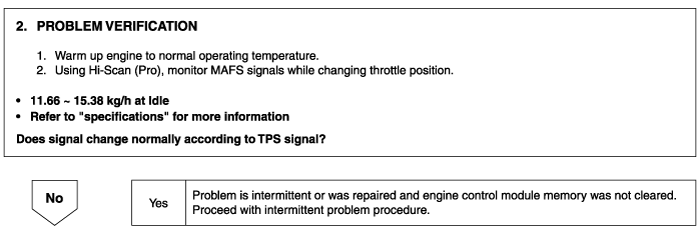
SPECIFICATIONS
|
MAFS |
Normal Parameter | ||
|
Approx. 700 RPM (Idle) |
Approx. 2000 RPM |
Approx. 3000 RPM | |
|
Signal Voltage |
0.6~1.0 V |
1.3~1.5 V |
1.7~1.9 V |
|
Mass Air Flow |
11.66 ~ 15.38 kg/h |
28.41 ~ 35.58 kg/h |
43.84 ~ 53.38
kg/h |
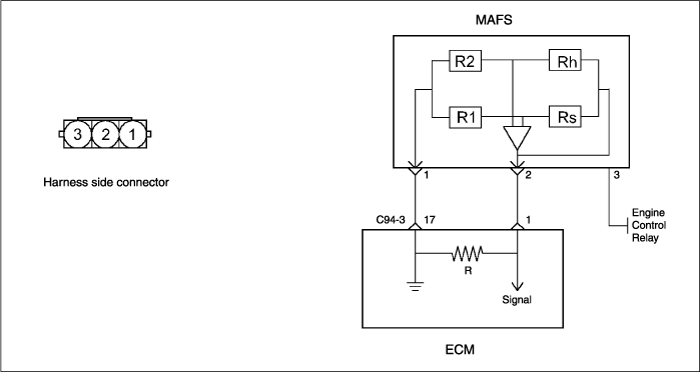
SCHEMATIC DIAGRAM
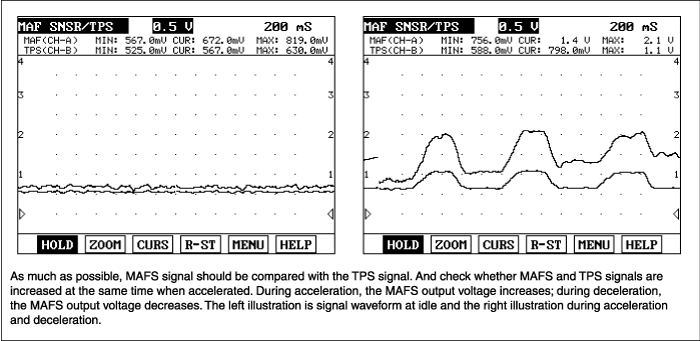
SIGNAL WAVEFORM
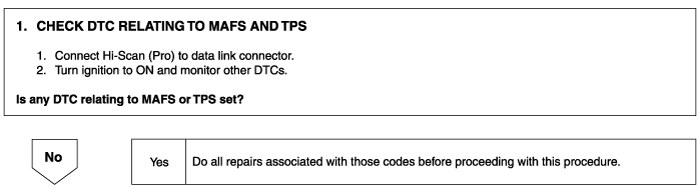
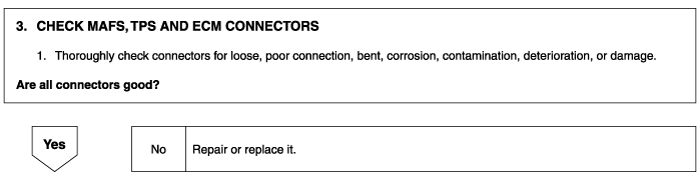
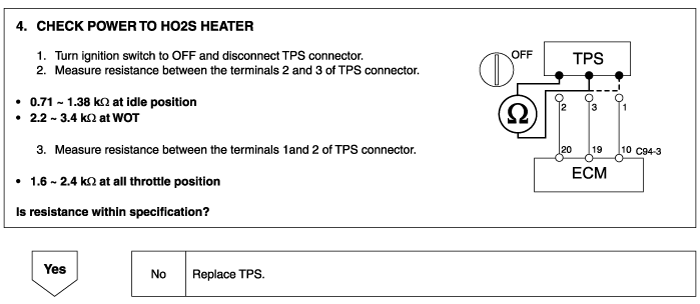
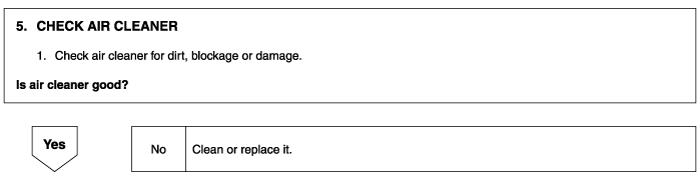
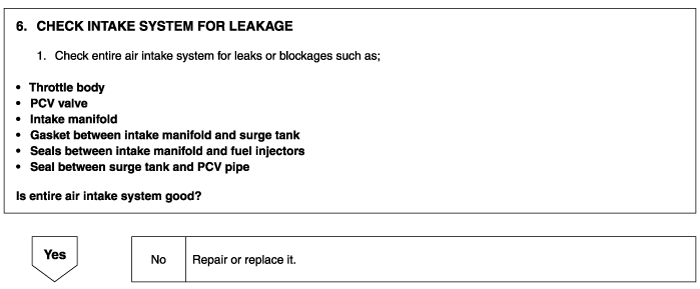
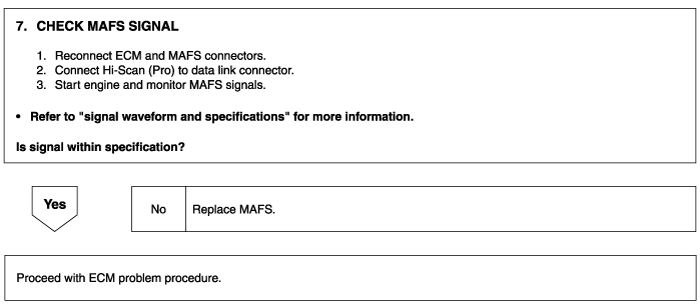
INSPECTION PROCEDURES