FRONT WHEEL ALIGNMENT
When using a
commercially-available computerized four wheel alignment equipment
(caster, camber, toe and turning angle) to inspect front wheel alignment,
always position the car on a level surface and the front wheels in the
straight ahead position. Prior to inspection make sure that the front
suspension and steering system are in normal operating condition and that
wheels and tiresare free of deflection and tires are inflated to
specification.
TOE-IN
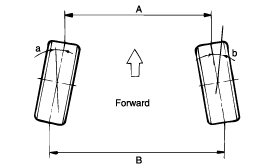
Toe-in (B-A or
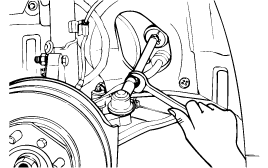
angle a+b) is adjusted by turning the tie rod turnbuckles. Toe in on the
left front wheel can be reduced by turning the tie rod toward the rear of
the car. Toe change is achieved by turning the tie for the rightand left
wheels simultaneously the same amount as follows :
Toe-in (B-A) : -2mm ~ +2mm
Toe-in (α+β) : -10´48" ~
+10´48"
|
| 1. |
Toe-in adjustment should be made by
turning the right and left tie rods in the same
amount. |
| 2. |
When adjusting toe-in, loosen the outer
bellows clip to prevent twisting the
bellows. |
| 3. |
After the adjustment, firmly tighten the
tie rod end lock nuts and reinstall the bellows
clip. | |
Tightneing
torque
Tie rod end lock nuts :
50~55 Nm (500~550 kgf•m, 37~40
lbf•ft)
|
CAMBER
The steering
knuckle which is integral with the strut assembly is preadjusted to the
specified camber at the factory and requires no adjustment.
CASTER
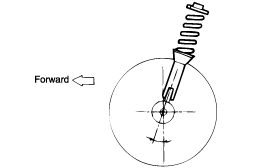
Caster is
pre-set at the factory and can not be adjusted. If caster is not within
standard value, replace the bent or damaged parts.
| 1. |
The front suspension assembly must be
free of worn, loose or damaged parts prior to measuring front
wheel alignment. |
| 2. |
Camber and caster are pre-set at the
factory and cannot be
adjusted. |
| 3. |
If camber and caster are not within
specifications, replace bent or damaged
parts. | |
REAR WHEEL ALIGNMENT
TOE-IN
| 1. |
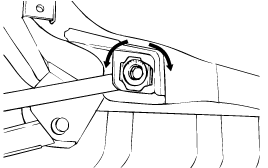
The assist arm mounting cam bolt
(crossmember side) should be turned an equal amount on both
sides when adjusting.
Inside direction of the vehicle :
toe-in
Outside direction of the vehicle :
toe-out
| |
| 2. |
The scale has gradations of
approximately 2.4 mm (14´).
| |
CAMBER
Standard value
:-30´ ± 30´
|
| 1. |
The rear suspension assembly must be
free of worn, loose or damaged parts prior to measuring rear
wheel alignment. |
| 2. |
Camber is pre-set at the factory and
cannot be adjusted. |
| 3. |
If camber is not within the
specifications, replace bent or damaged
parts. | |
TIRE WEAR
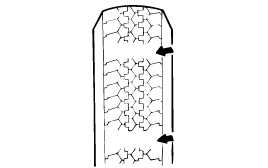
| 1. |
Measure the tread depth of the
tires.
Tread depth of tire [Limit] : 1.6 mm
(0.06 in.)
|
|
| 2. |
If the remaining tread depth is less than the
limit, replace the tire.
|
When the tread depth of the tires is
reduced to 1.6 mm (0.06 in.) or less, the wear indicators will
appear. | |
