| GENERAL DESCRIPTION |
The relevant data for
the immobilizer function are stored at permanent memory (EEPROM or Flash
etc.).
The immobilizer data
are stored by three independent entries.
The data from EEPROM
are evaluated by "2 of 3 decision". That means all three entries are read
and the content is compared before authentication process.
If the contents of all
entries are equal, the authentication will run without additional
measures.
If only the contents
of two entries are equal, the authentication will run and fault code
"EEPROM defective“ is stored at ECM.
If the contents of all
three entries are different from each other, no authentication will be
possible and the fault code "EEPROM defective“ will be stored. The limp
home function cannot be activated. The ECM shall be replaced if the EEPROM
related fault occurs again after new teaching of all keys.
| DTC DESCRIPTION |
This DTC is defined as
not only ECM have inconsistent data of EEPROM for number of keys taught,
user password state and invalid write operation to EEPROM but ECM can not
recognize the unique PIN code during Key Authentication.
| DTC DETECTING CONDITION |
| Item |
Detecting
Condition |
Possible
cause | ||||
| Enable Condition |
|
| ||||
| Detecting Criteria |
|
| MONITOR SCANTOOL DATA |
| 1. |
Ignition "ON" & Engine
"OFF". |
| 2. |
Connect Scan tool and clear the
DTCs. |
| 3. |
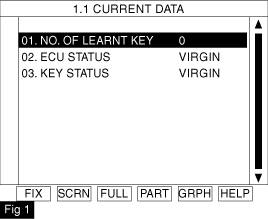
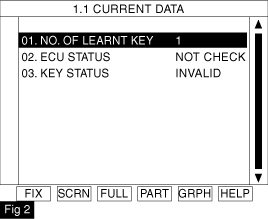
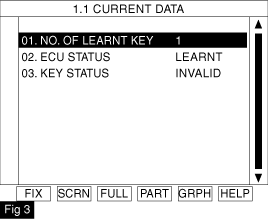
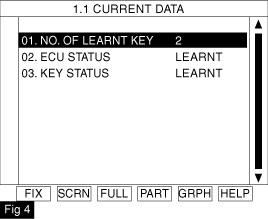
If the DTCs are retrieved again, monitor
"CURRENT DATA" to check No. of Learnt key, ECM and KEY
status.
Fig 1 : ECM has not matched with any Key
yet.
Fig 2 : ECM Internal Failure.
Fig 3 : IG On with unmatched
key.
Fig 4 : 2(two) Keys have been matched with
ECM. |
| 4. |
Are both Key and ECM status
learnt?
Fault is intermittent caused by poor contact
in the SMARTRA's and/or ECM's connector or was repaired and ECM
memory was not cleared. Thoroughly check connectors for looseness,
poor connection, bending, corrosion, contamination, deterioration,
or damage.
Repair or replace as necessary and then go
to "Verification of Vehicle Repair" procedure.
Go to "Component Inspection"
procedure. |


| COMPONENT INSPECTION |
| 1. |
Check ECM
|

| VERIFICATION OF VEHICLE REPAIR |
After a repair, it is
essential to verify that the fault has been corrected.
| 1. |
Connect scan tool and monitor CURRENT DATA
to check No. of Learnt key, ECM and KEY
status. |
| 2. |
Select Diagnostic Trouble Codes(DTCs)" mode
and Clear the DTCs. |
| 3. |
Are any DTCs present?
Go to the applicable troubleshooting
procedure.
System is performing to specification at
this
time. |