| COMPONENT LOCATION |
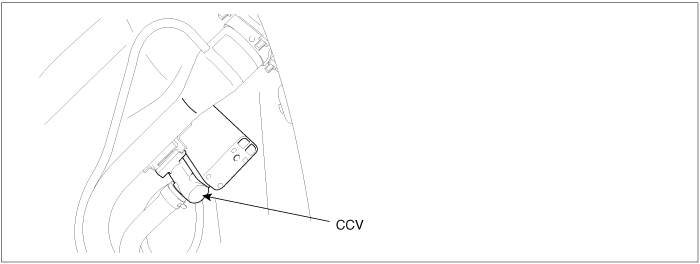
| GENERAL DESCRIPTION |
The evaporative
emissions system prevents hydrocarbon (HC) vapors from the fuel tank from
escaping into the atmosphere where they could form photochemical smog.
Gasoline vapors are collected in the charcoal canister. The Canister
Closing Valve (CCV) closes off the air inlet into the canister for leak
detection of the evaporative emission system. The CCV also prevents fuel
vapors from escaping from the canister. When the engine purges the HC
vapors from the canister, the clean air comes into the canister through
the canister air-filter and the CCV.
| DTC DESCRIPTION |
The ECM measures
pressure in the fuel tank by means of tank pressure sensor during all
engine operating states except engine stop and start. ECM sets DTC P0449
if the ECM detects that the fuel tank pressure is too low as a result of
the stuck closed CCV. And the same error code is set in the next driving
cycle, the ECM illuminates the MIL.
| DTC DETECTING CONDITION |
| Item |
Detecting
Condition |
Possible
Cause | ||||||
| DTC Strategy |
|
| ||||||
| Enable Conditions |
| |||||||
| Threshold Value |
| |||||||
| Diagnostic Time |
| |||||||
| MIL On Condition |
|
| SPECIFICATION |
| Canister Close Valve |
Normal Parameter At 20°C (68°F) |
| Resistance |
19.8 ~ 21.8Ω |
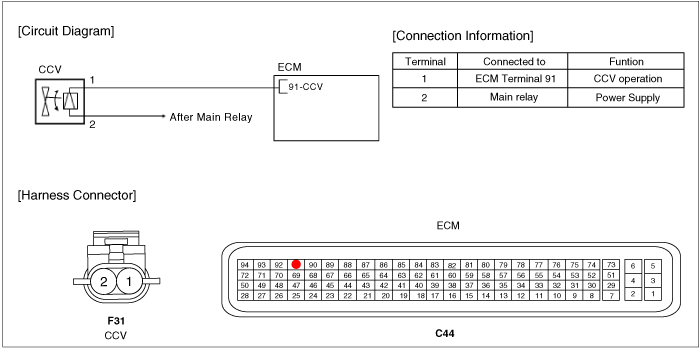
| SCHEMATIC DIAGRAM |
| MONITOR DTC STATUS |
If DTCs (or pending codes) relating to CCV
are present, do ALL REPAIRS associated with those codes before
proceeding with this troubleshooting
tree. |

| 1. |
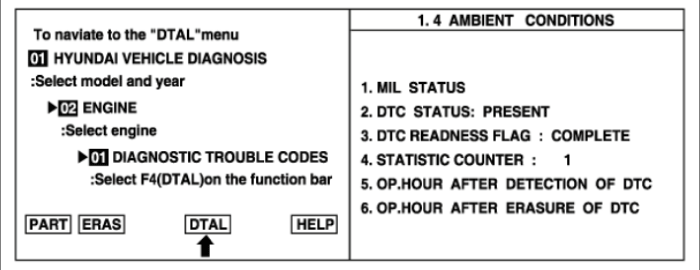
Connect scan tool and select "Diagnostic
Trouble Codes(DTCs)" mode |
| 2. |
Press F4(DTAL) to select DTC information
from the DTCs menu |
| 3. |
Confirm that "DTC Readiness Flag" indicates
"Complete". If not, drive the vehicle within conditions noted in the
freeze frame data or enable
conditions |
| 4. |
Read "DTC Status" parameter
|
| 5. |
Is parameter displayed "History(Not Present)
fault"?
▶ Fault is intermittent, caused by poor
contact in the sensor's and/or ECM's connector or was repaired and
ECM memory was not cleared. Thoroughly check connectors for
looseness, poor connection, bending, corrosion, contamination,
deterioration, or damage. Repair or replace as necessary and go to
"Verification of Vehicle Repair" procedure
▶ Go to next step as
below |


Canister
Air-Filter inspection
| 1. |
Disassemble the Canister Air-Filter and hose
from their respective positions. |
| 2. |
Check the Canister air-filter for
contamination. |
| 3. |
Is Canister Air-Filter contaminated with
dust?
▶ Replace as necessary and go to
"Verification of Vehicle Repair" procedure
▶ Go to next step as
below. |
Canister
Closing Valve(CCV) inspection
| 1. |
Reconnect all EVAP hardware that was
previously disconnected |
| 2. |
Disconnect hose connecting Canister Closing
Valve(CCV) to canister |
| 3. |
Ignition "ON" & Engine
"OFF" |
| 4. |
Blow air to the canister side of the valve
and verify air escapes to the air filter
side. |
| 5. |
Install scantool and select "CANISTER CLOSE
VALVE" on the Actuation Test mode |
| 6. |
Activates "CANISTER CLOSE VALVE" by pressing
"STRT(F1)" key |
| 7. |
Blow air into hose and verify air does not
escape. |
| 8. |
Repeat this procedure 4 or 5 times to ensure
CCV reliability. |
| 9. |
Is CCV working properly?
|
| TERMINAL AND CONNECTOR INSPECTION |
| 1. |
Many malfunctions in the electrical system
are caused by poor harness(es) and terminals. Faults can also be
caused by interference from other electrical systems, and mechanical
or chemical damage. |
| 2. |
Thoroughly check connectors for looseness,
poor connection, bending, corrosion, contamination, deterioration,
or damage. |
| 3. |
Has a problem been found?
▶ Repair as necessary and go to
"Verification of Vehicle Repair" procedure
▶ Check for open or short in power supply
circuit.
Measure voltage between terminal 1 of the
CCV harness connector and chassis ground (Approx. 5V)
▶ Check for open or short in control
circuit.
Measure voltage between terminal 2 of the
CCV harness connector and chassis ground (Approx. 4~5V)
▶ Repair as necessary and go to
"Verification of Vehicle Repair"
procedure. |
| VERIFICATION OF VEHICLE REPAIR |
After a repair, it is
essential to verify that the fault has been corrected.
| 1. |
Connect scan tool and select "Diagnostic
Trouble Codes(DTCs)" mode |
| 2. |
Press F4(DTAL) and confirm that "DTC
Readiness Flag" indicates "Complete". If not, drive the vehicle
within conditions noted in the freeze frame data or enable
conditions |
| 3. |
Read "DTC Status"
parameter |
| 4. |
Is parameter displayed "History(Not Present)
fault"?
▶ System performing to specification at this
time. Clear the DTC
▶ Go to the applicable troubleshooting
procedure. |