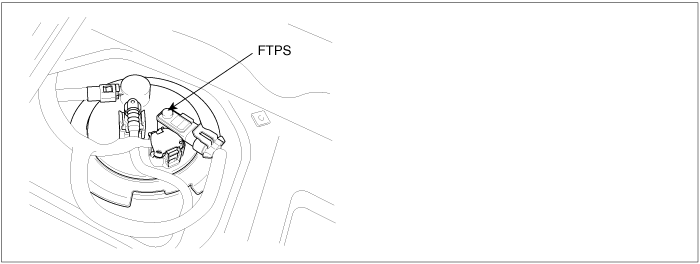
The evaporative
emission control system prevents hydrocarbon vapors from escaping from the
fuel tank into the atmosphere where they could form photochemical smog.
Gasoline vapors are collected in the charcoal canister. The Fuel Tank
Pressure Sensor (FTPS) is an integral part of the evaporative monitoring
system. The ECM monitors the FTPS signal to detect vacuum decay and excess
vacuum. The FTPS measures the difference between the air pressure inside
the fuel tank and outside air pressure to check the purge control solenoid
valve operation and for leak detection in the evaporative emission control
system by monitoring pressure and vacuum levels in the fuel tank during
the purge control solenoid valve operating cycles.
The ECM monitors
pressure stability in the fuel tank by means of Fuel Tank Pressure Sensor
(FTPS) for predetermined duration just before start the leakage monitoring
to detect noise signal of pressure sensor. The ECM sets DTC P0454 if the
pressure fluctuation is bigger than predetermined threshold.If same error
code is set in the next driving cycle, the ECM illuminates the
MIL.
Item
|
Detecting
Condition
|
Possible
Cause
|
DTC Strategy
|
|
| •
|
Poor connection or damaged
harness |
|
Enable Conditions
|
| •
|
Coolant temperature
>50°C(122°F) |
| •
|
Modeled ambient air temperature
>-10°C(14°F) |
| •
|
Vehicle speed
<10km/h(6mph) |
| •
|
Time after start >100
sec. |
| •
|
Estimated altitude
<2.4km(8000ft) |
| •
|
Minimum canister purge time:
3~25sec. |
| •
|
Idle speed engine operating
state |
| •
|
Differential fuel tank pressure: -11 ~
4hPa |
| •
|
Time since last EVAP monitoring test
abortion >60 sec. |
|
Threshold Value
|
| •
|
Leak detection test inhibited more
than 3 times due to noise in tank pressure
signal | |
Diagnostic Time
|
|
MIL On Condition
|
|
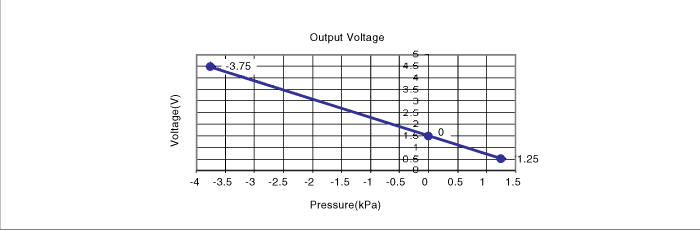
Pressure
|
-3.75 kPa(-1.10 inHg)
|
0 kPa(0 inHg)
|
1.25 kPa(0.37 inHg)
|
FTPS output voltage
|
4.5 V
|
1.5 V
|
0.5 V
|
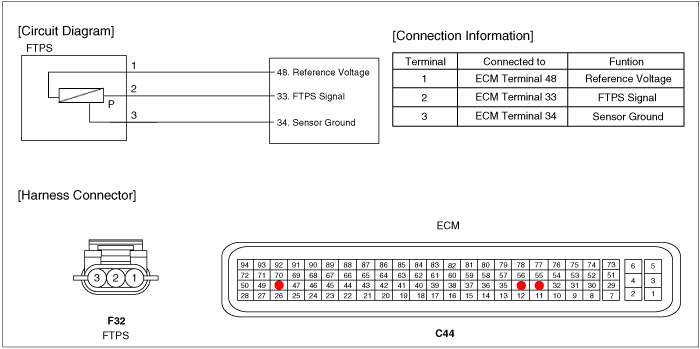
|
If DTCs (or pending codes) relating to FTPS
are present, do ALL REPAIRS associated with those codes before
proceeding with this troubleshooting
tree. |
| 1. |
Start engine to normal operating
temperature
|
Evaporative Emissions Systems (EVAP)
Leak Tests can be run by the Scan Tool. The tests are
automated and provide either a pass-fail result or directions
to check for
DTCs. | |
| 2. |
Install scan tool and clear
DTC |
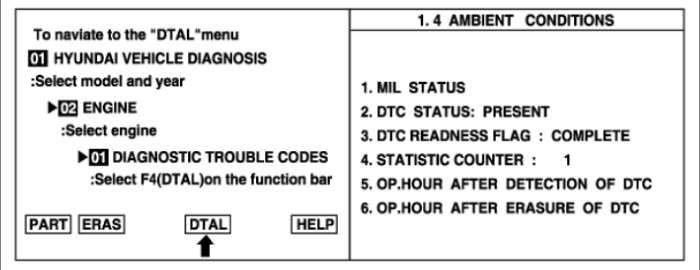
| 3. |
Perform "EVAP. LEAKAGE TEST" mode referring
to enable conditions as below
|
EVAP. Leakage Test enable
conditions
| - |
Following conditions must be
fulfilled to start the
test. |
1) Engine warm up at Idle
Status
2) No relevant DTC
3) Fuel level is below
80% |
|
| 4. |
Is DTC P0451 set again?

▶ Go to next step as below

▶ Fault is intermittent caused by poor
contact in the sensor's and/or ECM's connector or was repaired and
ECM memory was not cleared. Thoroughly check connectors for
looseness, poor connection, bending, corrosion, contamination,
deterioration, or damage. Repair or replace as necessary and go to
"Verification of Vehicle Repair"
procedure |
| TERMINAL AND CONNECTOR
INSPECTION |
| 1. |
Many malfunctions in the electrical system
are caused by poor harness(es) and terminals. Faults can also be
caused by interference from other electrical systems, and mechanical
or chemical damage. |
| 2. |
Thoroughly check connectors for looseness,
poor connection, bending, corrosion, contamination, deterioration,
or damage. |
| 3. |
Has a problem been found?
▶ Repair as necessary and go to
"Verification of Vehicle Repair" procedure
▶ Go to next step as
below |
| 1. |
Disconnect the hose connecting FTPS and fuel
pump at FTPS side.(Do not disconnect FTPS harness
connector) |
| 2. |
Install vacuum pump to the FTPS
nipple. |
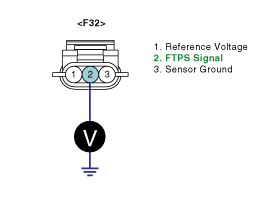
| 3. |
Apply vacuum pressure 0.4 inHg(1.5kPa) to
1.0 inHg(3.4kPa) and measure FTPS output voltage between terminal
2(back probe) of the FTPS harness connector and chassis
ground.
Specification : Voltage increases
proportionally with decreasing pressure(Approx. 2.5V to
4.5V)
|
|
Do not apply vacuum pressure less than
1.1 inHg(3.8kPa) |
|
| 4. |
Is voltage within the
specification?
▶ Check for poor connection between ECM and
component: backed out terminal, improper mating, broken locks or
poor terminal to wire connection. Repair as necessary and go to
"Verification of Vehicle Repair" procedure
▶ Check FTPS for contamination,
deterioration, or damage. Substitute with a known-good FTPS and
check for proper operation. If the problem is corrected, replace
FTPS and then go to "Verification of Vehicle Repair"
procedure |
| VERIFICATION OF VEHICLE
REPAIR |
| 1. |
Reconnect all EVAP hardware that was
previously disconnected |
| 2. |
Start engine to normal operating
temperature
|
Evaporative Emissions Systems (EVAP)
Leak Tests can be run by the Scan Tool. The tests are
automated and provide either a pass-fail result or directions
to check for
DTCs. | |
| 3. |
Install scan tool and clear
DTC |
| 4. |
Perform "EVAP. LEAKAGE TEST" mode referring
to enable conditions as below
|
EVAP. Leakage Test enable
conditions
| - |
Following conditions must be
fulfilled to start the test.
1) Engine warm up at Idle
Status
2) No relevant DTC
3) Fuel level is below
80% | | |
| 5. |
Monitoring for (pending) DTC.Is the same DTC
set?
▶ Go to the applicable troubleshooting
procedure.
▶ System performing to specification at this
time. |

