| REMOVAL |
| 1. |
Raise the rear of the vehicle and make sure
it is securely supported. Remove the rear
wheel. |
| 2. |
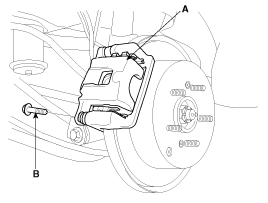
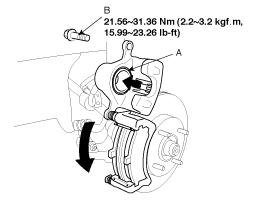
Remove the guide rod bolt(B), After raising
the caliper assembly(A), support it with a wire.
|
| 3. |
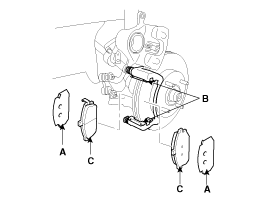
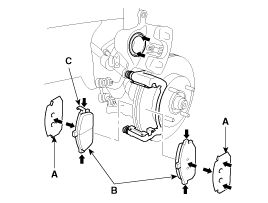
Remove pad shim(A), pad retainer(B) and pad
assembly(C) in the caliper bracket.
|
| INSTALLATION |
| 1. |
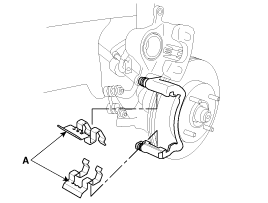
Install the pad retainers(A) on the caliper
bracket.
|
| 2. |
Check for foreign material between the pad
shim (A) and the back of the pads (B).
|
| 3. |
Contaminated brake discs or pads reduce
stopping ability. Keep grease off the discs and
pads. |
| 4. |
Install the brake pads (B) and pad shims (A)
correctly. Install the pad with the wear indicator (C) on the
inside.
If you are reusing the pads, always
reinstall the brake pads in their original position to prevent a
momentary loss of braking
efficiency. |
| 5. |
Push in the piston (A) so that the caliper
will fit over the pads. Make sure that the piston boot is in
position to prevent damaging it when pivoting the caliper
down. |
| 6. |
Pivot caliper down into position. Being
careful not to damage the pin boot, install the guide rod bolt (B)
and torque it to proper specification
|

| 7. |
Depress the brake pedal several time to make
sure the brakes work, then test-drive.
|
| 8. |
After installaion, check for leaks at hose
and line joints or connections, and retighten if
necessary. |
| INSPECTION |
| REAR BRAKE DISC THICKNESS CHECK |
| 1. |
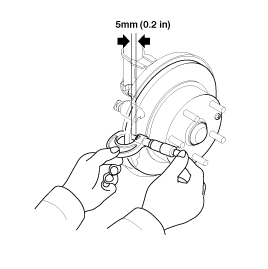
Remove all rust and contamination from the
disc surface, and then measure the disc thickness at 8 points, al
least, of the same distance (5 mm(0.12 in)) from the brake disk
outer circle.
|
| 2. |
Thickness variation should not exceed 0.01
mm(0.0004 in) (circumference) and 0.01 mm(0.0004 in) (radius) at any
directions. |
| 3. |
If wear exceeds the limit, replace the discs
and pad assembly for left and right of the vehicle.
|
REAR
BRAKE PAD CHECK
| 1. |
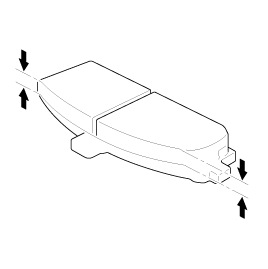
Check the pad wear. Measure the pad
thickness and replace it, if it is less than the specified
value.
|
| 2. |
Check that grease is applied, and the pad
and backing metal for damage. |
REAR
BRAKE DISC RUN OUT CHECK
| 1. |
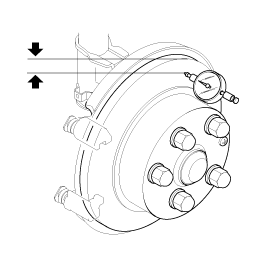
Place a dial gauge about 5 mm (0.2 in) from
the outer circumference of the brake disc, and measure the run out
of the disc.
|
| 2. |
If the run out of the brake disc exceeds the
limit specification, replace the disc, and then measure the run out
again. |
| 3. |
If the run out does not exceed the limit
specification, install the brake disc after turning it 180° and then
check the run out of the brake disc
again. |
| 4. |
If the run out cannot be corrected by
changing the position of the brake disc, replace the brake
disc. |
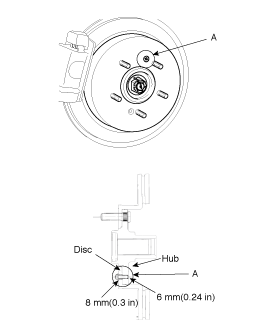
Seizing
of Rear brake disc
| 1. |
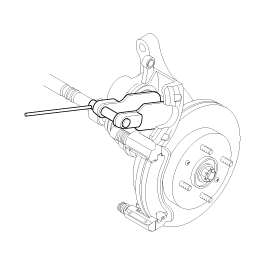
Remove the brake disc from hub using an M8
screw(A) if the brake disc has been seized with the hub due to
corrosion or overheating.
|