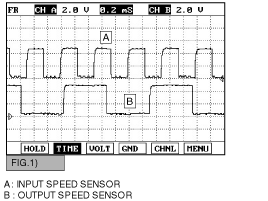
The value of the input
shaft speed should be equal to the value of the output shaft speed, when
multiplied by the 3rd gear ratio, while the transaxle is engaged in the
3rd gear. For example, if the output speed is 1,000 rpm and the 3rd gear
ratio is 1.000, then the input speed is 1,000 rpm.
This code is set if
the value of input shaft speed is not equal to the value of the output
shaft, when multiplied by the 3rd gear ratio, while the transaxle is
engaged in 3rd gear. This malfunction is mainly caused by mechanical
troubles such as control valve sticking or solenoid valve malfuctioning
rather than an electrical issue.
Item
|
Detecting Condition &
Fail Safe
|
Possible
cause
|
DTC Strategy
|
| •
|
3rd gear incorrect
ratio | |
| •
|
Faulty Input speed
sensor |
| •
|
Faulty output speed
sensor |
| •
|
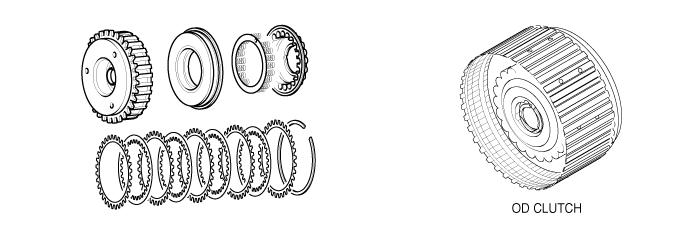
Faulty UD clutch or OD
clutch | |
Enable
Conditions
|
| •
|
A/T oil temp sensor voltage
<4.5V |
| •
|
Voltage of Battery
>10V |
| •
|
TRANSAXLE RANGE SWITCH is
normal | |
Threshold
value
|
| •
|
ㅣInput speed/3rd gear ratio - output
speed|≥200rpm /3rd. gear
ratio | |
Diagnostic
Time
|
|
Fail Safe
|
| •
|
Locked into 3rd gear.
(If diagnosis code P0733 is output
four times, the transaxle is locked into 3rd
gear) | |
| 1. |
Connect scantool to data link
connector(DLC). |
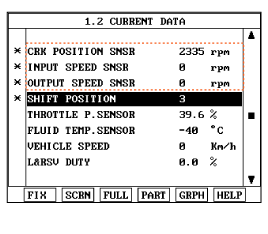
| 3. |
Monitor the "ENGINE SPEED, INPUT SPEED
SENSOR, OUTPUT SPEED SENSOR, GEAR POSITION" parameter on the
scantool. |
| 4. |
Disconnect the solenoid valve connector and
perform the "STALL TEST".
Specification : 2100~2900 engine
rpm
|
OPERATING ELEMENT OF EACH SHIFTING RANGE
|
UD/C
|
OD/C
|
REV/C
|
2ND/B
|
LR/B
|
OWC
|
P
|
|
|
|
|
●
|
|
R
|
|
|
●
|
|
●
|
|
N
|
|
|
|
|
●
|
|
D1
|
●
|
|
|
|
●
|
○
|
D2
|
●
|
|
|
●
|
|
|
D3
|
●
|
●
|
|
|
|
|
D4
|
|
●
|
|
●
|
|
|
※ Low & Reverse Brake is released when
the vehicle speed is over 7Km/h(5 MPH).
Stall test
procedure in D3 and reason
Procedure
| B. |
Set 3rd gear hold by disconnecting the
solenoid valve connector. Fully depress the brake pedal, then
place the transaxle gear lever into "D" range. Press and hold
the accelerator pedal to the floor for no more than eight
seconds while observing the engine, input speed,
and output speed RPM
values.
* The slippage of 3rd gear operating
parts can be detected by stall test in
D3 |
Reason for stall test
| A. |
If there is no mechanical defaults in
A/T, all slippage occurs in torque
converter. |
| B. |
Therefore, engine revolution is
output, but input and output speed revolution must be "zero"
due to wheel's lock. |
| C. |
If OD clutch system(3rd gear operating
part) has faults, input speed revolution will be out of
specification. |
| D. |
If output speed revolution is output.
It means that the foot brake force is not applied fully.
Retesting using greater braking force is
required. | |
| 5. |
Is "STALL TEST " within
specification?

▶ Go to "Signal Circuit Inspection"
procedure.

▶ Go to "Component Inspection"
procedure.
|
● Do not let anybody stand in front of
or behind the vehicle while this test is being carried
out.
● Check the A/T fluid level and
temperature and the engine coolant temperature.
| - |
Fluid level : At the hot mark on
the oil level gauge. |
| - |
Fluid temperature : 80~100 °
(C176 °F~ 212 °F). |
| - |
Engine coolant temperature :
80~100 °C (176 °F~ 212
°F). |
● Chock both rear wheels(left and
right).
● Pull the parking brake lever on with
the brake pedal fully depressed.
● The throttle should not be left
fully open for more than eight seconds.
● If carrying out the stall test two
or more times, move the select lever to the "N" position and
run the engine at 1,000 rpm to let the A/T fluid cool down
before carrying out subsequent
tests. | |
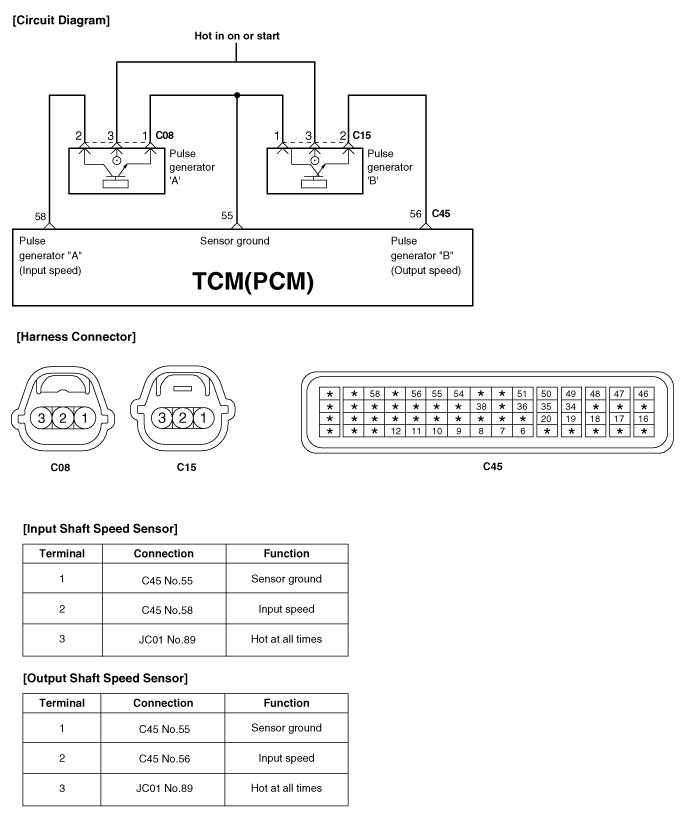
| SIGNAL CIRCUIT
INSPECTION |
| 3. |
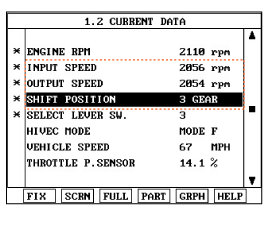
Monitor the "INPUT & OUTPUT SPEED
SENSOR" parameter on the scantool. |
| 4. |
Accelerate the Engine speed until about 2000
rpm in the 3rd gear.
Specification : INPUT SPEED - (OUTPUT
SPEED × GEAR RATIO) ≤ 200 RPM
|
|
| 5. |
Are "INPUT & OUTPUT SPEED SENSOR" within
specifications?
▶ Go to "Component Inspection"
procedure.
▶ Check for electrical noise of circuit in
INPUT & OUTPUT SPEED SENSOR or replace INPUT & OUTPUT SPEED
SENSOR. Repair as necessary and go to "Verification Vehicle Repair"
procedure. |
| 1. |
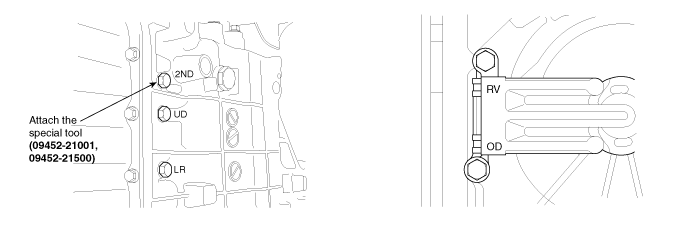
Connect Oil pressure gauge to "UD" and "OD"
port. |
| 3. |
Drive the car with gear position
3. |
| 4. |
Compare it with reference data as
below.
Specification : shown
below
|
Measurement
condition
|
Standard hydraulic pressure kPa
(psi)
|
Selector lever position
|
Shift position
|
Engine speed (rpm)
|
Under drive clutch pressure
|
Reverse clutch pressure
|
Overdrive clutch pressure
|
Low&reverse brake pressure
|
Second brake pressure
|
Damper clutch Apply pressure (DA)
|
Damper clutch Release pressure
(DR)
|
P
|
-
|
2,500
|
-
|
-
|
-
|
260-340
(38-50)
|
-
|
-
|
-
|
R
|
Reverse
|
2,500
|
-
|
1,270-1,770
(185-256)
|
-
|
1,270-1,770
(185-256)
|
-
|
-
|
-
|
N
|
-
|
2,500
|
-
|
-
|
-
|
260-340
(38-50)
|
-
|
-
|
-
|
D
|
1st gear
|
2,500
|
430-510
(62-74)
|
-
|
-
|
1,010-1,050
(146-152)
|
-
|
-
|
-
|
2nd gear
|
2,500
|
430-510
(62-74)
|
-
|
-
|
-
|
430-510
(62-74)
|
-
|
-
|
3rd gear
|
2,500
|
430-510
(62-74)
|
-
|
430-510
(62-74)
|
-
|
-
|
More than 730 (100)
|
0-10
(0-1)
|
4th gear
|
2,500
|
-
|
-
|
430-510
(62-74)
|
-
|
780-880
(110-130)
|
More than 730 (100)
|
0-10
(0-1)
|
※ The values are subject to change according
to vehicle model or condition
※ Depress the acceleration pedal "GENTLY"
under no load when measuring the hydraulic
pressure. |
| 5. |
Is oil pressure value within
specification?
▶ Repair AUTO TRANSAXLE(Clutch or Brake) as
necessary and go to "Verification Vehicle Repair"
procedure.
▶ Replace AUTO TRANSAXLE (BODY CONTROL VALVE
faulty) as necessary and go to "Verification Vehicle Repair "
procedure. |
| VERIFICATION OF VEHICLE
REPAIR |
After a repair, it is
essential to verify that the fault has been corrected.
| 1. |
Connect scan tool and select "Diagnostic
Trouble Codes(DTCs)" mode. |
| 2. |
Using a scantool, Clear
DTC. |
| 3. |
Operate the vehicle within DTC Enable
conditions in General information. |
| 4. |
Are any DTCs present ?
▶ Go to the applicable troubleshooting
procedure.
▶ System performing to specification at this
time. |
