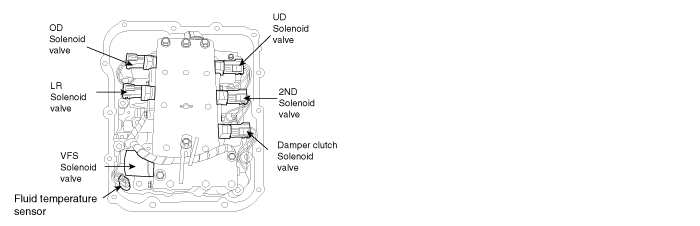
The TCM(PCM) controls
the locking and unlocking of the Torque Converter Clutch (or Damper
Clutch), to the input shaft of the transmission, by applying hydraulic
pressure. The main purpose of T/C clutch control is to save fuel by
decreasing the hydraulic load inside the T/C. The TCM(PCM) outputs duty
pulses to control the Damper Clutch Control Solenoid Valve(DCCSV) and
hydraulic pressure is applied to the DC according to the DCC duty ratio
value. When the duty ratio is high, high pressure is applied and the
Damper Clutch is locked. The normal operating range of the Damper Clutch
Control duty ratio value is from 30%(unlocked) to
85%(locked).
The TCM(PCM) increases
the duty ratio to engage the Damper Clutch by monitoring slip rpms
(difference value beteween engine speed and turbine speed). To decrease
the slip of the Damper Clutch, the TCM(PCM) increases the duty ratio by
appling more hydraulic pressure. When slip rpm does not drop under
specification with 100% duty ratio, the TCM(PCM) determines that the
Torque Converter Clutch is stuck OFF and sets this code.
Item
|
Detecting Condition &
Fail Safe
|
Possible
cause
|
DTC Strategy
|
|
※ TORQUE CONVERTER(DAMPER) CLUTCH :
TCC
| •
|
Faulty TCC or oil pressure
system |
| •
|
Faulty TCC solenoid
valve |
| •
|
Faulty body control
valve |
|
Enable
Conditions
|
| •
|
During the connect
control | |
Threshold
value
|
| •
|
Detect 2 times the Lock-up clutch
control duty=100% for
2sec | |
Diagnostic
Time
|
|
Fail Safe
|
| •
|
Damper clutch abnormal system (If
diagnosis code P0741 is output four times, TORQUE
CONVERTER(DAMPER) CLUTCH is not controlled by
TCM(PCM)) | |
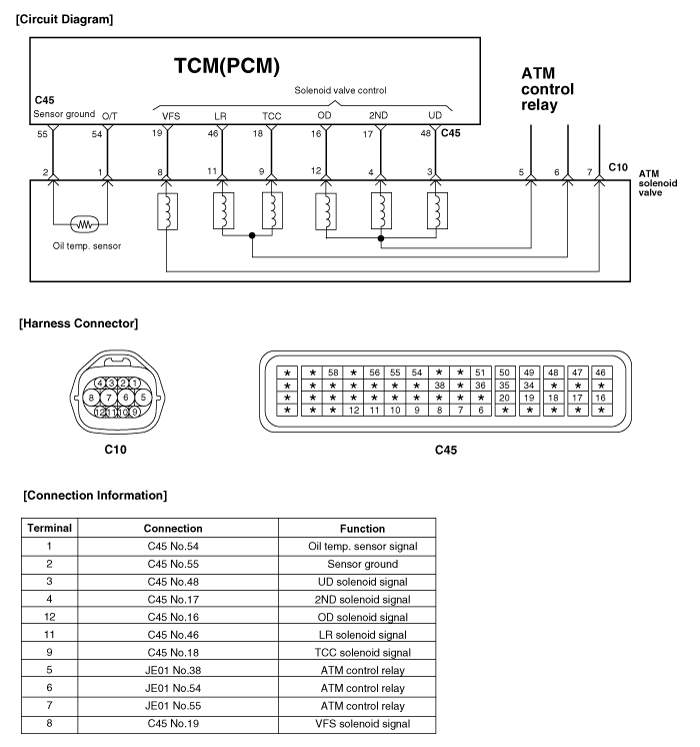
| 1. |
Connect scantool to data link
connector(DLC). |
| 3. |
Select "D RANGE" and drive
vehicle. |
| 4. |
Monitor the "TORQUE CONVERTER(DAMPER)
CLUTCH" parameter on the scantool.
Specification : TCC SLIP<160RPM(In
condition that TCC SOL. DUTY > 80% )
|
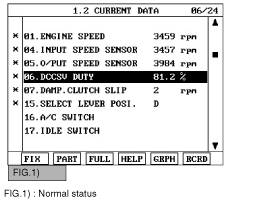
|
| 5. |
Are "TCC SOLENOID DUTY and TCC SLIP" within
specifications?

▶ Fault is intermittent caused by poor
contact in the sensor's and/or TCM(PCM)'s connector or was repaired
and TCM(PCM) memory was not cleared. Throughly check connectors for
looseness, poor connection, bending, corrosion, contamination,
deterioration or damage. Repair or replace as necessary and go to
"Verification Vehicle Repair" procedure.

▶ Go to "Component Inspection"
procedure. |
| 1. |
CHECK TORQUE CONVERTER CLUTCH SOLENOID
VALVE
| (1) |
Connect scantool to data link
connector(DLC). |
| (2) |
Ignition "ON" & Engine
"OFF". |
| (3) |
Select A/T Solenoid valve Actuator
test and Operate Actuator
test. |
| (4) |
Can you hear operating tone for using
TCC SOLENOID VALVE Actuator Testing Function?
▶ Go to "CHECK OIL PRESSURE" as
below.
▶ Replace "TCC SOLENOID VALVE" as
necessary and Go to "Verification Vehicle Repair"
procedure. | |
| 2. |
CHECK OIL PRESSURE
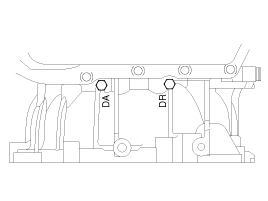
| (1) |
Connect Oil pressure gauge to "DA"
port. |
| (2) |
Ignition "ON" & Engine
"OFF". |
| (3) |
After connecting Scantool and monitor
the "TCC SOLENIOD VALVE DUTY" parameter on the Scantool data
list. |
| (4) |
Select 1st gear and accelerate Engine
speed to 2500 rpm. |
| (5) |
Measure oil pressure.
Specification : approx.
7.5kg/cm²
| |
| (6) |
Is oil pressure value within
specification?
▶ Repair TORQUE CONVERTER
CLUTCH(REPLACE Torque Converter ) as necessary and go to
"Verification Vehicle Repair " procedure.
▶ Replace A/T ass'y (possible BODY
CONTROL VALVE faulty) as necessary and go to "Verification
Vehicle Repair "
procedure. | |
| VERIFICATION OF VEHICLE
REPAIR |
After a repair, it is
essential to verify that the fault has been corrected.
| 1. |
Connect scan tool and select "Diagnostic
Trouble Codes(DTCs)" mode. |
| 2. |
Using a scantool, Clear
DTC. |
| 3. |
Operate the vehicle within DTC Enable
conditions in General information. |
| 4. |
Are any DTCs present ?
▶ Go to the applicable troubleshooting
procedure.
▶ System performing to specification at this
time. |