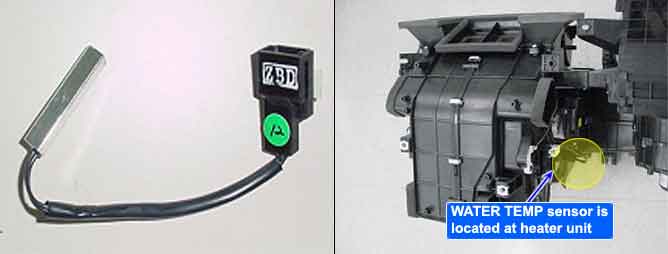
A water temp sensor
located at heater unit detects coolant temperature. Its signal is used for
cold engine lockout control. When the driver operates the heater before
the engine is warmed up, the signal from sensor causes the heater control
unit to reduce blower motor speed until coolant temperature reaches the
threshold value.
DTC Description
The ECM sets DTC B1203
if there is a short circuit in water temp sensor signal harness or the
measured resistance value of the sensor is less than the threshold
value(about 1.2kΩ)
DTC Detecting Condition
Item
Detecting
Condition
Possible
Cause
DTC
Strategy
● Resistance
check
●
Short circuit in harness ● Fault water
temp. Sensor ● Fault A/C Control
Unit
Threshold
value
●
<1.2kΩ
Detecting
time
●
0.3sec
FAIL
SAFE
● Control with
the value of 28.4°F
Schematic Diagram
Signal Waveform
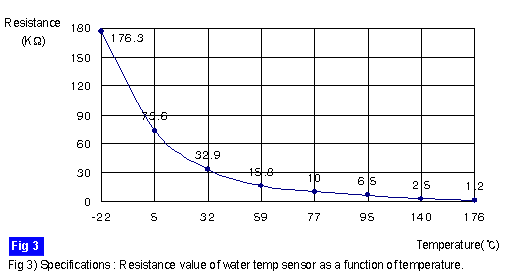
※ Resistance value of
water temp sensor as a function of temperature.
Temperature(°F)
Resistance(kΩ)
Temperature(°F)
Resistance(kΩ)
-22
176.3
77
10
5
73.6
95
6.5
32
32.9
140
2.5
59
15.8
176
1.2
Monitor Scantool Data
1.
Connect scantool to Data Link
Connector(DLC).
2.
Engine "ON"
3.
Monitor the "WATER TEMP SENSOR" Parameter on
the Scantool.
4.
Are the DTC B1203 present and is parameter of
"WATER TEMP.SENSOR" fixed ?
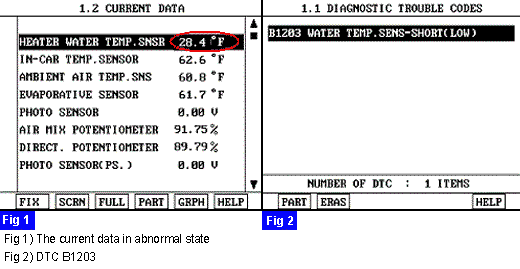
※ Parameter of "WATER TEMP SENSOR" will be
fixed at 28.4°F, if there is any fault in WATER TEMP
SENSOR
YES
1)
Go to "Inspection & Repair"
procedure
NO
1)
Fault is intermittent caused by
poor contact in the sensor’ss and/or A/C control unit’ss
connector or was repaired and A/C control unit memory
was not cleared. Thoroughly check connectors for
looseness, poor connection, bending, corrosion,
contamination, deterioration, or damage. Repair or
replace as necessary and then go to "Verification of
Vehicle Repair"
procedure.
Terminal and Connector
Inspection
1.
Many malfunctions in the electrical system are
caused by poor harness and terminals. Faults can also be caused by
interference from other electrical systems, and mechanical or
chemical damage.
2.
Thoroughly check connectors for looseness,
poor connection, bending, corrosion, contamination, deterioration,
or damage.
3.
Has a problem been found?
YES
1)
Repair as necessary and go to
"Verification of Vehicle Repair"
procedure
NO
1)
Go to "Signal Circuit Inspection"
procedure
Signal Circuit
Inspection
Check for short to
ground in harness
1.
Ignition
"OFF"
2.
Disconnect water temp.
sensor.
3.
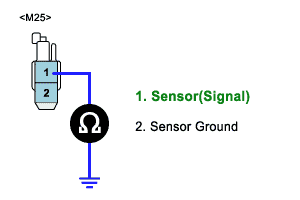
Measure resistance between terminal "1" of
water temp. sensor and chassis ground.
A.
Specification :Approx. ∞ Ω
4.
Is the measured resistance within
specifications?
YES
1)
Go to "Component Inspection"
procedure.
NO
1)
Check for short to ground in
harness. Repair as necessary and go to "Verification of
Vehicle Repair"
procedure.
Component Inspection
Check WATER TEMP
Sensor
1.
Ignition
"OFF"
2.
Disconnect water temp.
sensor.
3.
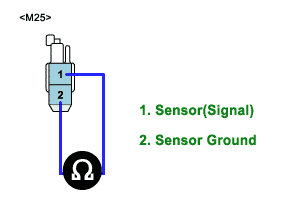
Measure resistance between terminal "1" and
"2" of water temp. sensor.
A.
Specification : Refer the specifications
in fig3)
4.
Is the measured resistance within
specifications in fig3)? (tolerance limits ±3%)
YES
1)
Go to "Check A/C Control Unit"
procedure
NO
1)
Substitute with a known-good water
temp. sensor and check for proper operation. If the
problem is corrected, replace water temp. sensor and
then go to "Verification of Vehicle Repair"
procedure.
Check A/C Control
Unit
1.
Engine "ON"
2.
Disconnect water temp.
sensor.
3.
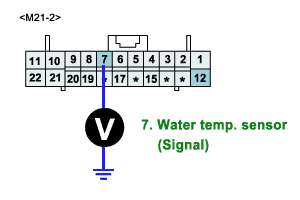
Measure Voltage between terminal "7" of A/C
Control Unit and chasis ground
A.
Specification : Approx. 5V
4.
Is the measured voltage within
specifications?
YES
1)
Check connectors for looseness,
poor connection, bending, corrosion, contamination,
deterioration, or damage. Repair or replace as necessary
and then go to "Verification of Vehicle Repair"
procedure.
NO
1)
Substitute with a known-good A/C
Control Unit and check for proper operation. If the
problem is corrected, replace A/C Control Unit and then
go to "Verification of Vehicle Repair"
procedure.
Verification of Vehicle
Repair
After a repair, it is
essential to verify that the fault has been corrected.
1.
Connect scantool and selet "Diagnostic Trouble
Codes(DTCs)" mode and then clear
DTC
2.
Operate the vehicle and monitor the DTC on the
scantool
3.
Are any DTCs present?
YES
1)
Go to the applicable
troubleshooting
procedure
NO
1)
System is performing to
specification at this
time.