| GENERAL DESCRIPTION |
During the key teaching
procedure the transponder will be programmed with vehicle specific data.
The vehicle specific data are written into the transponder memory. The
write procedure is unique; therefore the content of transponder can never
be modified or changed. The data are a string of 9 bytes defined by
vehicle manufacturer.
The transponder memory
is split into two strings called authenticator and key password after this
programming the transponder memory is locked and the data(PIN code) cannot
be read or changed respectively. The transponder status changes from
"virgin" to "learnt". Additionally every transponder includes a unique IDE
(Identifier number) of 32 bit. Unique means that the IDE of all
transponder is different from each other. The IDE is programmed by the
transponder manufacturer and is a read-only value. The authenticator and
the key password are not transferred from ECM to transponder or vice
versa. Only the results from the encryption algorithm are transferred. It
is almost impossible to calculate the vehicle specific data from the
encryption result.
For teaching of keys and
special purposes the ECM is connected to the tester device.
When IG is ON, the coil
supplies energy to the transponder which in turn accumulates energy in the
condenser.
Once the energy supply
from the coil has stopped, using the stored energy in the condenser, the
transponder transmits the ID CODE (stored within the ASIC).
| DTC DESCRIPTION |
This DTC is defined as
Invalid Transponder Data.
| DTC DESCRIPTION |
| Item |
Detecting
Condition |
Possible cause | |||||||
| Enable
Condition |
|
| |||||||
| Detecting
factors |
| ||||||||
| Detecting
Window |
| ||||||||
| Detecting
Criteria |
|
| MONITOR SCANTOOL DATA |
| 1. |
Ignition "ON" & Engine
"OFF". |
| 2. |
Connect Scan tool and clear the
DTCs. |
| 3. |
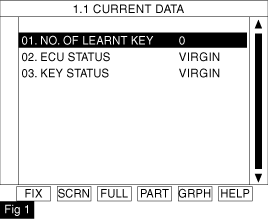
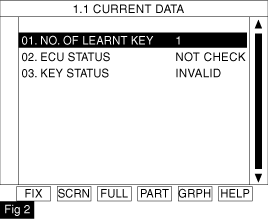
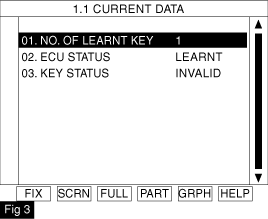
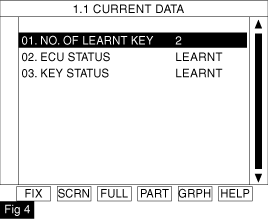
If the DTCs are retrieved again, monitor
"CURRENT DATA" to check No. of Learnt key, ECM and KEY
status.
Fig 1 : ECM has not matched with any Key
yet.
Fig 2 : ECM Internal Failure.
Fig 3 : IG On with unmatched key.
Fig 4 : 2(two) Keys have been matched with
ECM. |
| 4. |
Are both Key and ECM status
learnt?
Fault is intermittent caused by poor contact
in the SMARTRA's and/or ECM's connector or was repaired and ECM
memory was not cleared. Thoroughly check connectors for looseness,
poor connection, bending, corrosion, contamination, deterioration,
or damage.
Repair or replace as necessary and then go to
"Verification of Vehicle Repair" procedure.
Go to "Component Inspection"
procedure. |


| COMPONENT INSPECTION |
| 1. |
Check Transponder
|

| VERIFICATION OF VEHICLE REPAIR |
After a repair, it is
essential to verify that the fault has been corrected.
| 1. |
Connect scan tool and monitor CURRENT DATA to
check No. of Learnt key, ECM and KEY
status. |
| 2. |
Select Diagnostic Trouble Codes(DTCs)" mode
and Clear the DTCs. |
| 3. |
Are any DTCs present?
Go to the applicable troubleshooting
procedure.
System is performing to specification at this
time. |