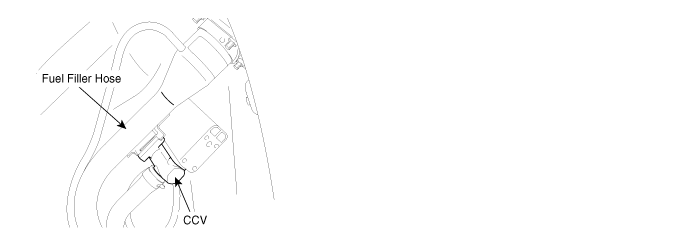
The vent valve is a
device that is designed to close off the fresh air inlet to the canister.
Current vent valve designs are powered closed. An electrically operated
vent valve solenoid is requiredfor OBD II compliant evaporative systems.
Normally the vent valve is in the open (unpowered)state, but to control
the vacuum levels in the fuel tank the EVPD will command the vent
valvesolenoid to the closed position. This controlled vacuum level will
allow the EVPD to determine the integrity of the evaporative
system.
The vent valve orifice
is much larger than the purge valve orifice or purge lines so that when
thevent valve is open, the purge flow is not restricted. The fresh air
inlet in the vent valve solenoid is normally filtered with a serviceable
dust filter that helps to prevent contaminants from being drawn into the
evaporative system (e.g. water, salt, silica, etc.).
This test will detect
blockage by commanding the vent solenoid to its normally open state and
commanding the purge system to maintain a calibratable constant amount of
purge flow. The fuel tank vacuum is monitored using the fuel tank pressure
sensor for a calibration-specified amount of time. Anormally functioning
evaporative system will maintain a relatively low vacuum level. Whereas, a
failing evaporative system will experience an increasing vacuum level
until a “fail” threshold is reached, at which time the test reports a
“fail” condition.
Checking output signals
from FTPS under detecting condition, if FTPS signal is detected higher
than 14in H2O for more than 5sec. when purging at 0.15 g/s. PCM sets
P2422.
Item
|
Detecting
Condition
|
Possible cause
|
DTC
Strategy
|
| •
|
Test is failed if tank vacuum exceeds a
prescribed threshold for a prescribed time when purging at a
prescribed rate. | |
| •
|
Faulty Canister Close
Valve |
| •
|
Clogging of canister air
filter |
| •
|
Open in ground harness of
FTPS |
|
EnableConditions
|
| •
|
10 < Ignition Volt <
15.9907 |
| •
|
Barometric pressure > 72
kPa |
| •
|
Engine off time > 720min or Startup
IAT-Startup ECT < 12°C( 53.6
°F) |
| •
|
Startup ECT -Startup IAT < 12°C( 53.6
°F) |
| •
|
0°C( 32 °F) < Startup ECT <
40°C(104 °F) |
| •
|
0°C( 32 °F) < Startup IAT <
40°C(104 °F) |
| •
|
Start-up IAT-IAT < 1°C(33.8
°F) |
| •
|
Purge enable time <
Threshold |
| •
|
Cold Start Time <
300sec. |
| •
|
15 % < Fuel Level <
85% |
| •
|
Restricted path test time <
120sec. | |
Threshold
value
|
|
DiagnosisTime
|
|
MIL On
Condition
|
|
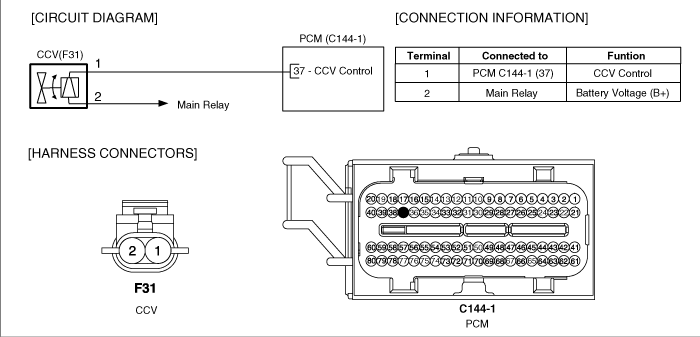
| 1. |
Warm-up engine to normal operating
temperature.
|
Evaporative Emissions Systems (EVAP)
Leak Tests can be run by the Scan Tool.The tests are automated
and provide either a pass-fail result or directions to check
for DTCs. | |
| 2. |
Install scan tool and clear
DTC |
| 3. |
Perform "EVAP. LEAKAGE TEST" mode referring to
enable conditions as below |
| 4. |
Monitoring for (pending) DTC by performing "
DIAGNOSTIC TROUBLE CODES"or "MONITORING TEST RESULTS". Is the same
DTC set ?

▶ Go to "System Inspection"
procedure.

▶ Fault is intermittent caused by poor contact
in sensor’s and/or PCM’s connector or was repaired and PCM memory
was not cleared. Thoroughly check connectors for looseness, poor
connection, bending, corrosion, contamination, deterioration, or
damage. Repair or replace as necessary and go to "Verification of
vehicle Repair" procedure |
| 1. |
Check Canister air filter and CCV
| (1) |
Visually inspect air filter is
clogged. |
| (2) |
Visually inspect duck between air filter
and CCV is clogged. |
| (3) |
Check that Canister is deformed or
clogged by foreign materials. |
| (4) |
Has a problem been found ?
▶ Repair or replace as necessary and
then, go to "Verification of Vehicle Repair"
procedure.
▶ Open in ground harness of FTPS(Fuel
tank pressure sensor) can cause this DTC. so check it for
open.(Refer to DTC P0454) If the problem is not corrected,
substitute with a known-good PCM and check for proper
operation.If the problem is corrected, replace PCM and then go
to "Verification of Vehicle Repair" procedure.
|
There is a memory reset function
on scantool that can erase optional parts
automaticallydetected and memorized by
PCM. | | |
| VERIFICATION OF VEHICLE
REPAIR |
After a repair, it is
essential to verify that the fault has been corrected.
| 1. |
Monitor and record the Freeze Frame Data for
the Diagnostic Trouble Code(DTC) which has been
diagnosed. |
| 2. |
Using a Scantool, Clear the
DTCs |
| 3. |
Operate the vehicle within conditions noted in
the freeze frame data or enable
conditions |
| 4. |
Monitor that all rediness test have been
verified as " Complete " |
| 5. |
Are any DTCs present ?
▶ Go to the applicable troubleshoooting
procedure.
▶ System is performing to specification at
this
time. |
