| Wheel Alignment |
When using commercially
available computerized four wheel alignment equipment (caster, camber,
toe) to inspect the front wheel alignment, always position the car on a
level surface with the front wheels facing straight ahead.
Prior to inspection,
make sure that the front suspension and steering system are in normal
operating condition and that the wheels and tires face straight ahead and
the tires are inflated to the specified pressure.
Toe
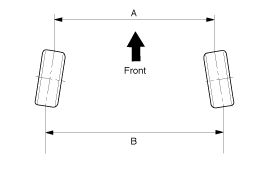
Toe is a measurement of
how much the front of the wheels are turned in or out from the
straight-ahead position.
| Item |
Description |
| A - B <
0 |
Positive (+)
toe (toe in) |
| A - B >
0 |
Negative (-)
toe (toe out) |
When the wheels are
turned in toward the front of the vehicle, toe is positive (+) (toe in).
When the wheels are turned out toward the front of the vehicle, toe is
negative(-) (toe out). Toe is measured in degrees, from side to side, and
totaled.
[Front]
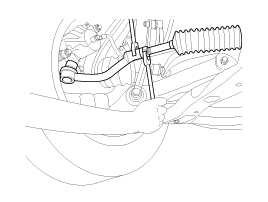
Toe-in(B-A or angle a+b)
is adjusted by turning the tie rod turnbuckles. Toe-in on the left front
wheel can be reduced by turning the tie rod toward the rear of the car.
Toe- in change is adjusted by turning the tie rods for the right and left
heels simultaneously at the same amount as follows.
|
Standard value
:
Toe-in
Total : 0°±0.2°
Individual : 0°±0.1°
|
|

|
Tie rod(A) Specified torque :
50~55N.m (5~5.5kgf.m,
36.2~39.8lb-ft)
|
[Rear]
|
Standard value
:
Toe-in
Total : 0.2°±0.2°
Individual : 0.1°±0.1°
|
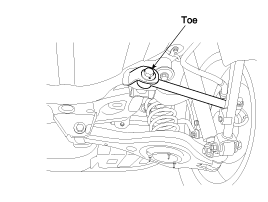
Adjust the toe-in by
turning the cambolt of the assist arm.
|
Left cambolt : Clockwise → toe-in
Right cambolt : Clockwise →
toe-out
The variation of toe by a rotation of the
cambolt :
About 0.4°
|
|

|
Specified
torque
110 ~ 120N.m (11 ~ 12kgf.m, 79.5 ~
86.8lb-ft)
|
Camber
[Front]
Camber is the inward or
outward tilting of the wheels at the top.
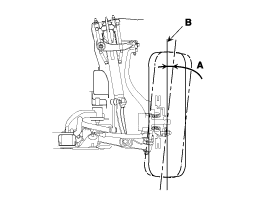
| Item |
Description |
| A |
Positive
camber angle |
| B |
True
vertical |
When the wheel tilts out
at the top, then the camber is positive(+).
When the wheel tilts in
at the top, then the camber is negative(-).
|
Standard value : -0°±0.5°
Difference between right and left angle is
within 0.5°
|
Camber is pre-set at the factory and doesn't
need to be adjusted. If the camber is not within the standard value,
replace the bent or damaged parts. |
[Rear]
|
Standard value : -0.5°±0.5°
Difference between right and left angle is
within 0.5°
|
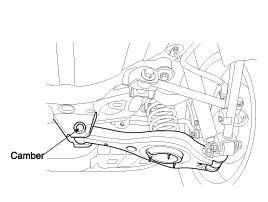
Adjust the camber by
turning the cambolt of the rear lower arm.
|
Left cambolt : Clockwise →
camber(+)
Right cambolt : Clockwise
→camber(-)
The variation of camber by a rotation of the
cambolt :
About 0.2°
|
Caster
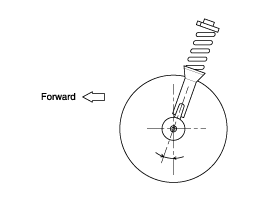
Caster is the tilting of
the strut axis either forward or backward from vertical. A backward tilt
is positive (+) and a forward tilt is negative (-).
Caster is pre-set at the
factory and doesn't need to be adjusted. If the caster is not within the
standard value, replace the bent or damaged parts.
|
Caster :
4.8°±0.75°
|
|
| TIRE WEAR |
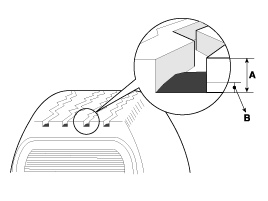
| 1. |
Measure the tread depth of the
tires.
|
| 2. |
If the remaining tread(A) depth is less than
the limit, replace the tire.
|
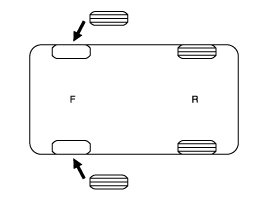
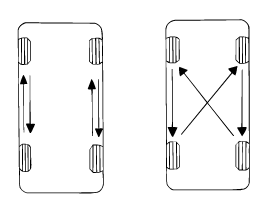
| TIRE ROTATION |
Rotate the tires in the
pattern illustrated.
CHECKING FOR PULL AND WANDER
If the steering pulls to
one side, rotate the tires according to the following wheel rotation
procedure.
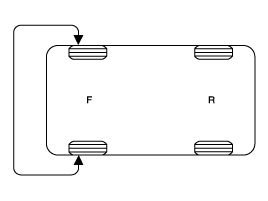
| 1. |
Rotate the front right and front left tires,
and perform a road test in order to confirm vehicle
stability.
|
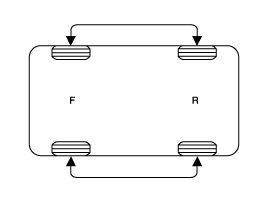
| 2. |
If the steering pulls to the opposite side,
rotate the front and rear tires, and perform a road test
again.
|
| 3. |
If the steering continues to pull to one side,
rotate the front right and left tires again, and perform a road
test.
|
| 4. |
If the steering continues to pull to the
opposite side, replace the front wheels with new ones.
|