| ENGINE COOLANT REFILLING AND
BLEEDING |
|
Never remove the radiator cap when the engine
is hot. Serious scalding could be caused by hot fluid under high
pressure escaping from the
radiator. |
|
When pouring engine coolant, be sure to shut
the relay box lid and not to let coolant spill on the electrical
parts or the paint. If any coolant spills, rinse it off
immediately. |
| 1. |
Make sure the engine and radiator are cool to
the touch. |
| 3. |
Loosen the drain plug, and drain the
coolant. |
| 4. |
Tighten the radiator drain plug
securely. |
| 5. |
Remove, drain and reinstall the reservoir.
Fill the tank halfway to the MAX mark with water, then up to the MAX
mark with antifreeze. |
| 6. |
Fill fluid mixture with coolant and water(4 :
6) slowly through the radiator cap. Push the upper/lower hoses of
the radiator so as bleed air easily.
| •
|
Use only genuine
antifreeze/coolant. |
| •
|
For best corrosion protection, the
coolant concentration must be maintained year-round at
50% minimum.
Coolant concentrations less than
50% may not provide sufficient protection against
corrosion or freezing. |
| •
|
Coolant concentrations greater
then 60% will impair cooling efficiency and are not
recommended. | |
| •
|
Do not mix different brands of
antifreeze/coolants. |
| •
|
Do not use additional rust
inhibitors or antirust products; they may not be
compatible with the
coolant. | | |
| 7. |
Start the engine and run coolant
circulates.
When the cooling fan operates and coolant
circulates, refill coolant through the radiator
cap. |
| 8. |
Repeat 7 until the cooling fan 3 ~ 5times and
bleed air sufficiently out of the cooling
system. |
| 9. |
Install the radiator cap and fill the
reservoir tank to the "MAX" line with
coolant. |
| 10. |
Run the vehicle under idle until the cooling
fan operates 2 ~ 3 times. |
| 11. |
Stop the engine and wait coolant gets
cool. |
| 12. |
Repeat 6 to 11 until the coolant level doesn't
fall any more, bleed air out of the cooling system.
|
As it is to bleed air out to the cooling
system and refill coolant when coolant gets cool completely,
recheck the coolant level in the reservoir tank for 2 ~ 3 days
after replacing
coolant. | |
CAP TESTING
| 1. |
Remove the radiator cap, wet its seal with
engine coolant, then install it no pressure tester.
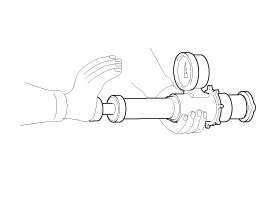
|
| 2. |
Apply a pressure of 93 ~ 123kPa (0.95 ~
1.25kgf/cm², 14 ~ 19psi) |
| 3. |
Check for a drop in
pressure. |
| 4. |
If the pressure drops, replace the
cap. |
TESTING
| 1. |
Wait until engine is cool, then carefully
remove the radiator cap and fill the radiator with engine coolant,
then install it on the pressure tester.
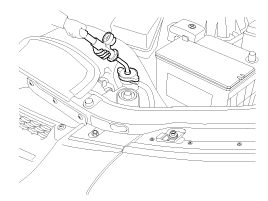
|
| 2. |
Apply a pressure tester to the radiator and
apply a pressure of 93 ~ 123kPa (0.95 ~ 1.25kgf/cm² 14
~18psi). |
| 3. |
Inspect for engine coolant leaks and a drop in
pressure. |
| 4. |
Remove the tester and reinstall the radiator
cap.
|
Check for engine oil in the coolant
and/or coolant in the engine
oil. | | |


