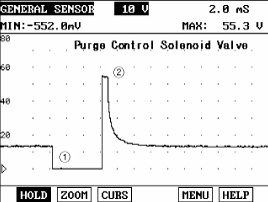
The evaporative emission
control system prevents hydrocarbon (HC) vapors from the fuel tank from
escaping into the atmosphere where they could form photochemical smog.
Gasoline vapors are collected in the charcoal canister. The evaporative
canister is designed to trap and store fuel vapor emissions from the fuel
tank.
When the carbon in the
canister is unsaturated, fuel vapor passing over and through the activated
carbon surface is absorbed and fresh air can pass out through the vent
system with very little residual fuel vapor. When fresh air is drawn
through the canister from the vent system, fuel vapors recombine with the
air and are metered into the engine.
This test detects a leak
across the purge valve by measuring an increase in evaporative system
vacuum. A leak across the purge valve can allow hydrocarbons from the tank
to leak to the atmosphere when the engine is off. The test should be
calibrated to detect a 0.02” (0.5mm) leak path across the purge valve.
This testdoes not require idle conditions to run.
Checking output signals
from tank vaccum under detecting condition, if signals is high than
threshold for more than 2 sec., PCM sets P0441. MIL(Malfunction Indicatin
Lamp) turns on when the malfunction lasts till 1 driving
cycle.
Item
|
Detecting
Condition
|
Possible cause
|
DTC
Strategy
|
| •
|
Test is failed if tank vacuum exceeds
prescribed threshold, based on fuel level for a prescribed
time | |
|
EnableConditions
|
| •
|
10 < Ignition Volt <
15.9907 |
| •
|
Barometric pressure > 72
kPa |
| •
|
Engine off time > 720min or Startup
IAT-Startup ECT < 12°C( 53.6
°F) |
| •
|
Startup ECT -Startup IAT < 12°C( 53.6
°F) |
| •
|
0°C( 32 °F) < Startup ECT <
40°C(104 °F) |
| •
|
0°C( 32 °F) < Startup IAT <
40°C(104 °F) |
| •
|
Start-up IAT-IAT < 1°C(33.8
°F) |
| •
|
1s < Engine Run Time <
100s | |
Threshold
value
|
|
DiagnosisTime
|
|
MIL On
Condition
|
|
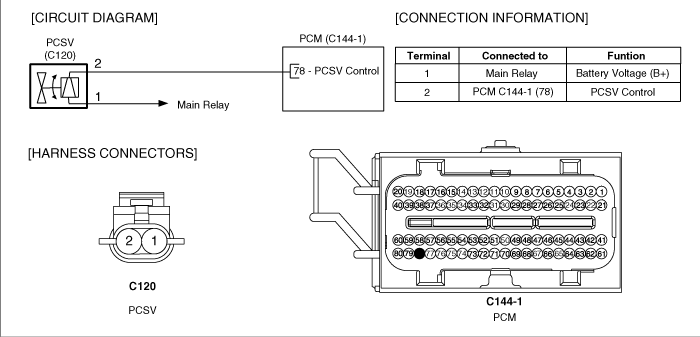
| 1. |
Warm-up engine to normal operating
temperature.
|
Evaporative Emissions Systems (EVAP)
Leak Tests can be run by the Scan Tool.
The tests are automated and provide
either a pass-fail result or directions to check for
DTCs. | |
| 2. |
Install scan tool and clear
DTC |
| 3. |
Perform "EVAP. LEAKAGE TEST" mode referring to
enable conditions as below
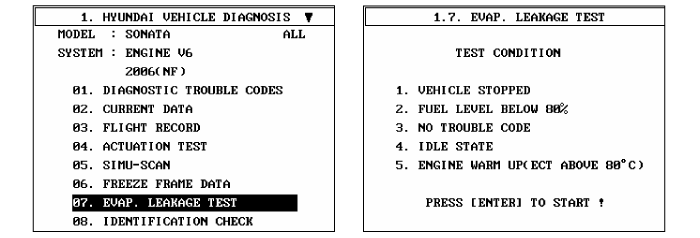
|
| 4. |
Monitoring for (pending) DTC by performing "
DIAGNOSTIC TROUBLE CODES" or "MONITORING TEST RESULTS". Is the same
DTC set ?

▶ Go to "Component Inspection"
procedure.

▶ Fault is intermittent caused by poor contact
in sensor’s and/or PCM’s connector or was repairedand PCM memory was
not cleared. Thoroughly check connectors for looseness, poor
connection,bending, corrosion, contamination, deterioration, or
damage. Repair or replace as necessary and goto "Verification of
vehicle Repair" procedure. |
| 1. |
Check PCSV
| (2) |
Remove PCSV and check it for open stuck
or leak |
| (3) |
Measure resistance between terminals "1"
and "2" of the PCSV connector.
Specification: Approx. 24.5 ~
27.5Ω(20°C(68°F))
| |
| (4) |
Connect Scantool and Perform ACTUATION
TEST for PCSV with scantool |
| (5) |
Check that clicking sound can be heard
by actuation test.
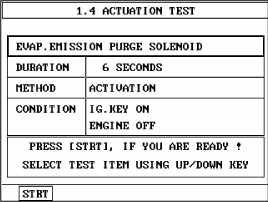
|
| (7) |
Is the PCSV normal?
▶ Substitute with a known - good PCM and
check for proper operation.
▶ If the problem is corrected, replace
PCM and go to "Verification of Vehicle Repair"
procedure.
|
There is a memory reset function
on scantool that can erase optional parts
automaticallydetected and memorized by PCM. After
testing PCM on the vehicle, use this function to reuse
the PCM on the others |
▶ Substitute with a known - good PCSV
and check for proper operation.
▶ If the problem is corrected, replace
PCSV and go to "Verification of Vehicle Repair"
procedure. | |
| VERIFICATION OF VEHICLE
REPAIR |
After a repair, it is
essential to verify that the fault has been corrected.
| 1. |
Monitor and record the Freeze Frame Data for
the Diagnostic Trouble Code(DTC) which has been
diagnosed. |
| 2. |
Using a Scantool, Clear the
DTCs |
| 3. |
Operate the vehicle within conditions noted in
the freeze frame data or enable
conditions |
| 4. |
Monitor that all rediness test have been
verified as " Complete " |
| 5. |
Are any DTCs present ?
▶ Go to the applicable troubleshoooting
procedure.
▶ System is performing to specification at
this
time. |

 ) and the surge voltage (
 ) is between 40 V and 60
V.