This test determines the
presence of a large leak, such as a fuel fill cap not installed or a
hosedisconnected, by initially bringing the evaporative system to a vacuum
level of10.2inH2O during idle conditions. This is done by commanding the
vent valve toclose and requesting the Canister Purge Subsystem to enter
the tank draw mode. Note: thisvacuum increase process is a continuation of
the preset mode process that was initiated duringthe Preset Large Leak
Function.
During this vacuum level
increase process, the vacuum level in the fuel tank is monitored using
afuel tank pressure sensor for a duration that is determined by the
accumulated purge volume thathas exited the evaporative system. This
accumulated purge volume is determined by the vacuumindex tracking logic.
A normally functioning or passing evaporative system will achieve
thecalibration-specified vacuum level before the accumulated purge volume
exceeds calibratedthreshold, but a failing evaporative system will not
achieve this calibration-specified vacuum level.
This test detects a
large leak (> 0.04”) in the evaporative system by measuring the time it
takes to draw a pre-determined amount of vacuum in the evaporative system.
The inability to draw a vacuum under controlled conditions is indicative
of having a large leak. Test failures can be caused by either hardware
failures (i.e. a hole, broken seal, etc) or by the customer not correctly
reinstalling the gas cap following re-fueling.
The Large Leak test is
split up in to two sub-tests, the Preset Large Leak Test and the Idle
Large Leak Test. The Idle Large Leak test runs when the vehicle is at
idle. The Preset Large Leak test runs when the vehicle is off idle and
will report it’s results if the diagnostic times out and ends before the
vehicle returns to idle.
Checking tank vaccum
from tank pressure sensor under detecting condition, if tank vaccum
signals is less than 10.0996 at idle condition or not after purge volume
has been drawn from tank, PCM sets P0455. MIL(Malfunction Indicatin Lamp)
turns on when the malfunction lasts till 1 driving cycle.
Item
|
Detecting
Condition
|
Possible cause
|
DTC
Strategy
|
| •
|
Test is failed if tank vacuum cannot
reach prescribedvaccum after a prescribed purge volume has
been drawn from the tank | |
| •
|
Leakage in each hose/fuel filler
pipe |
| •
|
Leakage in CCV/Canister/ Fuel
tank |
|
Enable
Conditions
|
| •
|
10 < Ignition Volt <
15.9907 |
| •
|
Barometric pressure > 72
kPa |
| •
|
Engine off time > 720min or Startup
IAT-Startup ECT < 12°C( 53.6
°F) |
| •
|
Startup ECT -Startup IAT < 12°C( 53.6
°F) |
| •
|
0°C( 32 °F) < Startup ECT <
40°C(104 °F) |
| •
|
0°C( 32 °F) < Startup IAT <
40°C(104 °F) |
| •
|
Start-up IAT-IAT < 1°C(33.8
°F) |
| •
|
1s < Engine Run Time <
100s |
| •
|
Purge enabling Rum time <
Threshold |
| •
|
Cold Test Timer <
300sec. |
| •
|
Vehicle Speed < 3KPH(1.864114
MPH) |
| •
|
Vehicle Speed < 6KPH(3.728227
MPH) |
| •
|
Throttle Position <
1.9989% |
| •
|
Vehicle Speed > 2KPH(1.242742
MPH) | |
Threshold
value
|
At idle
Condition
| •
|
Tank Vaccum <10.0996 in
HO2 |
| •
|
purge integral >
Threshold | |
Diagnosis
Time
|
|
MIL On
Condition
|
|
| 1. |
Warm-up engine to normal operating
temperature.
|
Evaporative Emissions Systems (EVAP)
Leak Tests can be run by the Scan Tool.
The tests are automated and provide
either a pass-fail result or directions to check for
DTCs. | |
| 2. |
Install scan tool and clear
DTC |
| 3. |
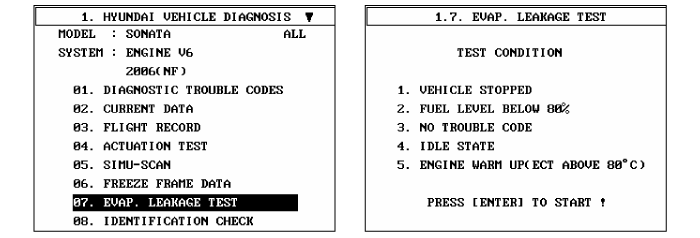
Perform "EVAP. LEAKAGE TEST" mode referring to
enable conditions as below
|
| 4. |
Monitoring for (pending) DTC by performing "
DIAGNOSTIC TROUBLE CODES" or "MONITORING TEST RESULTS". Is the same
DTC set ?

▶Go to "System Inspection"
procedure.

▶ Fault is intermittent caused by poor contact
in sensor’s and/or PCM’s connector or was repairedand PCM memory was
not cleared. Thoroughly check connectors for looseness, poor
connection,bending, corrosion, contamination, deterioration, or
damage. Repair or replace as necessary and goto "Verification of
vehicle Repair" procedure. |
| 1. |
Check vapor hoses for leakage in fuel
system.
| (1) |
Check vapor hoses between the following
components for leakage:
| A. |
Intake manifoled ~ Purge control
solenoid valve (PCSV) |
| B. |
Purge control solenoid valve
(PCSV) ~ Canister |
| C. |
Canister ~ Canister close valve
(CCV) |
|
| (2) |
Does a leak exist?
▶ Repair or replace as necessary and
then, go to "Verification of Vehicle Repair"
procedure.
▶ Go to "Check fuel filler pipe for
leakage" as
below. | |
| 2. |
Check fuel filler pipe for crack or
leakage.
| (1) |
Check that there is crack or leakage in
fuel filler pipe |
| (2) |
Is there any crack or leakage
?
▶ Repair or replace as necessary and
then, go to "Verification of Vehicle Repair"
procedure.
▶ Go to "Component inspection"
procedure. | |
| 1. |
Check CCV for leakage.
| (1) |
Disconnect the hose leading from the CCV
to Canister at CCV. |
| (2) |
Visually Check any tear of the hose
leading from the CCV to
Canister |
| (3) |
When the CCV operates, apply a vacuum at
the nipple and verify that the CCV holds
vacuum. |
| (4) |
Does a leak exist?
▶ Repair or replace as necessary and
then go to "Verification of Vehicle Repair"
procedure.
▶ Go to "Check Canister for leakage" as
necessary. | |
| 2. |
Check Canister for leakage.
| (1) |
Disconnect the hose leading from the CCV
to Canister at Canister. |
| (2) |
When the other nipples are plugged,
apply a vacuum at the vent nipple and verify that the Canister
holds vacuum |
| (3) |
Does a leak exist?
▶ Repair or replace as necessary and
then go to "Verification of Vehicle Repair"
procedure.
▶ Go to "Check fuel tank for leakage" as
below. | |
| 3. |
Check fuel tank for leakage.
| (1) |
Check fuel tank for crack or
leakage. |
| (2) |
Does a leak exist?
▶ Repair or replace as necessary and
then go to "Verification of Vehicle Repair"
procedure.
▶ Substitute with a known - good PCM and
check for proper operation.
▶ If the problem is corrected, replace
PCM and go to "Verification of Vehicle Repair"
procedure.
|
There is a memory reset function
on scantool that can erase optional parts automatically
detected and memorized by PCM. After testing PCM on the
vehicle, use this function to reuse the PCM on the
others | | |
| VERIFICATION OF VEHICLE
REPAIR |
After a repair, it is
essential to verify that the fault has been corrected.
| 1. |
Monitor and record the Freeze Frame Data for
the Diagnostic Trouble Code(DTC) which has been
diagnosed. |
| 2. |
Using a Scantool, Clear the
DTCs |
| 3. |
Operate the vehicle within conditions noted in
the freeze frame data or enable
conditions |
| 4. |
Monitor that all rediness test have been
verified as " Complete " |
| 5. |
Are any DTCs present ?
▶ Go to the applicable troubleshoooting
procedure.
▶ System is performing to specification at
this
time. |
