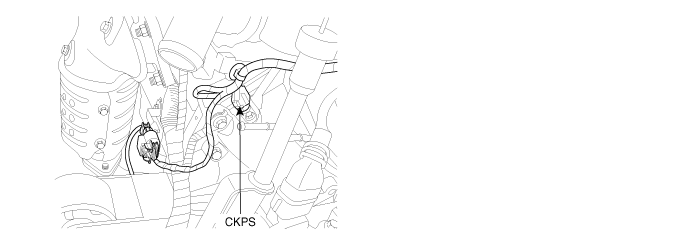
The Tooth Error
Correction (TEC) Learn Algorithm determines engine-specific variation in
crankshaft position sensing. The largest factor of variation is geometric
tooth spacing although other factors, such as bearing run out, may also be
present. Once TEC is learned, compensation factors are then calculated and
used by the Misfire Diagnostic algorithm to improve the accuracy of engine
positiondeterminations.Tooth error correction factors are normally learned
only once during the life of a vehicle. However, if a vehicle controller,
engine crankshaft, target wheel, or crank sensor is replaced or serviced,
tooth error correction factors must be re-learned. This can be performed
in a service environment with serial data commands.
It is impossible to
forge or machine a perfectly proportioned crankshaft wheel. Therefore,
each crankshaft wheel produced will have minor variations in the spacing
and/or width of its gear teeth.These variations (tooth error), if not
compensated for, can cause false misfire detection. In order to account
for tooth error, the tooth error correction algorithm measures the
variation in crankshaft wheel teeth and calculates a compensation factor,
which is applied to the reference periods when the misfire detection
algorithm runs. This compensation factor is learned once, early in the
life of the vehicle, and need never be learned again unless the crank
wheel is replaced or the vehicle’s PCM EEPROM or similar storage device is
erased.
Checking tooth error
correction under detecting condition, if the TEC is out of Threshold
value, PCM sets P0315.
Item
|
Detecting
Condition
|
Possible
cause
|
DTC Strategy
|
| •
|
This DTC indicates that crankwheel
tooth error has not been
learned. | |
|
Enable Conditions
|
| •
|
11.4932 ≤ Ignition Voltage
≤15.9907 |
| •
|
10.0006 ≤ Engine load<
89.9993 |
| •
|
2000 ≤ engine speed ≤
4000 |
| •
|
Vehicle speed < 5kph( 3.106856
mph) |
| •
|
Tec RPM stability timer
>10sec |
| •
|
0°C(32°F)< coolant temp<
110°C(230°F) |
| •
|
Not active disabling
faults |
| •
|
Not key on disabling
faults | |
Threshold value
|
| •
|
Distance driven without learning tooth
error ≥ 4000km(2485.484769
mile) |
| •
|
Maximum allowed number of tooth error
correction samples taken in the On The Road(OTR)learning
mode< 50 counts |
| •
|
Individual tooth error factors outside
calibratable range = True |
| •
|
Sum of tooth error factors variation
outside calibratable range ≥ 50
counts | |
Diagnosis Time
|
| •
|
Continuous
(More than 0.15sec
failure) | |
MIL On Condition
|
|
| 1. |
Visually check CKPS and target
wheel
| (2) |
Check CKPS and target wheel for
deformation or damage
visually |
| (3) |
Is the above items normal
?

▶ Go to "Verification of Vehicle
Repair" procedure.

▶ Substitute with a known - good PCM
and check for proper operation. If the problem is corrected,
replace PCM and go to "Verification of Vehicle Repair"
procedure.
|
There is a memory reset function
on scantool that can erase optional parts automatically
detected and memorized by PCM. Before or after testing
PCM on the vehicle, use this function to reuse the PCM
on the
others | | |
| VERIFICATION OF VEHICLE
REPAIR |
After a repair, it is
essential to verify that the fault has been corrected.
| 1. |
Monitor and record the Freeze Frame Data for
the Diagnostic Trouble Code(DTC) which has been
diagnosed. |
| 2. |
Using a Scantool, Clear the
DTCs |
| 3. |
Operate the vehicle within conditions noted
in the freeze frame data or enable
conditions |
| 4. |
Monitor that all rediness test have been
verified as " Complete " |
| 5. |
Are any DTCs present ?
▶ Go to the applicable troubleshoooting
procedure.
▶ System is performing to specification at
this
time. |
