
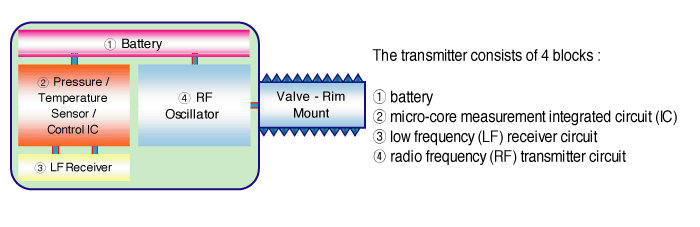
This transmitter is a
transmitter device with tire valve, which is mounted in the valve hole of
the wheel rim and transmits the pressure and temperature inside the tire,
the battery voltage of the transmitter, and the tire identification code
(ID) at normal and abnormal condition with the radio wave (RF) that
conforms to the used area. Also this device has a countermeasure function
such as the random delay of transmission time so that the RF signal from
each tire will not interfere due to simultaneous transmission. Wheel
sensors shall support usage on steel or aluminum rims.
Sensor transmissions
continue when sensor status is 'Normal Fixed State'. Sensor transmissions
stop when sensor status is 'Storage State' or the sensor battery runs out.
The transmitter should transmit data at vehicle speeds between 0mph (0kph)
and 186mph (300kph). Operating Temperature Range is -40 to 248°F (-40 to
120°C). Transmitter shall enter thermal shutdown once the measured
temperature is greater than or equal to 257°F(125°C). The accuracy of the
sensor is 23 to 44.6°F(-5 to 7°C) at this temperature. The sensor shall
exit thermal shutdown once the temperature is less than or equal to
212°F(100°C). The transmitter shall have the capability to measure the
internal battery voltage as an indicator of the end of life of the sensor.
Since the unit is sealed, this parameter cannot be verified with a
production unit.
【Tire
Pressure Monitoring】
When 4 sensors have
been learned as road wheels, it shall not be possible to learn new road
wheel sensors on the same Ignition cycle. In normal mode low line, tire
pressure and temperature shall be transmitted every 3 minutes 20s
nominally independent of vehicle operation. Monitoring shall be every 20s.
If sensor detects rapid deflation, then RF messages will be transmitted
every 4s for 1 minute duration. Communication from wheel sensors shall be
via RF at a frequency of 315 MHz, 5kBaud. Tire pressure measurement
tolerance shall be ±7 kPa from 32 to 122°F(0 to 50°C) and ±17.5 kPa from
-40 to 248°F(-40 to 120°C) with a range of 100 to 450 kPa. Tire
temperature measurement tolerance shall be ±37.4°F(±3°C) from -4 to 158°F
(–20 to 70°C) and to ±41°F(±5°C) from -40 to 248°F(-40 to
120°C).
This DTC indicates
that the sensor battery voltage level is Low. The most likely cause is
battery passing it’s expected life / excessively Low temperatures / sensor
failure.
Item
|
Detecting
Condition
|
Possible
cause
|
DTC
strategy
|
|
|
Enable
conditions
|
| •
|
Latest Lowest sensor Temp. >
-4°F(–20°C) |
| •
|
Distance travelled during 12 min. >
2.5 Mile (4 km) | |
Threshold
value
|
|
Diagnosis
time
|
|
| 1. |
Park the vehicle on a level
surface. |
| 2. |
Connect 'TPMS exciter' or scantool to Data
Link Connector(DLC). |
| 3. |
Select "TPMS DIAGNOSIS"
mode. |
| 4. |
Select the "FULL" mode of "CURRENT DATA"
function. |
| 5. |
Monitor the parameter of SENSOR 1 on the
'TPMS exciter'or scantool after the vehicle drives 2.5 Mile (4 km)
during 12 min.
Specification : 'Sensor
Temp.' is more than –68°F( –20°C) and 'Sensor battery value'
is 'Normal'.
|
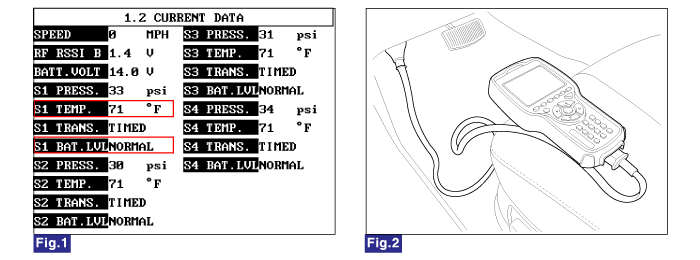
Fig 1) Sensor current data
(normal)
Fig 2) Connect the DLC for 'TPMS
exciter' |
| 6. |
Is parameter within
specifications?
|

|
▶ Fault is
intermittent. It has been repaired and TPMS receiver module
memory is not cleared yet.
▶ Go
to "Verification of vehicle Repair"
procedure.
|
|

|
▶ Go to "Component
Inspection"
procedure.
|
|
| 1. |
Turn ON 'TPMS
exciter'. |
| 2. |
Select "TIRE SNSR CONFIG(EXCITER)"
mode. |
| 3. |
Execute "SET SENSOR STATUS" of each
wheel.
Specification : 'Sensor
battery value' is 'Normal' and 'Sensor Temp.' is more than
–68°F( –20°C).
|
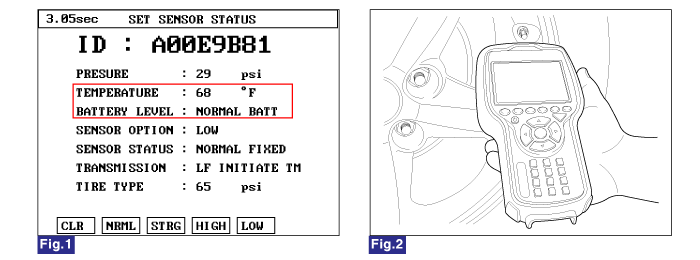
Fig 1) Sensor status (normal)
Fig 2) Executing "SET SENSOR
STATUS" |
| 4. |
Is parameter within
specifications?
|
|
▶ Check wheel /
tire where abnormal sensor data was detected.
▶Check for sensor if unable to retrieve data with
'TPMS exciter'.
▶ Repair or
replace if necessary and go to "Verification of Vehicle
Repair" procedure.
|
|
|
▶ Replace TPMS
sensor if necessary and register sensor ID with 'TPMS
exciter'.
▶ Go to "Verification
of Vehicle Repair"
procedure.
|
|
| Verification of Vehicle
Repair |
| 1. |
Connect TPMS exciter or scantool and select
"Diagnostic Trouble Codes(DTCs)"
mode |
| 2. |
Using a TPMS exciter or scantool, Clear
DTC. |
| 3. |
Operate the vehicle within DTC Enable
conditions in General information. |
| 4. |
Are any DTCs present
? |
|
|
▶ Go to the applicable
troubleshooting procedure.
|
|
|
▶ System performing to
specification at this time.
|