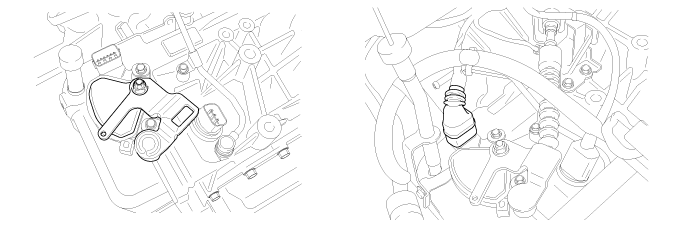
The Transaxle Range
Switch sends the shift lever position information to the TCM using a 12V
(battery voltage) signal. When the shift lever is in the D (Drive)
position the output signal of Tansaxle Range Switch is 12V and in all
other positions the voltage is 0V. The TCM judges the shift lever position
by reading all signals, for the Transaxle Range Switch, simultaneously.
The TCM sets this code
when the Transaxle Range Switch outputs multiple signals for more than 30
seconds.
Item
|
Detecting
Condition
|
Possible
Cause
|
DTC
Strategy
|
| •
|
Check for multiple signals
| |
| •
|
Open or short in TRANSAXLE RANGE
SWITCH |
| •
|
Faulty TRANSAXLE RANGE
SWITCH |
|
Enable
Conditions
|
|
Threshold
Value
|
|
Diagnostic
Time
|
|
Fail Safe
|
| •
|
Recognition as previous
signal
- When signal is input "D" and "N" at
the same time,TCM regards it as "N" RANGE.
- After PCM/TCM Reset,If the if the
PCM/TCM detects multiple signal or no signal, then it holds
the 3rd gear
position. | |
| 1. |
Connect scantool to data link
connector(DLC) |
| 2. |
Ignition "ON" & Engine
"OFF". |
| 3. |
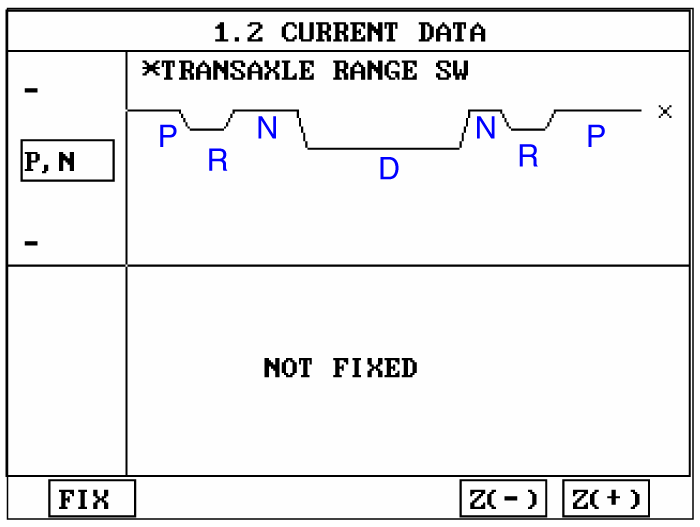
Monitor the "TRANSAXLE RANGE SWITCH"
parameter on the scantool |
| 4. |
Shift selector lever from "P" range to other
range.
|
| 5. |
Does "TRANSAXLE RANGE SWITCH" follow the
referance data?
|

|
▶ Fault is
intermittent caused by poor contact in the sensor's and/or
TCM(PCM)'s connector or was repaired and TCM(PCM) memory was
not cleared. Throughly check connectors for looseness, poor
connection, bending, corrosion, contamination, deterioration
or damage.Repair or replace as necessary and go to
"Verification Vehicle Repair" procedure.
|
|

|
▶ Go to "W/Harness
Inspection"
procedure.
|
|
| Terminal and Connector
Inspection |
| 1. |
Many malfunctions in the electrical system
are caused by poor harness and terminals. Faults can also be caused
by interference from other electrical systems, and mechanical or
chemical damage. |
| 2. |
Thoroughly check connectors for looseness,
poor connection, bending, corrosion, contamination, deterioration,
or damage. |
| 3. |
Has a problem been found?
|
|
▶ Repair as
necessary and go to "Verification vehicle Repair"
procedure
|
|
|
▶ Go to "Power
Circuit Inspection"
procedure
|
|
| 1. |
Disconnect "TRANSAXLE RANGE SWITCH"
connector. |
| 2. |
Ignition "ON" & Engine
"OFF". |
| 3. |
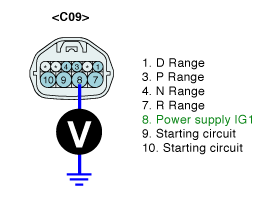
Measure voltage between each teminal of the
sensor harness connector and chassis ground.
Specification :
TERMINAL(C09)
|
1
|
3
|
4
|
7
|
8
|
9
|
10
|
SPECIFICATION
|
0V
|
0V
|
0V
|
0V
|
12V
|
0V
|
0V
|
|
| 4. |
Is voltage within
specifications?
|
|
▶ Go to "Signal
Circuit Inspection" procedure
|
|
|
▶ Check for Short
in harness. Repair as necessary and Go to "Verification Of
Vehicle Repair"
procedure
|
|
| Signal Circuit
Inspection |
| 2. |
Disconnect "TRANSAXLE RANGE SWITCH" and
"TCM(PCM)" connector. |
| 3. |
Measure resistance between each teminals of
the sensor harness to check for Short.
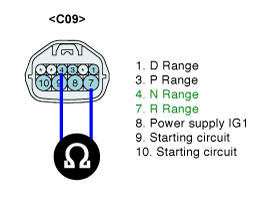
|
| 4. |
Is resistance within
specifications?
|
|
▶ Go to "Component
Inspection" procedure
|
|
|
▶ Check for Short
in harness. Repair as necessary and Go to "Verification Of
Vehicle RepairVerification Of Vehicle Repair"
procedure
|
|
| 2. |
Remove "TRANSAXLE RANGE SWITCH"
|
| 3. |
Measure continuity(resistance) between each
teminals of the sensor
Specification :
Approx. 0 Ω
|
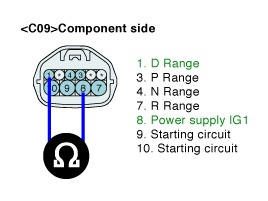
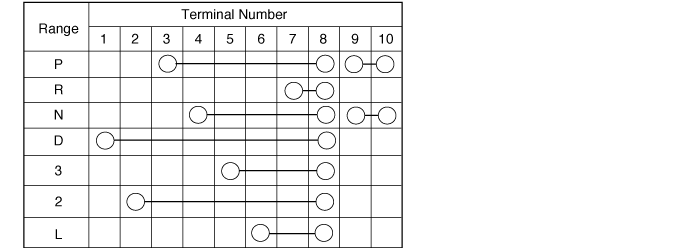
[ RANGE SWITCH continuity check table (Case
of SPORTS MODE vehicle has no 3,2,L range) ]
|
| 4. |
Is resistance within specification
?
|
|
▶ Substitute with a
known-good PCM/TCM and check for proper operation. If the
problem is corrected, replace PCM/TCM as necessary and then
go to "Verification of Vehicle Repair"
procedure.
|
|
|
▶ Replace
"TRANSAXLE RANGE SWITCH" as necessary and Go to "Verification
Vehicle Repair"
procedure
|
|
| Verification Of Vehicle
Repair |
After a repair, it is
essential to verify that the fault has been corrected.
| 1. |
Connect scan tool and select "Diagnostic
Trouble Codes(DTCs)" mode. |
| 2. |
Using a scantool, Clear
DTC. |
| 3. |
Operate the vehicle within DTC Enable
conditions in General information. |
| 4. |
Are any DTCs present ?
|
|
▶ Go to the
applicable troubleshooting procedure.
|
|
|
▶ System performing
to specification at this
time.
|
|