| General |
The supplemental
restraint system (SRS) is designed to supplement the seat belt to help
reduce the risk of severe injury to the driver and passenger by activating
and deploying the driver, passenger, side airbag and belt pre-tensioner in
certain frontal or side collisions. The SRS (Airbag) consists of : a
driver side airbag module located in the center of the steering wheel,
which contains the folded cushion and an inflator unit ; a passenger side
airbag module located in the passenger side crash pad contains the folded
cushion assembled with inflator unit ; side airbag modules located in the
driver and passenger seat contains the folded cushion and an inflator unit
; curtain airbag modules located inside the headliner which contains
folded cushions and inflator units. The Passenger Occupant Detection
System (ODS) utilizes a weight sensor placed in seat track assembly to
measure the occupant's loading force on the vehicle seat. Seat Track
Position Sensor (STPS) is located in the driver, it interfaces with the
SRS Control module (SRSCM) and will help determine whether to suppress
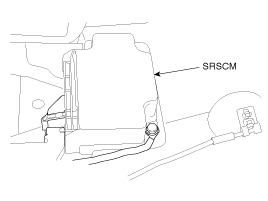
either stage of the multi-stage airbag system. SRSCM is located under the
center console. The impact sensing function of the SRSCM is carried out
by electronic accelerometer that continuously measures the vehicle's
acceleration and delivers a corresponding signal through amplifying and
filtering circuitry to the microprocessor.
SRSCM
(SRS Control Module)
The SRS airbag system
consists of electrical and electronic components. Be cautious of the
airbag parts.
The SRSCM will detect
front impact with an inside sensor, side impact with a side impact sensor,
airbag deployment request signal, and determine airbag module
deployment.
| 1. |
DC/DC converter: DC/DC converter in power
supply unit includes up/down transformer converter, and provides
ignition voltage for 2 front airbag ignition circuits and inside
operation voltage. If inside operation voltage is below critical
value setting, it will perform re- setting.
|
| 2. |
Safety sensor: The safety sensor is located
in the airbag ignition circuit. The safety sensor will operate
airbag circuit at any deployment condition and release airbag
circuit safely at normal driving condition. The safety sensor is a
double contact electro-mechanical switch that will close detecting
deceleration above certain criteria.
|
| 3. |
Back up power supply: SRSCM has a separate
back up power supply, it will supply deployment energy instantly in
low voltage condition or upon power failure by front crash.
|
| 4. |
Self diagnosis: SRSCM will constantly
monitor current SRS operation status and detect system failure
when the vehicle power supply is on, system failure may be checked
with trouble codes using the scan tool. (Hi-Scan)
|
| 5. |
Airbag warning lamp : Upon detecting
error , the SRSCM will transmit a signal to the airbag warning
lamp located in the cluster. The lamp will indicate SRS error.
When the ignition key is on, the SRS lamp will be turned on for
about 6 seconds, then will be turned off for a self check. If it
remains on, the error is indicated.
|
| 6. |
Trouble code registration: Upon error
occurrence in the system, the SRSCM will store a DTC corresponding
to the error. DTC can be cleared only by Hi-Scan.
|
| 7. |
Self diagnostic connector: Data stored in
SRSCM memory will be output to the Hi-Scan or other external
output devices through the data link connector located below the
driver side crash pad. |
| 8. |
Once the airbag is deployed, the SRSCM
should not be used again and replaced.
|
| 9. |
SRSCM will determine whether a passenger has
put on a seat belt using built-in switch signal in the seat belt
buckle, and deploy the front passenger seat airbag accordingly.
|
| 10. |
Side airbag deployment will be determined by
SRSCM that will detect satellite sensor impact signal upon
side crash, irrespective to seat belt condition.
|