| Removal |
Removal of the thermostat would have an
adverse effect, causing a lowering of cooling efficiency. Do not
remove the thermostat, even if the engine tends to
overheat. |

| 1. |
Drain engine coolant so its level is below
the thermostat. |
| 2. |
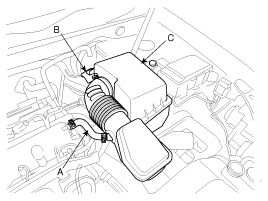
Disconnect the breather hose (A), ECM
connector (B) and remove the air cleaner assembly (C).
|
| 3. |
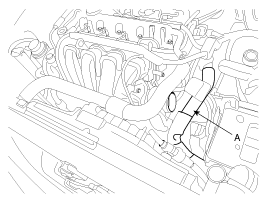
Remove the radiator lower hose
(A).
|
| 4. |
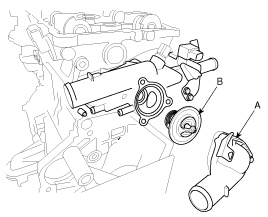
Remove water inlet fitting (A) and
thermostat (B).
|
| Inspection |
| 1. |
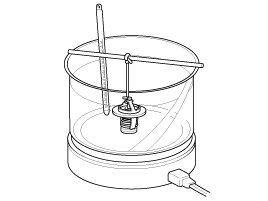
Immerse the thermostat in water and
gradually heat the water.
|
| 2. |
Check the valve opening
temperature.
If the valve opening temperature is not as
specified, replace the thermostat. |
| 3. |
Check the valve lift.
If the valve lift is not as specified,
replace the thermostat. |
| Installation |
| 1. |
Place thermostat (B) in thermostat
housing.
|
| 2. |
Install the water inlet fitting
(A).
|
| 3. |
Install the radiator lower hose
(A).
|
| 4. |
Install the air cleaner assembly (C) then
connect the breather hose (A), ECM connector (B).
|
| 5. |
Fill the engine
coolant. |
| 6. |
Start the engine and check for leaks.
|
| 7. |
Recheck the coolant
level. |