| 1. |
Loosen the wheel nuts slightly.
Raise the rear of the vehicle, and make sure
it is securely supported. |
| 2. |
Remove the rear wheel and tire from rear
hub.
|
Be careful not to damage the hub bolts
when removing the rear wheel and
tire. | |
| 3. |
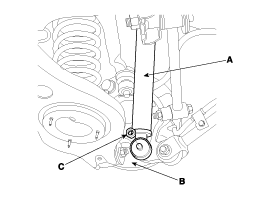
Remove the rear shock absorber assembly bolts
(C) from the rear axle assembly (B), then remove the shock absorber
assembly (A).
|
| 4. |
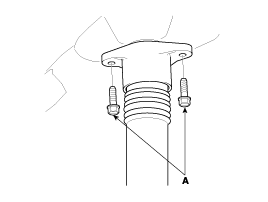
Remove the two rear shock absorber assembly
mounting bolts (A).
|
| 5. |
Disassembly the rubber bumper and the dust
cover from the rear shock absorber. |
| 1. |
Check the rubber parts for damage or
deterioration. |
| 2. |
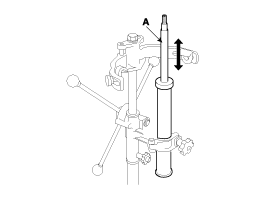
Check the shock absorber for abnormal
resistance or unusual sounds.
|
| 1. |
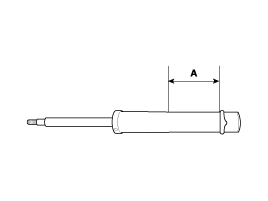
Fully extend the shock absorber
rod. |
| 2. |
Drill a hole to remove gas from the
cylinder.
|
The gas coming out is harmless, but be
careful of chips that may fly up when drilling. Be sure to use
face shield and safety
goggles. |
|
| 1. |
Assembly the rubber bumper and the dust cover
to the rear shock absorber, after pulling the rod of the rear shock
absorber completely. |
| 2. |
Install the two rear shock absorber mounting
bolts (A).
Tightening
torque :
50 ~ 65N.m (5.0 ~ 6.5kgf.m, 36.2 ~
47.0lb-ft)
|
|
| 3. |
Install the shock absorber assembly (A) to the
rear axle assembly (B) with the specified torque.
Tightening
torque :
140 ~ 160N.m (14~16kgf.m,
101.2~115.7lb-ft)
|
|
| 4. |
Install the wheel and the tire to the rear
hub.
Tightening
torque :
90 ~ 110N.m (9 ~ 11kgf.m, 65.1 ~
79.5lb-ft)
| |
|
Be careful not to damage the hub bolts when
installing the rear wheel and
tire. | |
