| Inspection |
Radiator Cap Test
| 1. |
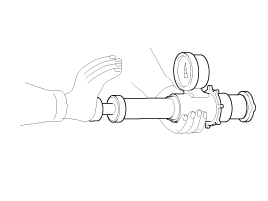
Remove the radiator cap, wet its seal with
engine coolant, then install it no pressure tester.
|
| 2. |
Apply a pressure of 93 ~ 123kPa (0.95 ~
1.25kgf/cm², 14 ~ 19psi) |
| 3. |
Check for a drop in
pressure. |
| 4. |
If the pressure drops, replace the
cap. |
Radiator Leakage Test
| 1. |
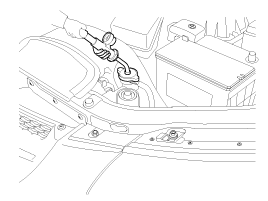
Wait until engine is cool, then carefully
remove the radiator cap and fill the radiator with engine coolant,
then install it on the pressure tester.
|
| 2. |
Apply a pressure tester to the radiator and
apply a pressure of 93 ~ 123kPa (0.95 ~ 1.25kgf/cm² 14 ~18
psi). |
| 3. |
Inspect for engine coolant leaks and a drop in
pressure. |
| 4. |
Remove the tester and reinstall the radiator
cap.
|

| Removal |
| 1. |
Drain the engine
coolant. |
| 2. |
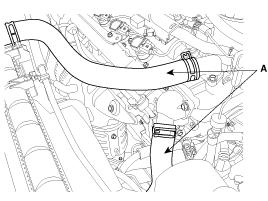
Disconnect radiator upper and lower
hoses(A).
|
| 3. |
Disconnect transaxle oil cooler
hoses.(Refer to TR
group) |
| 4. |
Remove radiator
bracket. |
| 5. |
Remove radiator
assembly. |
| Installation |
| 1. |
Install radiator
assembly. |
| 2. |
Install radiator upper
bracket. |
| 3. |
Connect transaxle oil cooler
hoses.(Refer to TR
group) |
| 4. |
Connect radiator upper and lower
hoses(A).
|
| 5. |
Fill with engine
coolant. |
| 6. |
Start engine and check for
leaks. |
| 7. |
Recheck engine coolant
level. |