| Description |
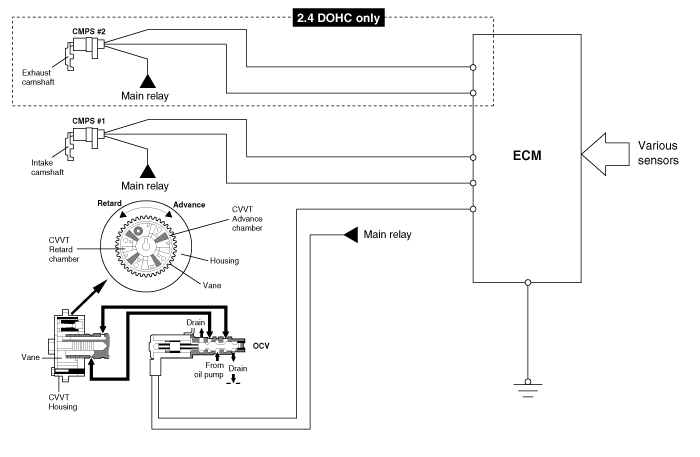
The CVVT (Continuously
Variable Valve Timing) is installed on the intake/exhaust camshaft which
monitors intake/exhaust valve open and close timing in order to improve
engine performance.
The intake/ exhaust
valve timing is optimized by CVVT system depending on engine
rpm.
This CVVT system
improves fuel efficiency and reduces NOx emissions at all levels of engine
speed, vehicle speed, and engine load through the effects of the EGR by
valve overlap optimization.
The CVVT changes the
phase of the intake camshaft via oil pressure.It changes the intake valve
timing continuously.
| [2.4 DOHC] |
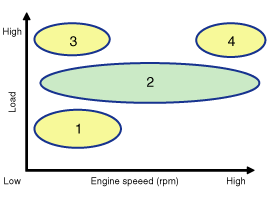
| Low speed/
Low load (1) |
Part load
(2) |
|
|
|
| Low speed/
High load (3) |
High speed/
High load (4) |
|
|
|
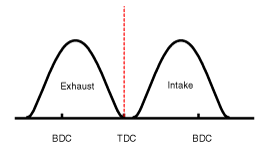
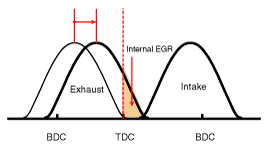
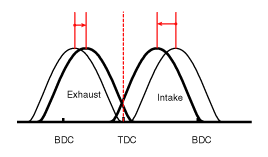
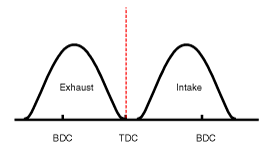
| Driving condition |
Exhaus valve |
Intake valve | ||||||
| Valve timing |
Effect |
Valve timing |
Effect | |||||
| Low speed/ Low load (1) |
Maximum advance |
Valve under-lap, Stable combustion |
Maximum advance |
Valve under-lap, Stable combustion | ||||
| Part load (2) |
Retard |
Pumping loss reduction, Enhanced power, HC reduction |
Retard |
Pumping loss reduction | ||||
| Low speed/ High load (3) |
Retard |
Enhanced power |
Advance |
Prevention of intake flowing backward | ||||
| High speed/ High load (4) |
Advance |
Pumping loss reduction |
Retard |
Improvement of volume
efficiency | ||||
| [3.3 V6] |
| Operation |
[2.4 DOHC]
The CVVT system makes
continuous intake/ Exhaust valve timing changes based on operating
conditions.
Intake/ Exhaust valve
timing is optimized to allow the engine to produce maximum power and
reduce exhaust gas.
The CVVT reduces the cam
advance at idle, stabilizes combustion, and reduces engine
speed.
Intake valve timing is
retarded and exhaust valve timing is advanced fully to reduce the idle rpm
and stabilze the combustion at idle condition.
Exhaust valve timing is
retarded at part load conditon.
The exhaust valve is
closed slowly to reduce the pumping loss and produce internal EGR
effect.
So, Fuel economy is
enhanced and HC is reduced.
If a malfunction occurs,
the CVVT system control is disabled.The intake valve timing is fixed at
the fully retarded position and the exhaust valve timing is fixed at the
fully advanced position.
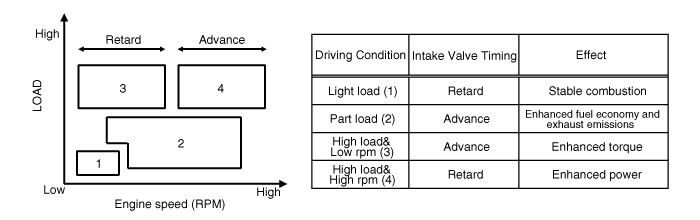
[3.3 V6]
The CVVT system makes
continuous intake valve timing changes based on operating
conditions.
Intake valve timing is
optimized to allow the engine to produce maximum power.
Cam angle is advanced to
obtain the EGR effect and reduce pumping loss.
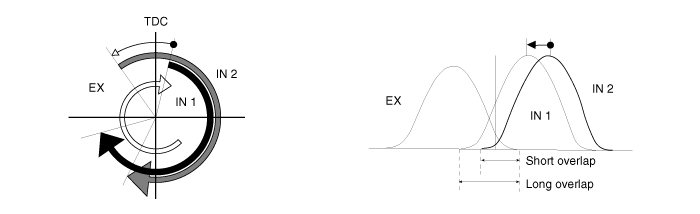
The intake valve is
closed quickly to reduce the entry of the air/fuel mixture into the intake
port and improve the changing effect.
Reduces the cam advance
at idle, stabilizes combustion, and reduces engine speed.
If a malfunction occurs,
the CVVT system control is disabled and the valve timing is fixed at the
fully retarded position.
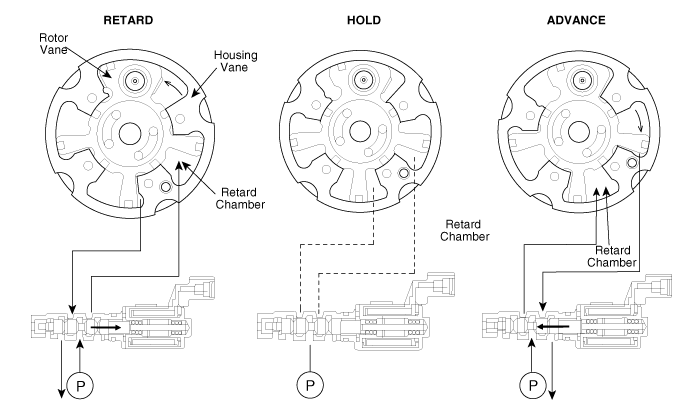
| 1. |
The above figure shows the relative operation
structuresof the housing vane to the rotor
vane. |
| 2. |
If the CVVT is held a certain control angle,
oil is replenished from the oil pump.
TheOCV (Oil-flow Control Valve) spool location
at this time is as follows.
Oil pump → Advance oil chamber (The inflow
side to the advance oil chamber is opened little by little) → The
drain side almost closes
Note that a difference may exist in the
position according to the engine running state (rpm, oil
temperature, and oil
pressure). |