The PCM/TCM controls the
locking and unlocking of the Torque Converter Clutch ( or Damper Clutch ),
to the input shaft of the transmission, by appling hydraulic pressure. The
main purpose of T/C clutch control is to save fuel by decreasing the
hydraulic load inside the T/C. The PCM/TCM outputs duty pulses to control
the Damper Clutch Control Solenoid Valve( DCCSV ) and hydraulic pressure
is applied to the DC according to the DCC duty ratio value. When the duty
ratio is high, high pressure is applied and the Damper Clutch is locked.
The normal operating range of the Damper Clutch Control duty ratio value
is from 30%(unlocked) to 85%(locked)..
The PCM/TCM increases
the duty ratio to engage the Damper Clutch by monitoring slip rpms
(difference vlaue beteween engine speed and turbine speed ). To decrease
the slip of the Damper Clutch, the PCM/TCM increases the duty ratio by
appling more hyraulic pressure. When slip rpm does not drop under some
value with 100% duty ratio, the PCM/TCM determines that the Torque
Converter Clutch is stuck OFF and sets this code.
Item
|
Detecting
Condition
|
Possible Cause
|
DTC
Strategy
|
|
※
TORQUE CONVERTER(DAMPER) CLUTCH : TCC
| •
|
Faulty TCC or oil pressure
system |
| •
|
Faulty TCC solenoid
valve |
| •
|
Faulty bady control
valve |
|
Enable
Conditions
|
| •
|
Manifold air pressure >
60kPa |
| •
|
Time after TCC release
>5secs | |
Threshold
Value
|
| •
|
|Engine rpm - Input speed sensor rpm| ≤
20 rpm | |
Diagnostic
Time
|
|
Fail
Safe
|
| •
|
Damper clutch abnormal
system
(If diagnosis code P0741 is output four
times, TORQUE CONVERTER(DEMPER) CLUTCH is not controlled by
PCM/TCM) | |
| 1. |
Connect scantool to data link
connector(DLC) |
| 3. |
Sellect "D RANGE" and drive
vehicle |
| 4. |
Monitor the "TORQUE CONVERTER(DAMPER) CLUTCH"
parameter on the scantool
Specification
: TCC SLIP>5RPM
|
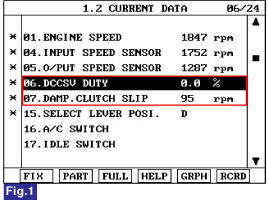
Fig 1) Normal
status |
| 5. |
Is TCC SLIP" within
specifications?
|

|
▶ Fault is
intermittent caused by poor contact in the sensor's and/or
TCM(PCM)'s connector or was repaired and TCM(PCM) memory was
not cleared. Throughly check connectors for looseness, poor
connection, bending, corrosion, contamination, deterioration
or damage.Repair or replace as necessary and go to
"Verification Vehicle Repair" procedure.
|
|

|
▶ Go to
"Component Inspection"
procedure
|
|
| Check Torque Converter
Clutch Solenoid Valve |
| 1. |
Connect scantool to data link
connector(DLC) |
| 2. |
Ignition "ON" & Engine
"OFF". |
| 3. |
Select A/T Solenoide valve Actuator test and
Operate Actuator test. |
| 4. |
Can you hear operating sound for using TCC
SOLENOID VALVE Actuator Testing Function ?
|
|
▶ Go to
"CHECK OIL PRESSURE" as below.
|
|
|
▶ Replace
"TCC SOLENOID VALVE" as necessary and Go to "Verification
Vehicle Repair"
procedure
|
|
| 1. |
Connect Oil pressure guage to "DR"
port. |
| 2. |
Ignition "ON" & Engine
"OFF". |
| 3. |
After connecting Scantool and monitor the "TCC
SOLENIOD VALVE DUTY" parameter on the Scantool data
list. |
| 4. |
Select 1st gear and accelerate Engine speed to
2500 rpm |
| 5. |
Measure oil pressure
Specification
: Approx.
598.2034KPa(6.1kg/cm²)
| |
| 6. |
Is oil pressure value within
specifications?
|
|
▶ Repair
TORQUE CONVERTER CLUTCH(REPLACE Torque Converter ) as
necessary and Go to "Verification Vehicle Repair "
procedure.
|
|
|
▶ Replace
A/T ass'y (possible to BODY CONTROL VALVE faulty) as necessary
and Go to "Verification Vehicle Repair "
procedure.
|
|
| Verification of Vehicle
Repair |
After a repair, it is
essential to verify that the fault has been corrected.
| 1. |
Connect scan tool and select "Diagnostic
Trouble Codes(DTCs)" mode. |
| 2. |
Using a scantool, Clear
DTC. |
| 3. |
Operate the vehicle within DTC Enable
conditions in General information. |
| 4. |
Are any DTCs present ?
|
|
▶ Go to the
applicable troubleshooting procedure.
|
|
|
▶ System
performing to specification at this
time.
|
|