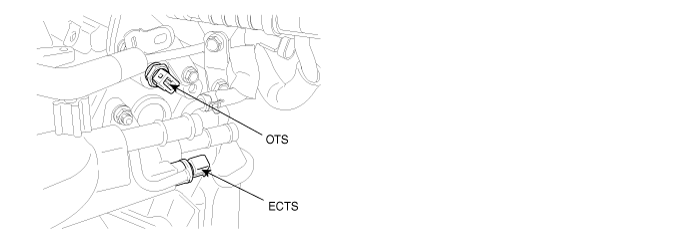
The fluid of the CVVT is
the engine oil and its density changes according to the engine oil
temperature. At this time the Oil Temperature Sensor (OTS) helps
compensation against the temperature differences. The Oil Temperature
Sensor measures the engine oil temperature before the engine oil comes
into the Oil-flow Control Valve (OCV). According to the measured
temperature, the Engine Control Module (PCM) compensates the oil-flow
control valve operation time.
Checking the oil
temperture, coolant temperature and intake air temperature every 25 sec.
under detecting condition, if the difference in temperature at start-up
exceeds threshold value, PCM sets P0196. MIL(Malfunction Indicatin Lamp)
turns on when the malfunction lasts till consecutive 2 driving
cycle.
Item
|
Detecting
Condition
|
Possible Cause
|
DTC Strategy
|
| •
|
Determines if the oil temperature value
is rational, compared to coolant and intake air
temperature. | |
|
Enable Condition
|
Case1
|
| •
|
Engine run time after startup < 30
sec |
| •
|
Soak period required > 300
min | |
Case2
|
| •
|
Minimum engine run time > 800
sec | |
Threshold value
|
Case1
|
| •
|
The difference in temperature between
oil and coolant temperatures at startup. >
35°C(63°F) | |
Case2
|
| •
|
The difference in temperature between
oil temperature and intake air temperature at startup >
35°C(63°F) | |
Diagnosis time
|
| •
|
Continous
(More than 800 sec.)
| |
MIL ON Condition
|
|
Temperature(°C/°F)
|
Resistance(kΩ)
|
-20°C/
-4°F
|
16.52kΩ
|
20°C/
68°F
|
2.45kΩ
|
80°C/
176°F
|
0.29kΩ
|
| 1. |
Check DTC Status
| (1) |
Connect scantool to Data Link
Connector(DLC). |
| (3) |
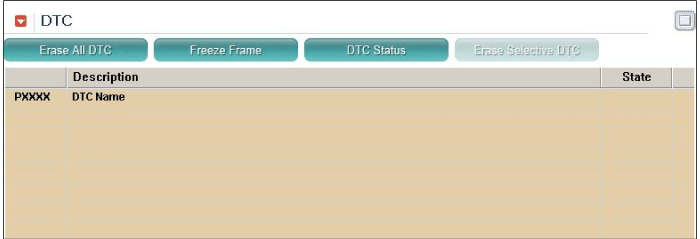
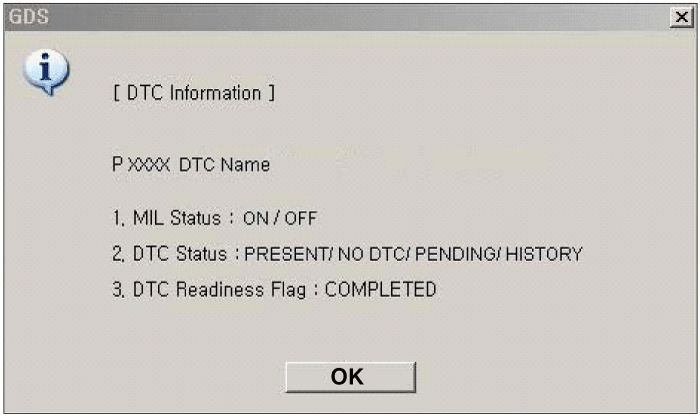
Select "DTC" button, and then Press "DTC
Status" to check DTC’s information from the DTCs
menu |
| (4) |
Read "DTC Status"
parameter.
|
| (5) |
Is parameter displayed "Present
fault"?
|

|
▶ Go
to "Terminal and Connector inspection" procedure.
|
|

|
▶
Fault is intermittent caused by poor contact in the
sensor’s and/or PCM’s connector or was repaired and PCM
memory was not cleared. Thoroughly check connectors for
looseness, poor connection, ending, corrosion,
contamination, deterioration, or damage. Repair or
replace as necessary and go to "Verification of Vehicle
Repair"
procedure.
|
| |
| 2. |
Monitor Oil Temperature parameter on the
scantool |
| 4. |
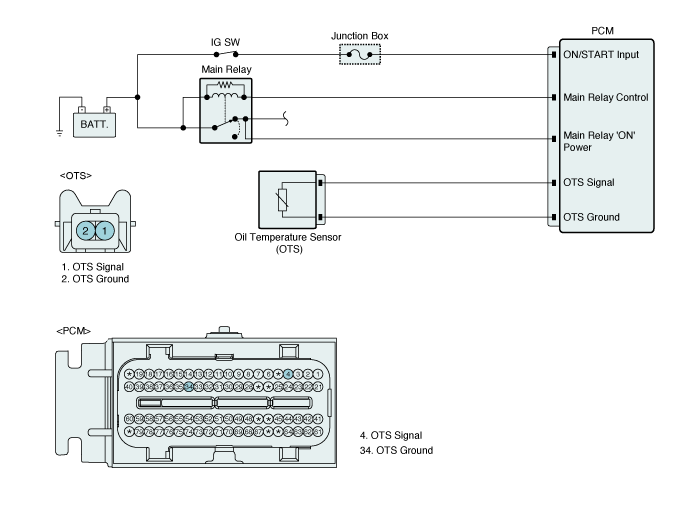
Disconnect OTS
connector. |
| 5. |
Measure resistance between signal and ground
terminals of OTS connector after checking out the oil temperature
with scantool
Specification :
Temperature(°C/°F)
|
Resistance(kΩ)
|
-20°C/
-4°F
|
16.52kΩ
|
20°C/
68°F
|
2.45kΩ
|
80°C/
176°F
|
0.29kΩ
|
|
| 6. |
Is the measured resistance within
specification ?
|
|
▶
Substitute with a known - good PCM and check for proper
operation.
If the problem is
corrected, replace PCM and go to "Verification of Vehicle
Repair" procedure.
|
|
|
▶
Substitute with a known - good OTS and check for proper
operation.
If the problem is
corrected, replace OTS and go to "Verification of Vehicle
Repair"
procedure.
|
|
| Verification of Vehicle
Repair |
After a repair, it is
essential to verify that the fault has been corrected.
| 1. |
Connect scantool and select "DTC"
button. |
| 2. |
Press "DTC Status" button and confirm that
"DTC Readiness Flag" indicates "Completed". If not, drive the
vehicle within conditions noted in the freeze frame data or enable
conditions |
| 3. |
Read "DTC Status"
parameter |
| 4. |
Is parameter displayed "History(Not Present)
fault"?
|
|
▶ System
performing to specification at this time. Clear the
DTC
|
|
|
▶ Go to the
applicable troubleshooting
procedure.
|
|