DESCRIPTION
- ANTILOCK BRAKE SYSTEM WITH TRACTION CONTROL
- ANTILOCK BRAKE SYSTEM (ABS)
- ELECTRONIC VARIABLE BRAKE PROPORTIONING
- ELECTRONIC STABILITY PROGRAM
- BRAKE ASSIST SYSTEM (BAS)
- ELECTRONIC ROLL MITIGATION (ERM)
ANTILOCK BRAKE SYSTEM WITH TRACTION CONTROL
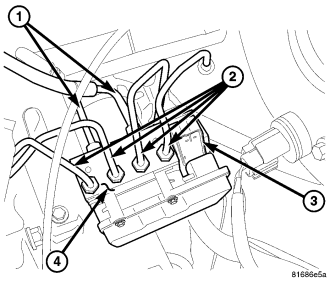
This vehicle uses the Continental Teves MK25e electronic brake control system. The system includes ABS (Anti-lock Brake System), EVBP (Electronic Variable Brake Proportioning), TCS (Traction Control System), BAS (Brake Assist System), ERM (Electronic Roll Mitigation) and ESP (Electronic Stability Program). All six systems work together to enhance vehicle stability and control in various driving conditions and are commonly referred to as ESP. ESP is standard
The electronic brake control system uses the following components to operate:
- Integrated Control Unit (ICU) – The ICU is a combination of the Electronic Brake Controller (EBC) and the Hydraulic Control Unit (HCU) (4)
- Wheel Speed Sensors (WSS) - Four sensors (one at each wheel)
- Dynamics Sensor – The Dynamics Sensor includes a yaw rate sensor, (The Dynamics Sensor is located under the center console near the center of the vehicle).
- lateral accelerometer and, on 4x4 vehicles with a low range transfer case (245 T-Case), a longitudinal accelerometer.
- Steering Angle Sensor (SAS) – The SAS is part of the clock spring assembly in the steering column.
- Brake Pressure Sensor – The brake pressure sensor is located in the HCU and is not serviceable separate from the HCU.
ALL-SPEED TRACTION CONTROL
The TCS is an all-speed traction control system that functions up to the maximum allowed vehicle speed. TCS enhances vehicle stability and mobility by reducing wheel spin when accelerating on slippery surfaces. TCS controls wheel spin by applying the brakes and/or reducing engine power.
ANTILOCK BRAKE SYSTEM (ABS)
The purpose of the antilock brake system (ABS) is to prevent wheel lockup under braking conditions on virtually any type of road surface. Antilock braking is desirable because a vehicle that is stopped without locking the wheels retains directional stability and some steering capability. This allows the driver to retain greater control of the vehicle during braking.ELECTRONIC VARIABLE BRAKE PROPORTIONING
Vehicles equipped with ABS use EVBP to balance front-to-rear braking. The EVBP is used in place of a rear brake proportioning valve. The EVBP system controls the slip of the rear wheels during braking at low to moderate deceleration, up until the point where ABS control is necessary. The brake pressure at the rear wheels is controlled by using the inlet and outlet valves located in the hydraulic control unit (HCU).
EVBP activation should not be perceptible by the customer because there is no pump motor noise and almost no brake pedal feedback.
ELECTRONIC STABILITY PROGRAM
The ESP system enhances directional control and stability of the vehicle under various driving conditions. ESP corrects for over/under steering of the vehicle by applying the brake of the appropriate wheel to assist in counteracting the over/under steer condition. Engine power may also be reduced to help the vehicle maintain the desired path. ESP uses sensors in the vehicle to determine the vehicle path intended by the driver and compares it to the actual path of the vehicle. When the actual path does not match the intended path, ESP applies the brake of the appropriate wheel to assist in counteracting the oversteer or understeer condition
- Oversteer – when the vehicle is turning more than appropriate for the steering wheel position.
- Understeer – when the vehicle is turning less than appropriate for the steering wheel position.
The “ESP/TCS Indicator Light” located in the instrument cluster, starts to flash as soon as the tires lose traction and the ESP system becomes active. The “ESP/TCS Indicator Light” also flashes when TCS is active.
BRAKE ASSIST SYSTEM (BAS)
The BAS is designed to optimize the vehicle’s braking capability during emergency braking maneuvers. The system detects an emergency braking situation by sensing the rate and amount of brake application and then applies optimum pressure to the brakes. This can help reduce braking distances. The BAS complements the antilock brake system (ABS). Applying the brakes very quickly results in the best BAS assistance.ELECTRONIC ROLL MITIGATION (ERM)
This system anticipates the potential for wheel lift by monitoring the driver’s steering wheel input and the speed of the vehicle. When ERM determines that the rate of change of the steering wheel angle and vehicles speed are sufficient to potentially cause wheel lift, it applies the appropriate brake and may reduce engine power to lessen the chance that wheel lift will occur. ERM will only intervene during very severe or evasive driving maneuvers.
ERM can only reduce the chance of wheel lift occurring during severe or evasive driving maneuvers. It can not prevent wheel lift due to other factors such as road conditions, leaving the roadway or striking objects or other vehicles.