CRANKSHAFT POSITION SENSOR
DESCRIPTION
The crankshaft position sensor mounts to the rear of the engine block near the transmission.
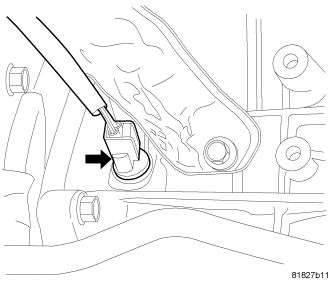
The PCM uses the Crankshaft Position sensor to calculate the following:
- Engine RPM
- TDC number 1 and 4
- Ignition coil synchronization
- Injector synchronization
- Camshaft-to-crankshaft misalignment (Timing belt skipped 1 tooth or more diagnostic trouble code).
OPERATION
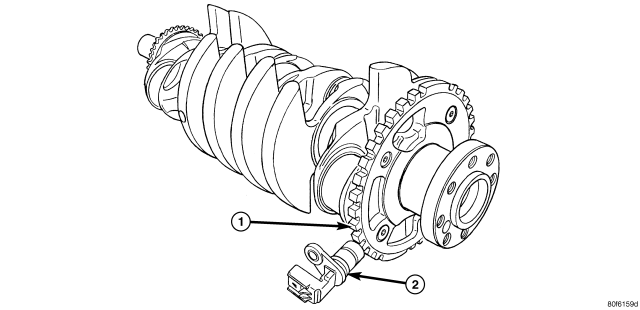
The PCM sends approximately 5 volts to the Hall-effect sensor. This voltage is required to operate the Hall-effect chip and the electronics inside the sensor. A ground for the sensor is provided through the sensor return circuit. The input to the PCM occurs on a 5 volt output reference circuit that operates as follows: The Hall-effect sensor contains a powerful magnet. As the magnetic field passes over the dense portion of the counterweight, the 5-volt signal is pulled to ground (0.3 volts) through a transistor in the sensor. When the magnetic field passes over the notches in the crankshaft counterweight, the magnetic field turns off the transistor in the sensor, causing the PCM to register the 5-volt signal. The PCM identifies crankshaft position by registering the change from 5 to 0 volts, as signaled from the Crankshaft Position sensor (2).
The PCM determines which cylinder to fire from the crankshaft position sensor input and the camshaft position sensor input. The #8 crankshaft counterweight has a target ring with 32 teeth and notches (1), including one long reference tooth and notch. From the crankshaft position sensor input the PCM determines engine speed and crankshaft angle (position).
REMOVAL
The Crankshaft Position Sensor is in the rear of the engine block near the transmission.
If vehicle is All Wheel Drive the Power Transfer Unit must be removed, (Refer to 21 - TRANSMISSION/TRANSAXLE/POWER TRANSFER UNIT - REMOVAL).
1. Disconnect the negative battery cable.
2. Raise vehicle and support.
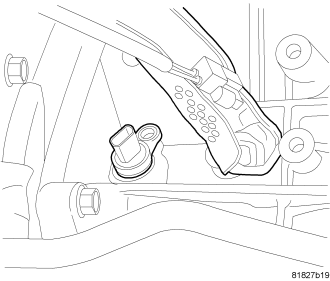
3. Remove heat shield retaining bolt.
4. Remove heat shield.
5. Unlock and disconnect the electrical connector to the crankshaft position sensor.
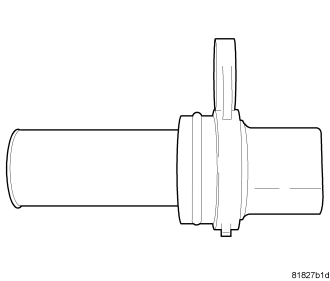
6. Remove the crankshaft position sensor bolt.
7. Remove the sensor.
INSTALLATION
1. Check o-ring for damage and lubricate the o-ring with engine oil before installing sensor .
2. Use a twisting motion when installing the sensor.
3. Install and tighten the crankshaft position sensor bolt and tighten to 9 N·m (79.5 in. lbs.).
4. Connect and lock the electrical connector to the crankshaft position sensor.
5. Install heat shield and retaining bolt.
If vehicle is All Wheel Drive the Power Transfer Unit must be installed, (Refer to 21 - TRANSMISSION/TRANSAXLE/POWER TRANSFER UNIT - INSTALLATION).
6. Lower vehicle.
7. Connect the negative battery cable.