MECHANISM-BRAKE TRANSMISSION SHIFT INTERLOCK
- DESCRIPTION
- OPERATION
- DIAGNOSIS AND TESTING - BRAKE TRANSMISSION SHIFT INTERLOCK
- ADJUSTMENTS - BRAKE TRANSMISSION SHIFT INTERLOCK
DESCRIPTION
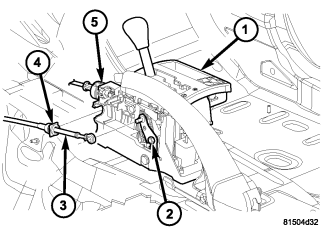
The Brake Transmission Shifter/Ignition Interlock (BTSI) is a cable operated system that prevents the transmission gear shifter from being moved out of PARK without the proper driver inputs. The system also contains a solenoid that is integral to the shifter assembly. The solenoid works in conjunction with the park lock cable (5) to permit shifter movement out of PARK when the brake is depressed.
OPERATION
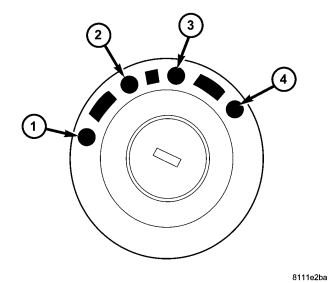
The Brake Transmission Shifter/Ignition Interlock (BTSI) is engaged whenever the ignition switch is in the LOCK (1) position. An additional electrically activated feature will prevent shifting out of the PARK position unless the brake pedal is depressed at least one-half inch. A solenoid in the shifter assembly is de-energized when the ignition is in the ON position and the brake pedal is depressed. When the key is in the ON position and the brake pedal is depressed, the shifter is unlocked and will move into any position. The interlock system also prevents the ignition switch from being turned to the LOCK position, unless the shifter is in the gated PARK position.
The following chart describes the normal operation of the Brake Transmission Shift Interlock (BTSI) system. If the “expected response” differs from the vehicle's response, then system repair and/or adjustment is necessary.| ACTION | EXPECTED RESPONSE |
| 1. Turn key to the "ACC" position and depress
brake pedal. | 1. Shifter CAN be shifted out of park. |
| 2. Turn key to the "ON" position,
with foot off of brake pedal. | 2. Shifter CANNOT be shifted out of park. |
| 3. Turn key to
the "ON" position and depress the brake pedal. | 3. Shifter CAN be shifted out of park. |
| 4. Leave shifter in any gear, except "PARK", and try to return key to the "LOCK" position. | 4. Key cannot be returned to the "LOCK" position. |
| 5. Return shifter to "PARK" and try to remove the key. | 5. Key can be removed (after returning to "LOCK"
position). |
| 6. With the key removed, and the brake depressed, try to shift out of "PARK". | 6. Shifter cannot be shifted out of "PARK". |
| NOTE: Any failure to meet these expected responses requires
system adjustment or repair. | |
DIAGNOSIS AND TESTING - BRAKE TRANSMISSION SHIFT INTERLOCK
SYSTEM VERIFICATION
1. Verify that the key can only be removed in the PARK position
2. When the shift lever is in PARK, the ignition key cylinder should rotate freely from ACC to LOCK. When the shifter is in any other gear or neutral position, the ignition key cylinder should not rotate to the LOCK position.
3. Shifting out of PARK should not be possible when the ignition key cylinder is in the ACC position and the brake pedal is not depressed.
4. Shifting out of PARK should not be possible while applying normal force on the shift lever and ignition key cylinder is in the ACC, ON, or START positions unless the foot brake pedal is depressed approximately 1/2 inch (12mm).
5. Shifting out of PARK should not be possible when the ignition key cylinder is in the LOCK position, regardless of the brake pedal position.
6. Shifting between any gears, NEUTRAL or into PARK may be done without depressing foot brake pedal with ignition switch in ACC, ON, or START positions.
| CONDITION | POSSIBLE CAUSE | CORRECTION |
| KEY WILL NOT ROTATE TO THE LOCK POSITION. | 1. Misadjusted Park Lock cable. | 1. Adjust Park Lock cable.
(Refer to 21 - TRANSMISSION AND TRANSFER CASE/AUTOMATIC TRANSMISSION/BRAKE
TRANSMISSION SHIFT INTERLOCK SYSTEM - ADJUSTMENTS) |
| 2. Misadjusted gearshift cable. | 2. Adjust gearshift cable.
(Refer to 21 - TRANSMISSION AND TRANSFER CASE/AUTOMATIC TRANSMISSION/GEAR SHIFT CABLE - ADJUSTMENTS) | |
| 3. Burrs on ignition key. | 3. Remove burrs and cycle key several times to verify operation. | |
| 4. Binding or broken components. | 4. Inspect system components and repair/replace components as necessary. | |
| VEHICLE WILL NOT START UNLESS SHIFTER IS HELD FORWARD, OR REARWARD, OF THE PARK POSITION. | 1. Misadjusted gearshift cable. | 1. Adjsut gearshift cable.
(Refer to 21 - TRANSMISSION
AND TRANSFER CASE/AUTOMATIC TRANSMISSION/GEAR SHIFT CABLE - ADJUSTMENTS) |
ADJUSTMENTS - BRAKE TRANSMISSION SHIFT INTERLOCK
The park interlock cable is part of the brake/shift lever interlock system. Correct cable adjustment is important to proper interlock operation. The gear shift and park lock cables must both be correctly adjusted in order to shift out of PARK.
ADJUSTMENT PROCEDURE
1. Remove floor console as necessary for access to the park lock cable. (Refer to 23 - BODY/INTERIOR/FLOOR CONSOLE - REMOVAL)
2. Shift the transmission into the PARK position.
3. Turn ignition switch to LOCK position. Be sure ignition key cylinder is in the LOCK position. Cable will not adjust correctly in any other position.
NOTE: If the key will not turn to the LOCK position, pull up on the cable lock button and manually move the cable in and out until the key can be turned to the LOCK position.
4. Pull cable lock button up to release cable, if necessary.
5. Ensure that the cable is free to self-adjust by pushing cable rearward and releasing.
6. Push lock button down until it snaps in place. The lock should be flush to the surface of the cylindrical portion of the cable adjustment housing.
BTSI FUNCTION CHECK
1. Verify removal of ignition key allowed in PARK position only.
2. When the shift lever is in PARK, the ignition key cylinder should rotate freely LOCK position. When the shifter is in any other position, the ignition key should not rotate to the LOCK position.
3. Shifting out of PARK should not be possible when the ignition key cylinder is in the ACC position and the brake pedal is not depressed.
4. Shifting out of PARK should not be possible while applying normal force on the shift lever and ignition key cylinder is in the ACC, ON, or START positions unless the foot brake pedal is depressed approximately 1/2 inch (12mm).
5. Shifting out of PARK should not be possible when the ignition key cylinder is in the LOCK position, regardless of the brake pedal position.
6. Shifting between any gears, NEUTRAL or into PARK may be done without depressing foot brake pedal with ignition switch in ACC, ON, or START positions.
7. The floor shifter lever and gate positions should be in alignment with all transmission detent positions.
8. Engine starts must be possible with shifter lever in PARK or NEUTRAL gate positions only. Engine starts must not be possible in any other gate positions other than PARK or NEUTRAL.
9. With the shifter lever handle in the:
- PARK position- apply forward force on center of handle and remove pressure. Engine start must be possible.
- PARK position- apply rearward force on center of handle and remove pressure. Engine start must be possible.
- NEUTRAL position- engine start must be possible.
- NEUTRAL position, engine running and brakes applied- Apply forward force on center of shift handle. Transmission should not be able to shift into REVERSE detent.