BATTERY CABLES
DESCRIPTION
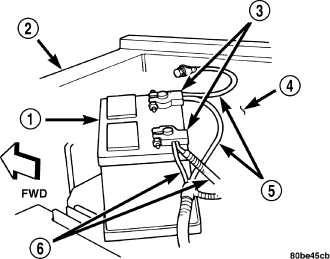
The battery cables (5) and (6) are large gauge, stranded copper wires sheathed within a heavy plastic or synthetic rubber insulating jacket. The wire used in the battery cables combines excellent flexibility and reliability with high electrical current carrying capacity. The battery cables feature a clamping type female battery terminal (3) made of soft lead that is die cast onto one end of the battery cable wire. A square headed pinch-bolt and hex nut are installed at the open end of the female battery terminal clamp. Large eyelet type terminals are crimped onto the opposite end of the battery cable wire and then solder-dipped. The battery positive cable wires have a red insulating jacket to provide visual identification and feature a larger female battery terminal clamp to allow connection to the larger battery positive terminal post. The battery negative cable wires have a black insulating jacket and a smaller female battery terminal clamp.
The battery cables cannot be repaired and, if damaged or faulty they must be replaced. Both the battery positive and negative cables are available for service replacement only as a unit with the battery wire harness, which may include portions of the wiring circuits for the generator and other components on some models. Refer to the appropriate wiring information in this service manual for the location of the proper battery cable wire harness diagrams. The wiring information also includes proper wire and connector repair procedures, further details on wire harness routing and retention, as well as pin-out and location views for the various wire harness connectors, splices and grounds.
OPERATION
The battery cables connect the battery terminal posts to the vehicle electrical system. These cables also provide a path back to the battery for electrical current generated by the charging system for restoring the voltage potential of the battery. The female battery terminal clamps on the ends of the battery cable wires provide a strong and reliable connection of the battery cable to the battery terminal posts. The terminal pinch bolts allow the female terminal clamps to be tightened around the male terminal posts on the top of the battery. The eyelet terminals secured to the opposite ends of the battery cable wires from the female battery terminal clamps provide secure and reliable connection of the battery cables to the vehicle electrical system.
The battery positive cable terminal clamp is die cast onto the ends of two wires. One wire has an eyelet terminal that connects the battery positive cable to the B(+) terminal studs of the Power Distribution Center (PDC), and the other wire has an eyelet terminal that connects the battery positive cable to the B(+) terminal stud of the engine starter motor solenoid. The battery negative cable terminal clamp is also die cast onto the ends of two wires. One wire has an eyelet terminal that connects the battery negative cable to the vehicle powertrain through a stud on the left side of the engine cylinder block. The other wire has an eyelet terminal that connects the battery negative cable to the vehicle body through a ground stud on the left wheel house, near the battery.
REMOVAL
The battery cables on this model may include portions of wiring circuits for the generator and other components on the vehicle. If battery cable replacement is required, it will be necessary to extract the cables out of the engine wire harness assembly. Use care not to damage the other wires and circuits which are also packaged into the engine wire harness assembly.
1. Turn the ignition switch to the Off position. Be certain that all electrical accessories are turned off.
2. Disconnect and isolate the negative battery cable terminal.
3. Remove the tape from the engine wire harness assembly, to access the desired battery cable.
4. One at a time, trace and disconnect the battery cable retaining fasteners and routing clips until the desired cable is free from the vehicle.
5. Feed the battery cable out of the vehicle.
INSTALLATION
1. Position the battery cable in the vehicle.
2. One at a time, trace and install the battery cable retaining fasteners and routing clips until the desired cable is properly installed in the engine wire harness assembly.
3. Install the tape on the engine wire harness assembly.
4. Connect the negative battery cable terminal.