BATTERY SYSTEM
DESCRIPTION
A single 12-volt battery is standard factory-installed equipment on this model. All of the components of the battery system are located within the engine compartment of the vehicle. The battery system for this vehicle covers the following related components, which are covered in further detail later in this section of the service manual:
- Battery - The storage battery provides a reliable means of storing a renewable source of electrical energy within the vehicle.
- Battery Cables - The battery cables connect the battery terminal posts to the vehicle electrical system.
- Battery Holddown - The battery holddown hardware secures the battery in the battery tray in the engine compartment.
- Battery Tray - The battery tray provides a secure mounting location in the vehicle for the battery and an anchor point for the battery holddown hardware.
For battery system maintenance schedules and jump starting procedure, see the owner's manual in the vehicle glove box. Optionally, refer to the Lubrication and Maintenance section of this manual for the recommended battery maintenance schedules and for the proper battery jump starting procedure. While battery charging can be considered a maintenance procedure, the battery charging procedure and related information are located later in this section of the service manual. This was done because the battery must be fully-charged before any battery system diagnosis or testing procedures can be performed.
OPERATION
The battery system is designed to provide a safe, efficient, reliable and mobile means of delivering and storing electrical energy. This electrical energy is required to operate the engine starting system, as well as to operate many of the other vehicle accessory systems for limited durations while the engine and/or the charging system are not operating. The battery system is also designed to provide a reserve of electrical energy to supplement the charging system for short durations while the engine is running and the electrical current demands of the vehicle exceed the output of the charging system. In addition to delivering, and storing electrical energy for the vehicle, the battery system serves as a capacitor and voltage stabilizer for the vehicle electrical system. It absorbs most abnormal or transient voltages caused by the switching of any of the electrical components or circuits in the vehicle.
CLEANING
The following information details the recommended cleaning procedures for the battery and related components. In addition to the maintenance schedules found in this service manual and the owner's manual, it is recommended that these procedures be performed any time the battery or related components must be removed for vehicle service.
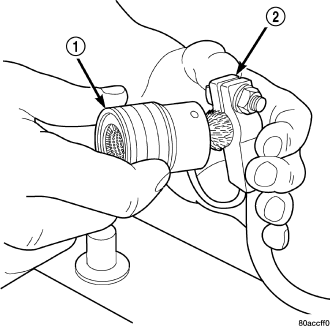
1. Clean the battery cable terminal clamps (2) of all corrosion. Remove any corrosion using a wire brush or a post and terminal cleaning tool (1), and a sodium bicarbonate (baking soda) and warm water cleaning solution.
2. Clean the battery tray and battery hold down hardware of all corrosion. Remove any corrosion using a wire brush and a sodium bicarbonate (baking soda) and warm water cleaning solution. Paint any exposed bare metal.
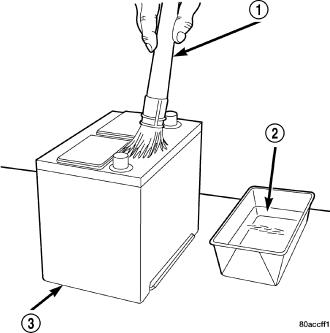
3. If the removed battery is to be reinstalled, clean the outside of the battery (3) case and the top cover with a sodium bicarbonate (baking soda) and warm water cleaning solution (2) using a stiff bristle parts cleaning brush (1) to remove any acid film. Rinse the battery with clean water. Ensure that the cleaning solution does not enter the battery cells through the vent holes. If the battery is being replaced, refer to Battery System Specifications for the factory-installed battery specifications. Confirm that the replacement battery is the correct size and has the correct ratings for the vehicle.
4. If the vehicle is so equipped, clean the battery thermal guard with a sodium bicarbonate (baking soda) and warm water cleaning solution using a stiff bristle parts cleaning brush to remove any acid film.
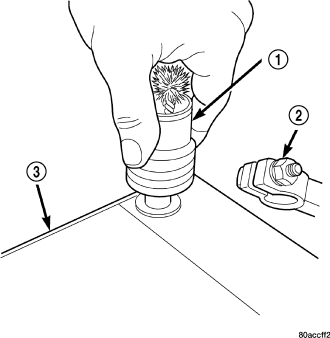
5. Clean any corrosion from the battery terminal posts with a wire brush or a post and terminal cleaner (1) , and a sodium bicarbonate (baking soda) and warm water cleaning solution.
INSPECTION
The following information details the recommended inspection procedures for the battery and related components. In addition to the maintenance schedules found in this service manual and the Owner's Manual, it is recommended that these procedures be performed any time the battery or related components must be removed for vehicle service.
1. Inspect the battery cable terminal clamps for damage. Replace any battery cable that has a damaged or deformed terminal clamp.
2. Inspect the battery tray and battery holddown hardware for damage. Replace any damaged parts.
3. Slide the thermal guard off of the battery case. Inspect the battery case for cracks or other damage that could result in electrolyte leaks. Also, check the battery terminal posts for looseness. Batteries with damaged cases or loose terminal posts must be replaced.
4. Inspect the battery thermal guard for tears, cracks, deformation or other damage. Replace any battery thermal guard that has been damaged.
5. Inspect the battery built-in test indicator sight glass for an indication of the battery condition. If the battery is discharged, charge as required. Refer to Standard Procedures for the proper battery built-in indicator test procedures. Also refer to Standard Procedures for the proper battery charging procedures.