P0089-FUEL PRESSURE 1 CONTROL PERFORMANCE
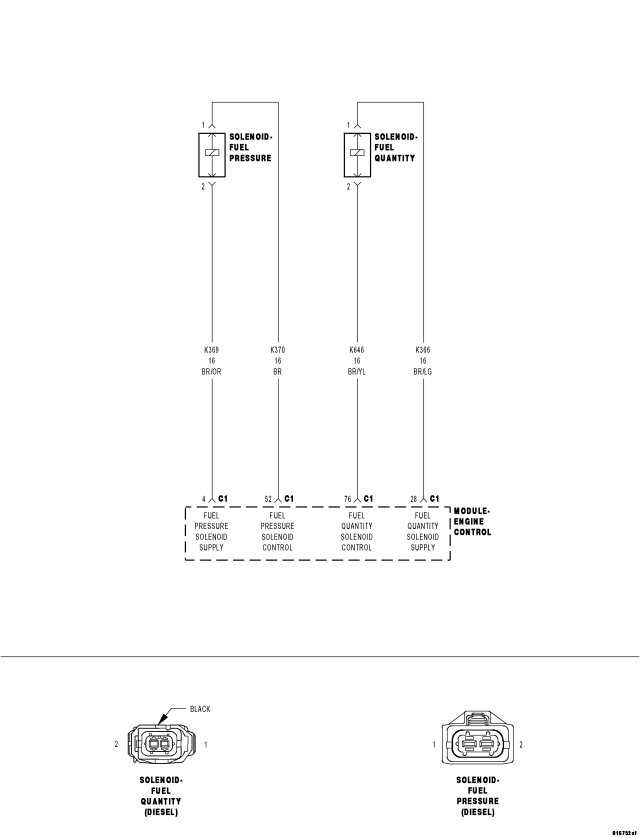
For a complete wiring diagram Refer to Section 8W
- When Monitored:
With the ignition on and the Fuel Pressure Solenoid command on.
- Set Condition:
The Engine Control Module (ECM) detects that the (K370) Fuel Pressure Solenoid Control circuit voltage is implausible for 0.28 seconds.
| Possible Causes |
| (K369) FUEL PRESSURE SOLENOID SUPPLY CIRCUIT OPEN OR HIGH RESISTANCE |
| (K370) FUEL PRESSURE SOLENOID CONTROL CIRCUIT SHORTED TO VOLTAGE |
| (K370) FUEL PRESSURE SOLENOID CONTROL CIRCUIT SHORTED TO GROUND |
| (K370) FUEL PRESSURE SOLENOID CONTROL CIRCUIT OPEN OR HIGH RESISTANCE |
| FUEL PRESSURE SOLENOID |
| ENGINE CONTROL MODULE (ECM) |
Always perform the Pre-Diagnostic Troubleshooting procedure before proceeding. (Refer to 9 - ENGINE - DIAGNOSIS AND TESTING)
Diagnostic Test
1. DTC IS ACTIVEIgnition on, engine not running.
With the scan tool, Clear DTCs in the Engine Control Module (ECM).
With the scan tool, actuate the Fuel Pressure Solenoid.
Monitor the scan tool for at least two minutes.
With the scan tool, select View DTCs.
Is the status Active for this DTC?
Yes
- Go To 2
No
- Refer to the *CHECKING FOR AN INTERMITTENT DTC Diagnostic Procedure. (Refer to 9 - ENGINE - DIAGNOSIS AND TESTING)
2. (K369) FUEL PRESSURE SOLENOID SUPPLY CIRCUIT OPEN OR HIGH RESISTANCE
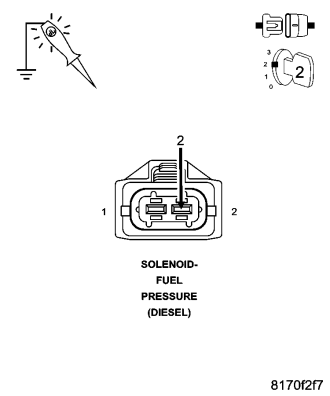
Turn the ignition off.
Disconnect the Fuel Pressure Solenoid connector.
Turn the ignition on.
With the scan tool, actuate the Fuel Pressure Solenoid.
Using a 12 volt test light connected to ground, check the (K369) Fuel Pressure Solenoid Supply circuit in the Fuel Pressure Solenoid harness connector.
NOTE: The test light should be illuminated and bright. Compare the brightness to that of a direct connection to the battery.
Is the test light illuminated and bright?
Yes
- Go to 3
No
- Repair the (K369) Fuel Pressure Solenoid Supply circuit for an open circuit or high resistance.
- Perform the ECM Verification Test Ver. 1 (Refer to 9 - ENGINE - DIAGNOSIS AND TESTING).
3. (K370) FUEL PRESSURE SOLENOID CONTROL CIRCUIT SHORTED TO VOLTAGE
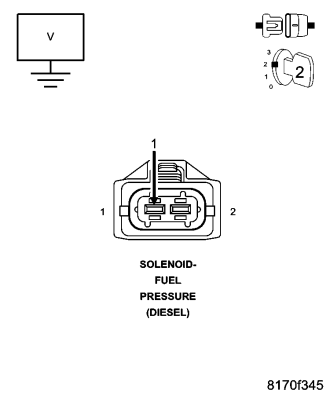
Turn the ignition off.
Disconnect the Engine Control Module (ECM) connector.
Remove the ASD Relay.
Connect a jumper wire between cavity 30 and cavity 87 of the ASD Relay Connector.
Turn the ignition on.
Measure the voltage of the (K370) Fuel Pressure Solenoid Control circuit in the Fuel Pressure Solenoid harness connector.
Is there any voltage present?
Yes
- Repair the (K370) Fuel Pressure Solenoid Control circuit for a short to voltage.
- Perform the ECM Verification Test Ver. 1 (Refer to 9 - ENGINE - DIAGNOSIS AND TESTING).
No
- Go to 4
4. (K370) FUEL PRESSURE SOLENOID CONTROL CIRCUIT SHORTED TO GROUND
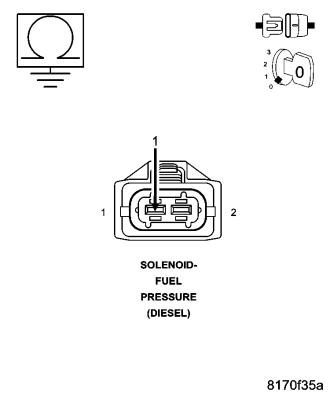
Turn the ignition off.
Measure the resistance between ground and the (K370) Fuel Pressure Solenoid Control circuit in the Fuel Pressure Solenoid harness connector.
Is the resistance below 1000 ohms?
Yes
- Repair the (K370) Fuel Pressure Solenoid Control circuit for a short to ground.
- Perform the ECM Verification Test Ver. 1 (Refer to 9 - ENGINE - DIAGNOSIS AND TESTING).
No
- Go to 5
5. (K370) FUEL PRESSURE SOLENOID CONTROL CIRCUIT OPEN OR HIGH RESISTANCE
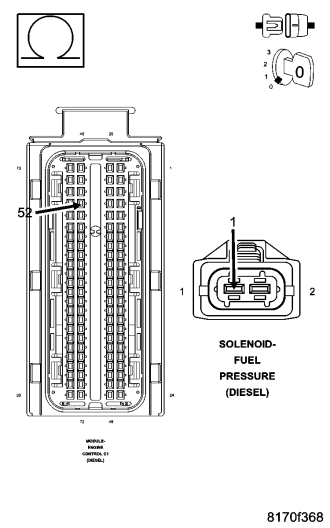
Measure the resistance of the (K370) Fuel Pressure Solenoid Control circuit between the Fuel Pressure Solenoid harness connector and the Engine Control Module (ECM) harness connector.
Is the resistance below 10.0 ohms?
Yes
- Go to 6
No
- Repair the (K370) Fuel Pressure Solenoid Control circuit for an open circuit or high resistance.
- Perform the ECM Verification Test Ver. 1 (Refer to 9 - ENGINE - DIAGNOSIS AND TESTING).
6. FUEL PRESSURE SOLENOID
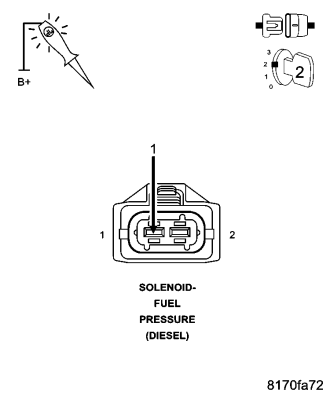
Connect the Engine Control Module (ECM) connector.
Remove the jumper wire and install the ASD Relay.
Turn the ignition on.
With the scan tool, actuate the Fuel Pressure Solenoid to 100%.
Using a 12 volt test light connected to 12 volts, check the (K370) Fuel Pressure Solenoid Control circuit in the Fuel Pressure Solenoid harness connector.
NOTE: The test light should be illuminated and bright. Compare the brightness to that of a direct connection to the battery.
NOTE: The circuit will remain actuated by the controller for 30 seconds. Be certain the actuation is active when checking the circuit.
With the scan tool, actuate the Fuel Pressure Solenoid to 0%.
Using a 12 volt test light connected to 12 volts, check the (K370) Fuel Pressure Solenoid Control circuit in the Fuel Pressure Solenoid harness connector.
NOTE: The test light should not be illuminated.
NOTE: The circuit will remain actuated by the controller for 30 seconds. Be certain the actuation is active when checking the circuit.
Is the test light illuminated and bright with the actuation at 100% and not illuminated with the actuation at 0%?
Yes
- Replace the Fuel Pressure Solenoid in accordance with the Service Information.
- Perform the ECM Verification Test Ver. 1 (Refer to 9 - ENGINE - DIAGNOSIS AND TESTING).
No
- Go to 7
7. ENGINE CONTROL MODULE (ECM)
Using the wiring diagram/schematic as a guide, inspect the wiring and connectors between the Fuel Pressure Solenoid and the Engine Control Module (ECM).
Look for any chafed, pierced, pinched, or partially broken wires.
Look for broken, bent, pushed out or corroded terminals.
Refer to any Technical Service Bulletins that may apply.
Were any problems found?
Yes
- Repair as necessary.
- Perform the ECM Verification Test Ver. 1 (Refer to 9 - ENGINE - DIAGNOSIS AND TESTING).
No
- Replace the Engine Control Module (ECM) in accordance with the Service Information.
- Perform the ECM Verification Test Ver. 1 (Refer to 9 - ENGINE - DIAGNOSIS AND TESTING).