OCCUPANT CLASSIFICATION MODULE
DESCRIPTION
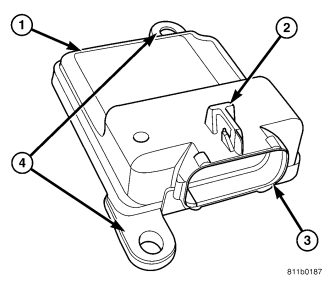
The Occupant Classification Module (OCM) (1) is secured with two screws to a stamped steel mounting bracket welded onto the underside of the passenger side front seat cushion frame near the inboard front corner. Concealed within a hollow in the center of the molded plastic OCM housing is a microprocessor and the other electronic circuitry of the module. The module housing is sealed to enclose and protect the internal electronic circuitry.
Two mounting tabs (4), a connector lock tower (2), and a connector receptacle (3) are integral to the OCM housing. The connector receptacle contains terminal pins that connect the OCM to the vehicle electrical system through a dedicated take out and connector of the passenger side front seat wire harness. A molded plastic lock pin is integral to one end of a long tether, while the other end of the tether is secured to the seat wire harness. After the wire harness has been connected to the module, the lock pin is engaged through the lock tower on the module housing preventing the connector latches from becoming disengaged and ensuring that a secure electrical connection is maintained at all times.
A non-calibrated OCM is the only component of the Occupant Classification System (OCS) that is available for separate service replacement. The OCS components of the passenger side front seat cushion including the cushion frame, springs, insulator pad, seat weight bladder and pressure sensor, seat cushion foam, wiring harness and the OCM are a factory-calibrated and assembled unit. Once this unit is connected to a vehicle electrically, the calibration settings are uploaded from the calibrated OCM and stored in the memory of the Airbag Control Module (ACM) (also known as the Occupant Restraint Controller/ORC). If only the OCM is subsequently replaced, the new, non-calibrated OCM learns the proper calibration settings from the ACM after it is connected to the vehicle electrically.
The OCM cannot be adjusted or repaired and, if damaged or ineffective, it must be replaced. The OCM software is flash programmable. The components of the passenger side front seat cushion including the cushion frame, springs, insulator pad, seat weight bladder and pressure sensor, seat cushion foam, wire harness and the OCM are serviced only as a factory-calibrated, assembled and tamper-evident unit. Only the OCM and the seat cushion trim are available for separate service replacement. Once a service replacement package has been installed in a vehicle, the OCM can thereafter be serviced only by replacing the entire passenger side front seat cushion unit with another complete service replacement package.
OPERATION
The microprocessor in the Occupant Classification Module (OCM) contains the Occupant Classification System (OCS) logic circuits. The OCM uses On-Board Diagnostics (OBD) and can communicate with other electronic modules in the vehicle as well as with the diagnostic scan tool using the Programmable Communications Interface (PCI) data bus. This method of communication is also used for OCS diagnosis and testing through the 16-way data link connector located on the driver side lower edge of the instrument panel.
The OCM provides a nominal five volts to both the pressure sensor of the seat weight bladder beneath the passenger side front seat cushion and to the belt tension sensor on the passenger side front seat belt lower anchor through dedicated hard wired sensor voltage and sensor ground circuits. The OCM then monitors the return voltage from each of the sensors on dedicated hard wired data communication circuits. The bladder pressure sensor input allows the OCM to determine whether the passenger side front seat is occupied and the relative size of the occupant by providing a weight-sensing reference to the load on the seat cushion. The belt tension sensor provides an additional logic input to the OCM microprocessor that allows it to distinguish between the lower seat belt cinch loads of a belted occupant and the higher loads associated with a belted child seat.
Pre-programmed decision algorithms and OCS calibration allow the OCM microprocessor to determine when passenger airbag protection is appropriate based upon the seat cushion load as signaled by the bladder pressure sensor and the seat belt cinch load as signaled by the belt tension sensor. When the programmed conditions are met, the OCM sends the proper electronic occupant classification messages over the PCI data bus to the Airbag Control Module (ACM) (also known as the Occupant Restraint Controller/ORC), and the ACM enables or disables the deployment circuits for the passenger front supplemental restraints. The ACM also provides a control output for the passenger airbag on/off indicator in the instrument panel grab handle based upon the electronic occupant classification messages it receives from the OCM.
The OCM microprocessor continuously monitors all of the OCS electrical circuits and components to determine the system readiness. If the OCM detects a monitored system fault, it sets an active and stored Diagnostic Trouble Code (DTC) and sends the appropriate electronic messages to the ACM over the PCI data bus. Then the ACM sets a DTC and sends messages to control the airbag indicator operation accordingly. An active fault only remains for the duration of the fault, or in some cases for the duration of the current ignition switch cycle, while a stored fault causes a DTC to be stored in memory by the OCM and the ACM. For some DTCs, if a fault does not recur for a number of ignition cycles, the OCM will automatically erase the stored DTC. For other internal faults, the stored DTC is latched forever.
The OCM receives battery current on a fused ignition switch output (run-start) circuit through a fuse in the Junction Block (JB). The OCM receives ground through a ground circuit and take out of the body wire harness, which it shares with the ACM. This take out has a single eyelet terminal connector that is secured by a ground screw to the top of the right front seat riser on the floor panel beneath the right front seat. These connections allow the OCM to be operational whenever the ignition switch is in the ON or START positions.
The hard wired inputs and outputs for the OCM may be diagnosed using conventional diagnostic tools and procedures. Refer to the appropriate wiring information. However, conventional diagnostic methods will not prove conclusive in the diagnosis of the OCM or the electronic controls and communication between other modules and devices that provide features of the OCS. The most reliable, efficient, and accurate means to diagnose the OCM or the electronic controls and communication related to OCM operation requires the use of a diagnostic scan tool. Refer to the appropriate diagnostic information.
REMOVAL
A non-calibrated Occupant Classification Module (OCM) is the only component of the Occupant Classification System (OCS) that is available for separate service replacement, as outlined in the procedures that follow. The OCS components of the passenger side front seat cushion including the cushion frame, springs, pad, seat weight bladder and pressure sensor, seat cushion foam and the OCM are a factory-calibrated and assembled unit. Once this unit is connected to a vehicle electrically, the calibration settings are uploaded from the OCM and stored in the memory of the Airbag Control Module (ACM) (also known as the Occupant Restraint Controller/ORC). If only the OCM is subsequently replaced, the new, non-calibrated OCM learns the proper calibration settings from the ACM after it is connected to the vehicle electrically.
If any of the remaining OCS components of the passenger side front seat cushion require replacement, they are serviced only as a factory-calibrated, assembled, and tamper-evident service replacement package. This package includes the assembled frame, springs, pad, seat weight bladder and pressure sensor, foam, wiring and a calibrated OCM. When installing this package, always replace all of the existing components with the new components as a unit. Do not attempt to separate or disconnect any of the new OCS components contained in the service replacement package from each other, and do not attempt to reuse any of the replaced components in this or any other vehicle.
Once any of the original factory-installed components except the OCM have been replaced with the service replacement package components, the OCM can only be serviced by replacing the entire passenger side front seat cushion unit with another complete service replacement package. Any time any one of these components is removed or replaced for any reason, the OCM must be re-calibrated using a diagnostic scan tool, the Occupant Classification Seat Weight special tool, and the Occupant Classification System Verification Test. Refer to the appropriate diagnostic procedures.
WARNING: To avoid personal injury or death, on vehicles equipped with airbags, disable the supplemental restraint system before attempting any steering wheel, steering column, airbag, occupant classification system, seat belt tensioner, impact sensor, or instrument panel component diagnosis or service. Disconnect and isolate the battery negative (ground) cable, then wait two minutes for the system capacitor to discharge before performing further diagnosis or service. This is the only sure way to disable the supplemental restraint system. Failure to take the proper precautions could result in accidental airbag deployment.
WARNING: To avoid personal injury or death on vehicles equipped with the Occupant Classification System (OCS), only the Occupant Classification Module (OCM) and the seat cushion trim may be serviced separately. All other components of the passenger side front seat cushion assembly must be serviced only as a complete factory-calibrated, assembled and tamper-evident service replacement package. This package includes the frame, springs, pad, bladder and pressure sensor, foam, wiring and a calibrated OCM. When installing this package always replace all of the existing components with the new components as a unit. Do not attempt to separate or disconnect any of the new OCS components in the service replacement package from each other, and do not attempt to reuse any of the replaced components in this or any other vehicle. Failure to take the proper precautions could result in failure of the passenger airbag to deploy when required, or in passenger airbag deployment when not required.
CAUTION: On vehicles equipped with the Occupant Classification System (OCS), never replace both the Airbag Control Module (ACM) (also known as the Occupant Restraint Controller/ORC) and the Occupant Classification Module (OCM) at the same time. If both require replacement, replace the OCM first. Then perform the supplemental restraint verification test including an ignition-On time of at least one minute before replacing the ACM. Both the ACM and the OCM store OCS calibration data, which they transfer to one another during the first minute of ignition-On time after one of them is replaced. If both modules are replaced at the same time, an irreversible fault will be set in both modules. If the data transfer is not allowed sufficient time to complete between modules (at least one minute of ignition-On), an irreversible fault will be set in the module requiring the data.
1. Disconnect and isolate the battery negative cable. Wait two minutes for the system capacitor to discharge before further service.
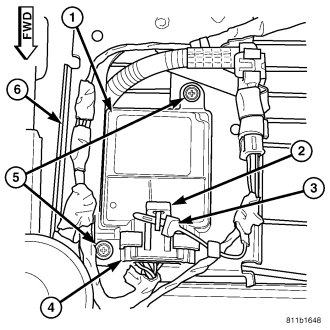
2. Reach under the front edge of the passenger side front seat cushion to access and remove the lock pin (3) from the connector lock tower (2) on the Occupant Classification Module (OCM) (1).
3. Disconnect the passenger side front seat wire harness connector (4) for the OCM from the OCM connector receptacle located on the forward facing side of the module.
4. Remove the two screws (5) that secure the OCM to the OCM bracket (6) that is welded onto the underside of the passenger side front seat cushion frame.
5. Remove the OCM from under the passenger side front seat.
INSTALLATION
A non-calibrated Occupant Classification Module (OCM) is the only component of the Occupant Classification System (OCS) that is available for separate service replacement, as outlined in the procedures that follow. The OCS components of the passenger side front seat cushion including the cushion frame, springs, pad, seat weight bladder and pressure sensor, seat cushion foam and the OCM are a factory-calibrated and assembled unit. Once this unit is connected to a vehicle electrically, the calibration settings are uploaded from the OCM and stored in the memory of the Airbag Control Module (ACM) (also known as the Occupant Restraint Controller/ORC). If only the OCM is subsequently replaced, the new, non-calibrated OCM learns the proper calibration settings from the ACM after it is connected to the vehicle electrically.
If any of the remaining OCS components of the passenger side front seat cushion require replacement, they are serviced only as a factory-calibrated, assembled, and tamper-evident service replacement package. This package includes the assembled frame, springs, pad, seat weight bladder and pressure sensor, foam, wiring and a calibrated OCM. When installing this package, always replace all of the existing components with the new components as a unit. Do not attempt to separate or disconnect any of the new OCS components contained in the service replacement package from each other, and do not attempt to reuse any of the replaced components in this or any other vehicle.
Once any of the original factory-installed components except the OCM have been replaced with the service replacement package components, the OCM can only be serviced by replacing the entire passenger side front seat cushion unit with another complete service replacement package. Any time any one of these components is removed or replaced for any reason, the OCM must be re-calibrated using a diagnostic scan tool, the Occupant Classification Seat Weight special tool, and the Occupant Classification System Verification Test. Refer to the appropriate diagnostic procedures.
WARNING: To avoid personal injury or death, on vehicles equipped with airbags, disable the supplemental restraint system before attempting any steering wheel, steering column, airbag, occupant classification system, seat belt tensioner, impact sensor, or instrument panel component diagnosis or service. Disconnect and isolate the battery negative (ground) cable, then wait two minutes for the system capacitor to discharge before performing further diagnosis or service. This is the only sure way to disable the supplemental restraint system. Failure to take the proper precautions could result in accidental airbag deployment.
WARNING: To avoid personal injury or death on vehicles equipped with the Occupant Classification System (OCS), only the Occupant Classification Module (OCM) and the seat cushion trim may be serviced separately. All other components of the passenger side front seat cushion assembly must be serviced only as a complete factory-calibrated, assembled and tamper-evident service replacement package. This package includes the frame, springs, pad, bladder and pressure sensor, foam, wiring and a calibrated OCM. When installing this package always replace all of the existing components with the new components as a unit. Do not attempt to separate or disconnect any of the new OCS components in the service replacement package from each other, and do not attempt to reuse any of the replaced components in this or any other vehicle. Failure to take the proper precautions could result in failure of the passenger airbag to deploy when required, or in passenger airbag deployment when not required.
CAUTION: On vehicles equipped with the Occupant Classification System (OCS), never replace both the Airbag Control Module (ACM) (also known as the Occupant Restraint Controller/ORC) and the Occupant Classification Module (OCM) at the same time. If both require replacement, replace the OCM first. Then perform the supplemental restraint verification test including an ignition-On time of at least one minute before replacing the ACM. Both the ACM and the OCM store OCS calibration data, which they transfer to one another during the first minute of ignition-On time after one of them is replaced. If both modules are replaced at the same time, an irreversible fault will be set in both modules. If the data transfer is not allowed sufficient time to complete between modules (at least one minute of ignition-On), an irreversible fault will be set in the module requiring the data.
1. Carefully position the Occupant Classification Module (OCM) (1) to the OCM bracket (6) that is welded onto the underside of the passenger side front seat cushion frame. When the OCM is correctly positioned, the connector receptacle on the module will be pointed forward in the vehicle.
2. Install and tighten the two screws (5) that secure the OCM to the OCM bracket that is welded onto the underside of the passenger side front seat cushion frame. Tighten the screws to 2 N·m (20 in. lbs.).
3. Reconnect the passenger side front seat wire harness connector (4) for the OCM to the OCM connector receptacle located on the forward facing side of the module. Be certain that the latches on the connector are each fully engaged.
4. Reinstall the lock pin (3) into the connector lock tower (2) on the OCM.
5. Do not reconnect the battery negative cable at this time. The supplemental restraint system verification test procedure should be performed following service of any supplemental restraint system component. (Refer to 8 - ELECTRICAL/RESTRAINTS - STANDARD PROCEDURE - VERIFICATION TEST).
6. Following successful completion of the supplemental restraint system verification test procedure, perform the Occupant Classification System Verification Test. Refer to the appropriate diagnostic procedures.