LINES-FUEL
DESCRIPTION
Low-Pressure Lines Are:
- the fuel supply line from fuel tank to fuel filter housing.
- the fuel return line back to fuel tank.
- the fuel drain line from each fuel injector.
- the fuel supply line from fuel filter to fuel injection pump.
- the fuel injection pump return line.
High-Pressure Lines Are:
- the fuel line from fuel injection pump to fuel rail.
- the four fuel lines from fuel rail up to the fuel injectors
WARNING: High-pressure fuel lines deliver diesel fuel under extreme pressure from the injection pump to the fuel injectors. This may be as high as 180,000 kpa (26,107 psi) . Use extreme caution when inspecting for high-pressure fuel leaks. Inspect for high-pressure fuel leaks with a sheet of cardboard. High fuel injection pressure can cause personal injury if contact is made with the skin.
OPERATION
High-Pressure Lines
CAUTION: The high-pressure fuel lines cannot contact each other or other components. Do not attempt to weld high-pressure fuel lines or to repair lines that are damaged. If lines are ever kinked or bent, they must be replaced. Use only the recommended lines when replacement of high-pressure fuel line is necessary.
High-pressure fuel lines deliver fuel (under pressure) of up to approximately 180,000 kPa (26,107 PSI) from the injection pump to the fuel injectors. The lines expand and contract from the high-pressure fuel pulses generated during the injection process. All high-pressure fuel lines are of the same length and inside diameter. Correct high-pressure fuel line usage and installation is critical to smooth engine operation.
WARNING: Use extreme caution when inspecting for high-pressure fuel leaks. Inspect for high-pressure fuel leaks with a sheet of cardboard. High fuel injection pressure can cause personal injury if contact is made with the skin.
REMOVAL
CAUTION: Cleanliness cannot be overemphasized when handling or replacing diesel fuel system components. This especially includes the fuel injectors, high-pressure fuel lines and fuel injection pump. Very tight tolerances are used with these parts. Dirt contamination could cause rapid part wear and possible plugging of fuel injector nozzle tip holes. This in turn could lead to possible engine misfire. Always wash/clean any fuel system component thoroughly before disassembly and then air dry. Cap or cover any open part after disassembly. Before assembly, examine each part for dirt, grease or other contaminants and clean if necessary. When installing new parts, lubricate them with clean engine oil or clean diesel fuel only.
1. Disconnect negative battery cable at battery. Isolate end of cable.
2. Remove dress-up cover from top of engine.
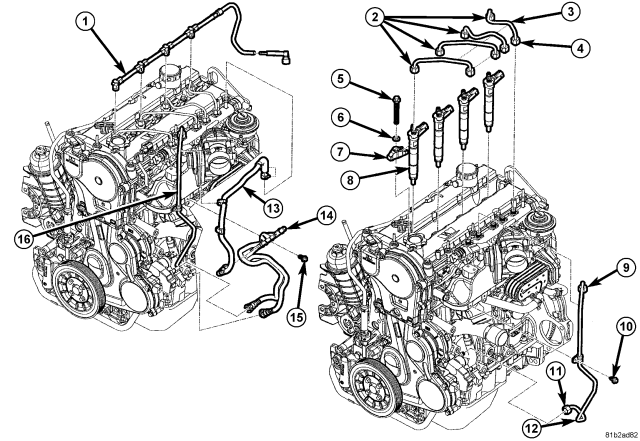
CAUTION: WHEN LOOSENING OR TIGHTENING HIGH-PRESSURE LINE FITTINGS ATTACHED TO A SEPARATE FITTING, USE A BACK-UP WRENCH ON FITTING. DO NOT ALLOW FITTING TO ROTATE. DAMAGE TO BOTH FUEL LINE AND FITTING WILL RESULT.
3. Disconnect fuel line fittings (2) and (4) and remove four fuel lines (3). Note and mark position of each fuel line while removing.
4. Remove fuel line clamp bolt (10).
5. Disconnect rail-to-injection pump high-pressure fuel line fittings (9) and (11) and remove fuel line (12). Note and mark position of fuel line while removing.
INSTALLATION
All high-pressure fuel lines are of the same length and inside diameter. Correct high-pressure fuel line usage and installation is critical to smooth engine operation.
CAUTION: Cleanliness cannot be overemphasized when handling or replacing diesel fuel system components. This especially includes the fuel injectors, high-pressure fuel lines and fuel injection pump. Very tight tolerances are used with these parts. Dirt contamination could cause rapid part wear and possible plugging of fuel injector nozzle tip holes. This in turn could lead to possible engine misfire. Always wash/clean any fuel system component thoroughly before disassembly and then air dry. Cap or cover any open part after disassembly. Before assembly, examine each part for dirt, grease or other contaminants and clean if necessary. When installing new parts, lubricate them with clean engine oil or clean diesel fuel only.
CAUTION: WHEN LOOSENING OR TIGHTENING HIGH-PRESSURE LINE FITTINGS ATTACHED TO A SEPARATE FITTING, USE A BACK-UP WRENCH ON FITTING. DO NOT ALLOW FITTING TO ROTATE. DAMAGE TO BOTH FUEL LINE AND FITTING WILL RESULT.
1. Position and connect rail-to-injection pump high-pressure fuel line (12). Tighten fittings (9) and (11) to 28 N·m (20 ft. lbs.) torque.
2. Install fuel line clamp bolt (10). Tighten bolt to 15 N·m (11 ft. lbs.) torque.
3. Position four fuel lines (3) to engine. Tighten fuel line fittings (2) to 28 N·m (20 ft. lbs.) torque. Tighten fuel line fittings (4) to 20 N·m (15 ft. lbs.) torque.
4. Install dress-up cover to top of engine.
5. Connect negative battery cable to battery.