LINE-A/C SUCTION
DESCRIPTION
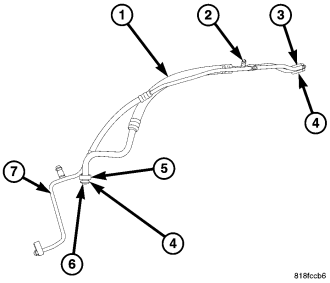
The A/C suction line (1) is the refrigerant line that carries refrigerant from the A/C evaporator to the A/C compressor. The A/C suction line contains the low side service port (2) and is secured to the A/C expansion valve by use of a tapping block (3) and to the A/C compressor by a metal fitting (5). The tapping block portion of the A/C suction also secures the A/C liquid line (7) to the A/C expansion valve.
The A/C suction line is sealed to the A/C expansion valve and A/C compressor by use of rubber O-ring seals (4) and a metal gasket (6). The O-ring seals used on the connections are made from a special type of rubber not affected by R-134a refrigerant.
NOTE: Replacement of the refrigerant line O-ring seals and gaskets is required anytime a refrigerant line is opened. Failure to replace the rubber O-ring seals and metal gaskets could result in a refrigerant system leak.
The A/C suction line can be serviced separately from the A/C liquid line and has no replaceable parts except for the O-ring seals, gaskets, low side service port valve and cap. The O-ring seals and gaskets must be replaced whenever the A/C suction line is removed.
The A/C suction line cannot be repaired and must be replaced if found to be leaking or damaged.
REMOVAL
WARNING: Refer to the applicable warnings and cautions for this system before performing the following operation (refer to 24 - HEATING & AIR CONDITIONING/PLUMBING - WARNING) and (refer to 24 - HEATING & AIR CONDITIONING/PLUMBING - CAUTION). Failure to follow the warnings and cautions could result in possible personal injury or death.
NOTE: The A/C liquid line can be serviced separately from the A/C suction line.
NOTE: 3.8L engine shown in illustrations. 2.8L engine similar.
1. Disconnect and isolate the negative battery cable.
2. Recover the refrigerant from the refrigerant system (refer to 24 - HEATING & AIR CONDITIONING/PLUMBING - STANDARD PROCEDURE - REFRIGERANT SYSTEM RECOVERY).
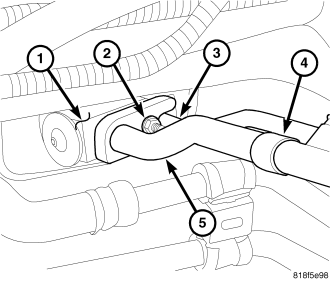
3. Remove the nut (2) that secures the A/C liquid line (3) and A/C suction line (5) to the A/C expansion valve (1).
4. Disconnect the A/C liquid and suction lines from the A/C expansion valve and remove and discard the O-ring seals.
5. If required, remove the retaining bracket (4) that secures the A/C liquid line to the A/C suction line and separate the liquid line from the suction line.
6. On 2.8L diesel engines, disconnect the air intake hose from the throttle body and position the hose out of the way.
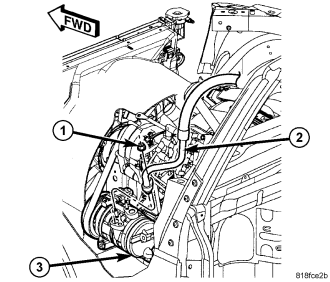
7. Remove the nut (1) that secures the A/C suction line (2) to the A/C compressor (3).
8. Disconnect the A/C suction line from the A/C compressor and remove and discard the O-ring seal and gasket.
9. Install plugs in, or tape over the opened liquid and suction line fittings and the compressor and expansion valve ports.
INSTALLATION
CAUTION: Be certain to adjust the refrigerant oil level when servicing the A/C refrigerant system (refer to 24 - HEATING & AIR CONDITIONING/PLUMBING/REFRIGERANT OIL - STANDARD PROCEDURE - REFRIGERANT OIL LEVEL). Failure to properly adjust the refrigerant oil level will prevent the A/C system from operating as designed and can cause serious A/C compressor damage.
NOTE: When replacing multiple A/C system components, refer to the Refrigerant Oil Capacities chart to determine how much oil should be added to the refrigerant system (refer to 24 - HEATING & AIR CONDITIONING/PLUMBING/REFRIGERANT OIL - STANDARD PROCEDURE - REFRIGERANT OIL LEVEL).
NOTE: Replacement of the refrigerant line O-ring seals and gaskets is required anytime a refrigerant line is opened. Failure to replace the rubber O-ring seals and metal gaskets could result in a refrigerant system leak.
NOTE: 3.8L engine shown in illustrations. 2.8L engine similar.
1. Position the A/C suction line (2) into the engine compartment.
2. Remove the tape or plugs from the opened liquid and suction line fittings and the compressor and expansion valve ports.
3. Lubricate new rubber O-ring seals with clean refrigerant oil and install them and a new gasket onto the liquid and suction line fittings. Use only the specified O-ring seals as they are made of a special material for the R-134a system. Use only refrigerant oil of the type recommended for the A/C compressor in the vehicle.
4. Connect the A/C suction line to the A/C compressor (3) and install the retaining nut (1). Tighten the nut to 23 N·m (17 ft. lbs.).
5. On 2.8L diesel engines, reconnect the air intake hose to the throttle body.
6. If removed, install the A/C liquid line (3) into the tapping block of the A/C suction line (5).
7. Connect the A/C liquid line and A/C suction line to the A/C expansion valve (1) and install the retaining nut (2). Tighten the nut to 8 N·m (70 in. lbs.).
8. If removed, install the bracket (4) that secures the A/C liquid line to the A/C suction line.
9. Reconnect the negative battery cable.
10. Evacuate the refrigerant system (refer to 24 - HEATING & AIR CONDITIONING/PLUMBING - STANDARD PROCEDURE - REFRIGERANT SYSTEM EVACUATE).
11. Adjust the refrigerant oil level (refer to 24 - HEATING & AIR CONDITIONING/PLUMBING/REFRIGERANT OIL - STANDARD PROCEDURE - REFRIGERANT OIL LEVEL).
12. Charge the refrigerant system (refer to 24 - HEATING & AIR CONDITIONING/PLUMBING - STANDARD PROCEDURE - REFRIGERANT SYSTEM CHARGE).