SEAT BELT TENSIONER
DESCRIPTION
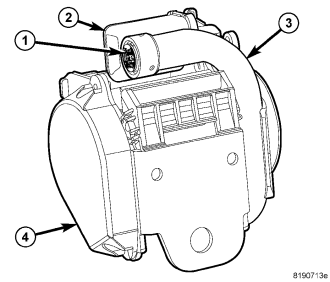
Seat belt tensioners supplement the dual front airbags for this vehicle. The seat belt tensioners are integral to the front seat belt retractor units (4), which are secured to the inner B-pillar on the right and left sides of the vehicle. The retractor is concealed beneath the molded plastic inner B-pillar trim.
The seat belt tensioner consists primarily of a sprocket/pinion, a steel tube (3), a cast metal housing, numerous steel balls, a stamped metal ball trap (2), a torsion bar and a small pyrotechnically activated gas generator with a connector receptacle (1). All of these components are located on one side of the retractor spool on the outside of the retractor housing except for the torsion bar, which serves as the spindle upon which the retractor spool rides. The seat belt tensioners are controlled by the Occupant Restraint Controller (ORC) and are connected to the vehicle electrical system through a dedicated take out of the body wire harness by a keyed and latching yellow molded plastic connector insulator to ensure a secure connection.
The seat belt tensioners cannot be repaired and, if ineffective or damaged, the entire front seat belt and retractor unit must be replaced. If the front airbags have been deployed, the seat belt tensioners have also been deployed. The seat belt tensioners are not intended for reuse and must be replaced following any front airbag deployment. A growling or grinding sound while attempting to operate the seat belt retractor is a sure indication that the seat belt tensioner has been deployed and requires replacement. (Refer to 8 - ELECTRICAL/RESTRAINTS/FRONT SEAT BELT AND RETRACTOR - REMOVAL).
OPERATION
The seat belt tensioners are deployed in conjunction with the dual front airbags by a signal generated by the Occupant Restraint Controller (ORC) through the driver or passenger seat belt tensioner line 1 and line 2 (or squib) circuits. When the ORC sends the proper electrical signal to the tensioners, the electrical energy generates enough heat to initiate a small pyrotechnic gas generator.
The gas generator is installed in one end of a steel tube that contains numerous steel balls. As the gas expands, it pushes the steel balls through the tube into a cast metal housing, where a ball guide directs the balls into engagement with the teeth of a sprocket that is geared to one end of the retractor spool. As the balls drive past the sprocket, the sprocket turns and drives the seat belt retractor spool causing the slack to be removed from the front seat belts. The ball trap captures the balls as they leave the sprocket and are expelled from the housing.
Removing excess slack from the front seat belts not only keeps the occupants properly positioned for an airbag deployment following a frontal impact of the vehicle, but also helps to reduce injuries that the occupant might experience in these situations as a result of harmful contact with the steering wheel, steering column, instrument panel or windshield. Also, the seat belt tensioner torsion bar that the retractor spool rides upon is designed to deform in order to control the loading being applied to the occupants by the seat belts during a frontal impact, further reducing the potential for occupant injuries.
The ORC monitors the condition of the seat belt tensioners through circuit resistance, and will illuminate the airbag indicator in the ElectroMechanical Instrument Cluster (EMIC) (also known as the Cab Compartment Node/CCN) and store a Diagnostic Trouble Code (DTC) for any fault that is detected. Proper diagnosis of the seat belt tensioner gas generator and the seat belt tensioner squib circuits requires the use of a diagnostic scan tool. Refer to the appropriate diagnostic information.