STANDARD PROCEDURE
CAMBER
Before each alignment reading the vehicle should be jounced (rear first, then front). Grasp each bumper at the center and jounce the vehicle up and down three times. Always release the bumper in the down position.
The wheel camber angle is preset. This angle is not adjustable and cannot be altered.
CASTER
Before each alignment reading the vehicle should be jounced (rear first, then front). Grasp each bumper at the center and jounce the vehicle up and down three times. Always release the bumper in the down position.
Check the caster of the front axle for correct angle. Be sure the axle is not bent or twisted. Road test the vehicle and observe the steering wheel return-to-center position. Low caster will cause poor steering wheel return ability.
During the road test, turn the vehicle to both the left and right. If the steering wheel returns to the center position unassisted, the caster angle is correct. However, if steering wheel does not return toward the center position unassisted, a low caster angle is probable.
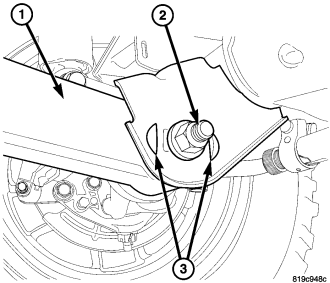
Caster can be adjusted by installing a Mopar® cam adjustment kit located between the notches in the axle bracket (3) and moving the lower suspension arm (1) at the axle forward or rearward.
The lower suspension arm will have to be removed at the axle bracket and then the knock-outs will have to be removed in order for the kit to be installed. (Refer to 2 - SUSPENSION/FRONT/LOWER CONTROL ARM - REMOVAL).
NOTE: Changing caster angle will also change the front propeller shaft angle. The propeller shaft angle has priority over caster. Refer to Group 3, Differential and Driveline for additional information.
TOE POSITION
Before each alignment reading the vehicle should be jounced (rear first, then front). Grasp each bumper at the center and jounce the vehicle up and down three times. Always release the bumper in the down position.
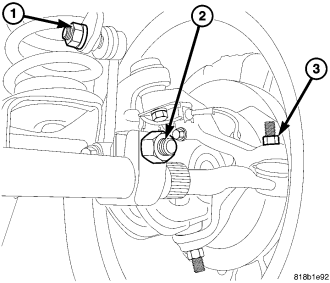
NOTE: The wheel toe position adjustment is the final adjustment. This adjustment must be performed with the engine running, if the vehicle is equipped with power steering.
1. Start the engine and turn wheels both ways before straightening the steering wheel. Center and secure the steering wheel.
2. Loosen the adjustment sleeve clamp bolts (2).
3. Adjust the total toe with the tie rod. Turn the knurled adjuster until the correct total toe is reached. Center both sockets at the knuckles and tighten the clamp bolts to 61 N·m (45 ft.lbs). Make sure the toe setting does not change during clamp tightening.
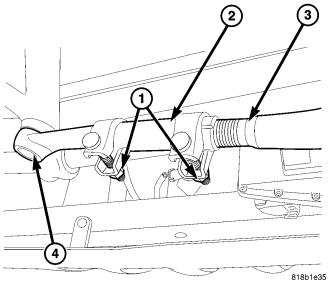
4. Adjust the drag link adjuster sleeve so that the left and right toe values are equal. Verify the steering wheel is still straight. Position the clamps as shown and tighten to 35 N·m (26 ft. lbs.).
5. Verify the toe specifications and turn off the engine.