SENSOR, Occupant Detection
DESCRIPTION
DESCRIPTION
 |
An Occupant Detection Sensor (ODS) is located directly below the passenger side front seat cushion trim cover. This sensor provides information to the Occupant Restraint Controller (ORC) used for control of the passenger belt alert feature.
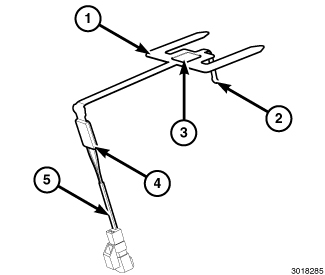
The ODS consists of a flexible clear plastic sensor mat (1) containing several resistive membrane, force sensing resistor cells that is secured by a locator tab (2) and two adhesive strips (3) to either the top surface of the seat cushion foam or, if the vehicle is so equipped, to the top surface of the heater element mat.
A short, two-conductor pigtail wire and connector (5) connect the sensor to the vehicle electrical system through a dedicated take out and connector of the seat wire harness. A hot melt adhesive block (4) encapsulates and protects the connections between the electrical conductors in the tail of the sensor mat and the pigtail wires as well as a diagnostic resistor.
The ODS cannot be adjusted or repaired, and must be replaced if
damaged or ineffective.
OPERATION
OPERATION
The Occupant Detection Sensor (ODS) acts as a simple switch to detect loads placed upon the passenger side front seat cushion. The sensor circuits are connected to and monitored by the Occupant Restraint Controller (ORC) whenever the ignition switch is in the ON position. The ORC uses an algorithm logic in monitoring the changing states of the sensor input to determine whether the seat cushion load is static or dynamic.
The ORC microprocessor continuously monitors all of the Supplemental Restraint System (SRS) electrical circuits to determine the system status and readiness. If the ORC detects a monitored system fault, it sets a Diagnostic Trouble Code (DTC). However, because the ODS input is only used for control of the passenger belt alert feature, which has no effect on SRS component features or functions, the airbag indicator is NOT illuminated in response to a detected ODS circuit fault.
The ODS receives source current and a clean ground through dedicated sensor plus and minus circuits from the ORC. The ORC then sends the appropriate sensor status information to the ElectroMechanical Instrument Cluster (EMIC) (also known as the Cab Compartment Node/CCN), which uses this information as an additional logic input used for control of the seat belt indicator and the passenger belt alert feature.
The hard wired circuits between the ODS and the ORC may be diagnosed using conventional diagnostic tools and procedures. Refer to the appropriate wiring information. However, conventional diagnostic methods will not prove conclusive in the diagnosis of the ODS or the electronic controls and communication between other modules and devices that provide some features of the passenger belt alert feature. The most reliable, efficient, and accurate means to diagnose the ODS or the electronic controls and communication related to passenger belt alert feature operation requires the use of a diagnostic scan tool. Refer to the appropriate diagnostic information.
REMOVAL
REMOVAL
To avoid serious or fatal injury on vehicles equipped with airbags, disable the Supplemental Restraint System (SRS) before attempting any steering wheel, steering column, airbag, seat belt tensioner, impact sensor or instrument panel component diagnosis or service. Disconnect and isolate the battery negative (ground) cable, then wait two minutes for the system capacitor to discharge before performing further diagnosis or service. This is the only sure way to disable the SRS. Failure to take the proper precautions could result in accidental airbag deployment.
WARNING:
 |
- Position the passenger side front seat to its most forward position for easiest access to the front seat mounting hardware.
- Disconnect and isolate the battery negative cable. Wait two minutes for the system capacitor to discharge before further service.
- Remove the passenger side front seat from the vehicle. (Refer to 23 - Body/Seats/SEAT - Removal) .
- Remove the trim from the front seat cushion foam and frame. (Refer to 23 - Body/Seats/COVER, Seat Cushion - Removal) .
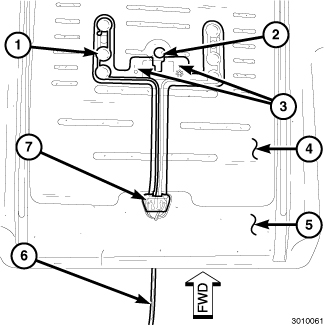
- Reach under the back of the front seat cushion frame to access and disconnect the Occupant Detection Sensor (ODS) (1) pigtail wire (6) connector from the seat wire harness.
- Disengage the ODS hot melt block (7) and pigtail wire from the recess and clearance hole near the back of the seat cushion foam (5).
- Disengage the ODS locator tab from the locator hole (2) near the center of the seat cushion foam.
- Disengage the two adhesive strips (3) of the ODS from the top surface of the seat cushion foam or, if the vehicle is so equipped, from the top surface of the heater element mat (4).
-
Remove the ODS from
the seat cushion.
INSTALLATION
INSTALLATION
To avoid serious or fatal injury on vehicles equipped with airbags, disable the Supplemental Restraint System (SRS) before attempting any steering wheel, steering column, airbag, seat belt tensioner, impact sensor or instrument panel component diagnosis or service. Disconnect and isolate the battery negative (ground) cable, then wait two minutes for the system capacitor to discharge before performing further diagnosis or service. This is the only sure way to disable the SRS. Failure to take the proper precautions could result in accidental airbag deployment.
WARNING:
When handling a new Occupant Detection Sensor (ODS), it should never be bent, creased, torn, cut or abraded. The ODS should not be handled with or come into contact with hard or sharp-edged tools or objects. Do not allow the ODS to drop more than 2 meters (6.5 feet). Prior to installation, do not sit on, stand on or place boxes, tools or any other foreign object on the ODS. If the ODS adhesive patches become inadvertently adhered to any seat materials or foreign objects prior to proper positioning on the seat cushion, the ODS must be scrapped and replaced with a new unit. Do not modify the seat foam or trim materials of a seat that contains an ODS. Failure to observe these cautions may result in an inoperative ODS, or an ODS that provides inaccurate inputs to the Occupant Restraint Controller (ORC).
CAUTION:
|
- Insert the locator tab of the Occupant Detection Sensor (ODS) mat (1) into the locator hole (2) near the center of the seat cushion foam (5) and push the tab all the way through the foam.
-
Position the sensor
mat on the seat cushion with the two mat sensor cell branches aligned
with the sides of the seat and the rear of the mat positioned as follows:
- On a seat without a heater mat (4), the sensor mat is positioned into a depression in the foam shaped similarly to the sensor located just rearward from the locator hole.
- On a seat with a heater mat, the rear edge of the sensor mat is aligned with the long transverse cutout in the heater mat located just rearward of the locator hole.
CAUTION: The adhesive used to secure the ODS to the seat is heat activated and requires that both the adhesive and the material it is applied to be ideally between 21° and 38° C (between 70° and 100° F). Application of the ODS to surfaces below 10° C (50° F) is not recommended as the adhesive becomes too firm to readily adhere. Do not touch or allow the adhesive patches to contact any foreign materials with the release paper removed. Do not attempt to add adhesive materials to the ODS.
- Peel the release paper off of the two adhesive strips (3) on each side of center on the underside of the ODS mat.
- Apply hand pressure (0.8 bar or 12 psi) over each of the two adhesive strips of the ODS mat for at least four seconds to activate and adhere the adhesive to the seat cushion foam or the heater element mat.
- Route the ODS pigtail wires (6) through the clearance hole near the back of the seat cushion foam and seat the hot melt block (7) into the recess.
- Reach under the back of the front seat cushion frame to access, route and reconnect the ODS pigtail wire and connector to the seat wire harness.
- Reinstall the trim onto the front seat cushion foam and frame. (Refer to 23 - Body/Seats/COVER, Seat Cushion - Installation) .
- Reinstall the passenger side front seat into the vehicle. (Refer to 23 - Body/Seats/SEAT - Installation) .
-
Reconnect the battery
negative cable.