Fuel Injection, Diesel
WARNING
WARNING
Before working on the common rail
high pressure fuel system, a minimum wait time of 30 seconds after
engine shut-down is mandatory.
WARNING:
Any work at the common rail high
pressure fuel system (rail, function-block, pressure regulator valve,
pressure limiter valve, rail pressure sensor, pipe connection, high
pressure pipes (pump/rail or /function-block, function block/rail,
rail/injectors)) is not permitted when the engine is running.
WARNING:
Cutting fuel jets; injury and/or
risk of eyes and skin. When opening the high pressure fuel system,
fuel jets can ignite on a hot engine surface.
WARNING:
The first high pressure component
to be serviced, must be loosened slowly, so that the pressure inside
the fuel system can adjust to ambient pressure.
WARNING:
High voltages may occur in piezo
systems and control units (actuators are usually charged up to 160V,
and control unit internal voltage is usually 240V). This can lead
to the danger of electrocution upon direct contact and may result
in possible serious or fatal injury. Danger to cardiac pacemaker or
similar devices may be caused by the resulting magnetic field.
WARNING:
CAUTION
CAUTION
The inversion of the pin-out of
the injector connector causes permanent damage to the piezo injector.
Make sure the polarity of the injector wiring will never be inverted
during the service operation.
CAUTION:
FUEL ECONOMY AND MAINTENANCE
FUEL ECONOMY AND MAINTENANCE
A vehicle that is not properly tuned and maintained cannot be expected to perform at its maximum efficiency and can have an adverse effect on fuel economy. The following recommendations will ensure that the vehicle is performing at its maximum efficiency:
- Use the recommended motor oil grade. Using the manufacturer's recommended grade of Mopar® motor oil can improve fuel mileage by 1-2%. Mopar® motor oil labeled "Energy Conserving" contains friction-reducing additives.
- Check and replace air filters. Replacing a clogged air filter with a new Mopar® air filter can improve fuel mileage by as much as 10%.
- Keep the engine tuned. Repairing a vehicle that is noticeably out of tune can improve fuel mileage by an average of 4%. Maintaining a vehicle and repairing problems, such as a faulty oxygen sensor, can improve mileage by as much as 40%.
- Keep tires properly inflated. Underinflated tires can lower fuel mileage by 0.4% for every 1 psi drop in pressure of all four tires.
SPECIFICATIONS
SPECIFICATIONS
| DESCRIPTION | N·m | Ft. Lbs. | In. Lbs. |
|---|---|---|---|
|
APP Sensor |
11 |
— |
97 |
|
Crankshaft Position Sensor Bolt |
11 |
— |
97 |
|
Crankshaft Position Sensor Shield Bolt |
15 |
— |
133 |
|
Fuel Injectors Retaining Bolts |
33 |
24 |
— |
|
Fuel Injector Tubes at Fuel Injectors |
28 |
21 |
— |
|
Fuel Injector Fuel Tubes at Fuel Rail |
5 |
— |
44 |
|
PLUS 75° TURN |
|||
|
Fuel Line Clamp Bolt |
15 |
— |
133 |
|
High Pressure Fuel Feed Tube at Fuel Rail |
5 |
— |
44 |
|
PLUS 75° TURN |
|||
|
High Pressure Fuel Tubes at High Pressure Pump |
28 |
21 |
— |
|
Oxygen Sensor |
50 |
37 |
— |
SPECIAL TOOLS
SPECIAL TOOLS
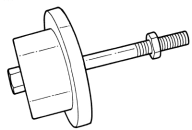 |
8941 - Puller Originally Shipped In Kit Number(s) 9299, 9299CC, 9299CC, 9300A-CAN, 9550, 9560. |
 |
9552 - Remover, Fuel Injector Originally Shipped In Kit Number(s) 9550, 9560, 9566. |