Plumbing
- WARNING
- CAUTION
- DIAGNOSIS AND TESTING - REFRIGERANT SYSTEM LEAKS
- REFRIGERANT SYSTEM RECOVERY
- REFRIGERANT SYSTEM EVACUATE
- REFRIGERANT SYSTEM CHARGE
WARNING
WARNING
The A/C system contains refrigerant under high pressure. Repairs should only be performed by qualified service personnel. Serious or fatal injury may result from improper service procedures.
WARNING:
Avoid breathing the refrigerant and refrigerant oil vapor or mist. Exposure may irritate the eyes, nose, and/or throat. Wear eye protection when servicing the A/C refrigerant system. Serious eye injury can result from direct contact with the refrigerant. If eye contact occurs, seek medical attention immediately.
WARNING:
Do not expose the refrigerant to open flame. Poisonous gas is created when refrigerant is burned. An electronic leak detector is recommended. Serious or fatal injury may result from improper service procedures.
WARNING:
If accidental A/C system discharge occurs, ventilate the work area before resuming service. Large amounts of refrigerant released in a closed work area will displace the oxygen and cause suffocation and serious or fatal injury.
WARNING:
The evaporation rate of R-134a refrigerant at average temperature and altitude is extremely high. As a result, anything that comes in contact with the refrigerant will freeze. Always protect the skin or delicate objects from direct contact with the refrigerant.
WARNING:
The R-134a service equipment or the vehicle refrigerant system should not be pressure tested or leak tested with compressed air. Some mixtures of air and R-134a have been shown to be combustible at elevated pressures. These mixtures are potentially dangerous, and may result in fire or explosion causing property damage and serious or fatal injury.
WARNING:
The engine cooling system is designed to develop internal pressures up to 145 kPa (21 psi). Do not remove or loosen the coolant pressure cap, cylinder block drain plugs, radiator drain, radiator hoses, heater hoses, or hose clamps while the engine cooling system is hot and under pressure. Allow the vehicle to cool for a minimum of 15 minutes before opening the cooling system for service. Failure to observe this warning can result in serious burns from the heated engine coolant.
WARNING:
CAUTION
CAUTION
Never add R-12 to a refrigerant
system designed to use R-134a. Do not use R-12 equipment or parts
on an R-134a A/C system. These refrigerants are not compatible and
damage to the A/C system will result.
CAUTION:
Never use R-12 refrigerant oil
in an A/C system designed to use R-134a refrigerant oil. These refrigerant
oils are not compatible and damage to the A/C system will result.
CAUTION:
The use of A/C system sealers
may result in damage to A/C refrigerant recovery/evacuation/recharging
equipment and/or A/C system. Many federal, state/provincial and local
regulations prohibit the recharge of A/C systems with known leaks.
Chrysler LLC recommends the detection of A/C system leaks through
the use of approved leak detectors and fluorescent leak detection
dyes. Vehicles found with A/C system sealers should be treated as
contaminated and replacement of the entire A/C refrigerant system
is recommended. A/C systems found to be contaminated with A/C system
sealers, A/C stop-leak products or seal conditioners voids the warranty
for the A/C system.
CAUTION:
Recover the refrigerant before
opening any fitting or connection. Open the fittings with caution,
even after the system has been discharged. Never open or loosen a
connection before recovering the refrigerant.
CAUTION:
If equipped, do not remove the
secondary retention clip from any spring-lock coupler connection while
the refrigerant system is under pressure. Recover the refrigerant
before removing the secondary retention clip. Open the fittings with
caution, even after the system has been discharged. Never open or
loosen a connection before recovering the refrigerant.
CAUTION:
The internal parts of the A/C
system will remain stable as long as moisture-free refrigerant and
refrigerant oil is used. Abnormal amounts of dirt, moisture or air
can upset the chemical stability. This may cause operational troubles
or even serious damage if present in more than very small quantities.
Before disconnecting a component, clean the outside of the fittings
thoroughly to prevent contamination from entering the refrigerant
system. Keep service tools and the work area clean. Do not open the
refrigerant system or uncap a replacement component until you are
ready to service the system. Immediately after disconnecting a component
from the refrigerant system, seal the open fittings with a cap or
plug. This will prevent contamination from entering the A/C system.
CAUTION:
Refrigerant oil will absorb moisture
from the atmosphere if left uncapped. Do not open a container of refrigerant
oil until you are ready to use it. Replace the cap on the oil container
immediately after using. Store refrigerant oil only in a clean, airtight,
and moisture-free container.
CAUTION:
Do not overcharge the refrigerant
system. Overcharging will cause excessive compressor head pressure
and can cause compressor noise and A/C system failure.
CAUTION:
DIAGNOSIS AND TESTING - REFRIGERANT SYSTEM LEAKS
DIAGNOSIS AND TESTING - REFRIGERANT SYSTEM LEAKS
R-134a service equipment or vehicle A/C system should not be pressure tested or leak tested with compressed air. Mixture of air and R-134a can be combustible at elevated pressures. These mixtures are potentially dangerous and may result in fire or explosion causing property damage and possible serious or fatal injury.
Avoid breathing A/C refrigerant and lubricant vapor or mist. Exposure may irritate eyes, nose and throat. Use only approved service equipment meeting SAE requirements to discharge an R-134a system. If accidental system discharge occurs, ventilate work area before resuming service.
WARNING:
| NOTE: |
If the A/C system refrigerant charge is empty or low, a leak in the A/C system is likely. When searching for a refrigerant leak in the A/C system, use an electronic leak detector and refrigerant leak detection dye with an Ultra Violet (UV) light that is designed for R-134a refrigerant. It is important to use only high-quality refrigerant leak detection equipment to properly locate refrigerant system leaks, such as the equipment listed in the teamPSE Service Equipment Catalog. Use only Chrysler approved R-134a leak detection dye, available through Mopar®. |
- Visually inspect all A/C lines, A/C fittings and A/C components under the hood for an oily residue. Oil residue can be an indicator of a leak location.
- Connect a high-quality manifold gauge set or refrigerant recovery machine to the A/C system and determine if the static A/C system pressure is above or below 345 kPa (50 psi) (Refer to 24 - Heating and Air Conditioning/Plumbing - Standard Procedure) . If static A/C system pressure is less than 345 kPa (50 psi), proceed to SYSTEM EMPTY. If static A/C system pressure is greater than 345 kPa (50 psi), go to SYSTEM LOW.
SYSTEM EMPTY
-
Evacuate the refrigerant
system to the lowest degree of vacuum possible (approximately -8 kPa
(-26 in. Hg) or greater vacuum) for at least 30 minutes (Refer to 24 - Heating and Air Conditioning/Plumbing
- Standard Procedure)
.
CAUTION: Use only Chrysler LLC approved R-134a leak detection dye. It is important to use only high-quality refrigerant leak detection equipment. Small leaks may not be found using low-budget equipment. Failure to follow these instructions may result in an incomplete diagnosis and possible remaining refrigerant leaks.
- Prepare an R-134a dye injector with a Chrysler approved R-134a leak detection dye.
-
Prepare the vehicle
specific amount of R-134a refrigerant (Refer to 24 - Heating and Air Conditioning/Plumbing/REFRIGERANT
- Specifications)
.
NOTE: Anytime an R-134a leak detection dye has been added to the refrigerant system, a label indicating that dye has been added should be placed on the vehicle in plain view, for other technicians.
- Dispense the leak detection dye and the correct amount of R-134a refrigerant into the evacuated refrigerant system (Refer to 24 - Heating and Air Conditioning/Plumbing - Standard Procedure) .
- Proceed to LEAK TEST.
SYSTEM LOW
Use only Chrysler LLC approved
R-134a leak detection dye. It is important to use only high-quality
refrigerant leak detection equipment. Small leaks may not be found
using low-budget equipment. Failure to follow these instructions may
result in an incomplete diagnosis and possible remaining refrigerant
leaks.
CAUTION:
-
Prepare an R-134a dye
injector with a Chrysler approved R-134a leak detection dye.
NOTE: Anytime an R-134a leak detection dye has been added to the refrigerant system, a label indicating that dye has been added should be placed on the vehicle in plain view, for other technicians.
- Dispense the leak detection dye and 0.284 kilograms (10 ounces) of R-134a refrigerant into the evacuated refrigerant system (Refer to 24 - Heating and Air Conditioning/Plumbing - Standard Procedure) .
- Proceed to LEAK TEST.
LEAK TEST
- Position the vehicle in a wind-free work area. This will aid in detecting small leaks.
-
Operate the heating and A/C system with the engine at idle under the following conditions for at least 15 minutes.
- Doors or windows open
- Transmission in Park or Neutral with the parking brake set (depending on transmission application)
- Front A/C and heater controls set to outside air, full cool, panel mode, high blower and A/C compressor engaged
- If equipped, rear A/C and heater controls set to full cool and high blower.
-
Shut the vehicle off and wait at least 5 minutes.
CAUTION: Use it is important to use only a high-quality Ultra Violet (UV) light when searching for a leak in the refrigerant system. Small leaks may not be found using budget equipment. Failure to follow these instructions may result in an incomplete diagnosis and possible remaining refrigerant leaks.
-
Begin searching for leaks using a high quality UV light to detect the fluorescent R-134a leak detection dye. Inspect all connections, plumbing fittings, brazed joints, hoses, hose crimps, service ports, compressor housing, pressure relief valve and A/C condenser for dye. Inspect the evaporator drain tube and condensate for presence of dye, which indicates a leak from the A/C evaporator.
WARNING: Use extreme care when working around a running engine. Keep hands and fingers clear of the radiator fan, accessory drive belt and all other moving components. Keep away when wearing loose clothing, jewelry or long hair that is not properly secured. Underhood components may become hot to the touch. Be careful not to come into contact with hot engine, A/C and engine cooling system components. Failure to follow these instructions may result in serious or fatal injury.
CAUTION: Use only an electronic leak detector designed for R-134a refrigerant. It is important to use only high-quality refrigerant leak detection equipment. Small leaks may not be found using budget equipment. Failure to follow these instructions may result in an incomplete diagnosis and possible remaining refrigerant leaks.
- If a leak is not found with the R-134a detection dye, use a high-quality electronic R-134a leak detector and insert it into the evaporator drain tube, and into the instrument panel air outlets, to check for evaporator leaks. Check the evaporator tubes at the A/C expansion valve, for leaks not visible behind the valve. Check around the front of the A/C compressor, for compressor shaft seal leaks. Check between the A/C condenser and radiator for condenser leaks not previously visible.
REFRIGERANT SYSTEM RECOVERY
REFRIGERANT SYSTEM RECOVERY
 |
The R-134a refrigerant must be recovered from the A/C system prior to performing any repairs that require disconnection of an A/C refrigerant line.
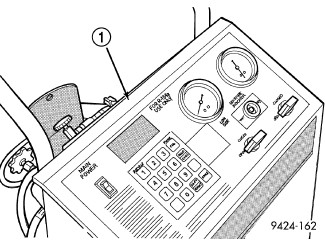
When recovering the A/C refrigerant system, use an R-134a refrigerant recovery/recycling/charging station (1) that meets SAE standard J2788. Per SAE standard J2788, refrigerant recovery stations must recover 95% of the refrigerant system within 30 minutes at 21.1° C (70° F) and be able to measure the amount of refrigerant removed from the system to an accuracy of 28 grams (1 oz.). See the operating instructions supplied by the equipment manufacturer for proper care and use of this equipment.
| NOTE: |
A/C system should be tested prior to refrigerant recovery if the use of A/C system sealants are suspected. These sealants have the potential to clog refrigerant recovery equipment and cause vehicle A/C component damage. Various tool manufacturers make tool kits that detect A/C system sealants. See the operating instructions supplied by the equipment manufacturer for proper care and use of this equipment. |
If sealants are detected in an A/C system, the system should be treated as contaminated and replacement of the entire A/C refrigerant system is recommended. A/C systems found to be contaminated with A/C system sealers, A/C stop-leak products or seal conditioners void the warranty for the A/C system.
RECOVERY PROCEDURE
Review safety precautions and warnings in this group before performing this procedure and . Failure to follow these instructions may result in serious or fatal injury.
WARNING:
Various aftermarket manufacturers
produce A/C system sealants that are designed to stop A/C refrigerant
system leaks. The use of A/C system sealants may result in damage
to A/C refrigerant recovery/evacuation/recharging equipment and/or
the vehicle A/C system and are not recommended for use by Chrysler
LLC.
CAUTION:
A small amount of refrigerant
oil is removed from the A/C system each time the refrigerant system
is recovered and evacuated. Before charging the A/C system, you MUST
replenish any oil lost during the recovery process. See the equipment
manufacturer instructions for more information.
CAUTION:
- If use of aftermarket A/C system sealant is suspected, the A/C system should be tested for sealant prior to refrigerant system recovery. See the operating instructions supplied by the equipment manufacturer for proper use and care of this equipment.
- Connect an R-134a refrigerant recovery/recycling/charging station that meets SAE standard J2788 to the refrigerant system.
- Recover the A/C refrigerant system following the operating instructions supplied by the recovery/recycling/charging station manufacturer.
- Disconnect the refrigerant recovery/recycling/charging station from the refrigerant system service ports.
- Reinstall the caps onto the refrigerant system service ports.
REFRIGERANT SYSTEM EVACUATE
REFRIGERANT SYSTEM EVACUATE
|
If the A/C refrigerant system has been open to the atmosphere, it must be evacuated before the A/C system can be recharged with R-134a refrigerant.
| NOTE: |
Special effort must be used to prevent moisture from entering the A/C system oil. Moisture in the oil is very difficult to remove and will cause a reliability problem with the A/C compressor. |
Moisture and air in the A/C refrigerant system will raise the compressor head pressure above acceptable operating levels. This will reduce the performance of the A/C system and damage the A/C compressor. Moisture will boil at near room temperature when exposed to vacuum. Always use an R-134a refrigerant recovery/recycling/charging station with a vacuum pump (1) that meets SAE standard J2788, or an R-134a compatible manifold gauge set and a stand-alone vacuum pump.
If an A/C compressor is left open to the atmosphere for an extended period of time, it is recommended that the refrigerant oil in the compressor be drained and replaced with new refrigerant oil to reduce the possibility of contaminating the refrigerant system (Refer to 24 - Heating and Air Conditioning/Plumbing/OIL, Refrigerant - Standard Procedure)
.
EVACUATION PROCEDURE
Review safety precautions and warnings in this group before performing this procedure and . Failure to follow these instructions may result in serious or fatal injury.
WARNING:
A small amount of refrigerant
oil is removed from the A/C system each time the refrigerant system
is recovered and evacuated. Before charging the A/C system, you MUST
replenish any oil lost during the recovery process. See the equipment
manufacturer instructions for more information.
CAUTION:
-
Recover the refrigerant
system (Refer to 24 - Heating
and Air Conditioning/Plumbing - Standard Procedure)
.
NOTE: When connecting service equipment couplers to refrigerant line service ports, verify that the valve of each coupler is fully closed prior to connecting. This will reduce the amount of effort required to make the connections.
- Connect an R-134a refrigerant recovery/recycling/charging station with a vacuum pump that meets SAE standard J2788 to the refrigerant system, or an R-134a compatible manifold gauge set and a stand-alone vacuum pump (depending on available equipment).
- Open the refrigerant recovery/recycling/charging station or manifold gauge set valves and start the vacuum pump. The vacuum pump should run a minimum of 45 minutes prior to recharge to eliminate all moisture in system. When the low-side gauge reads to the lowest degree of vacuum possible (approximately -88 kPa (- 26 in. Hg) or greater) for 30 minutes, close all valves and turn off vacuum pump. If the refrigerant system fails to reach specified vacuum, the refrigerant system likely has a leak that must be corrected. If the refrigerant system maintains specified vacuum for at least 30 minutes, start the vacuum pump, open the valves and allow the refrigerant system to evacuate an additional 10 minutes.
- Close the refrigerant recovery/recycling/charging station or manifold gauge set valves. Turn off and disconnect the vacuum pump.
- Disconnect the refrigerant recovery/recycling/charging station or manifold gauge set from the refrigerant system service ports.
- Install the caps onto the refrigerant system service ports.
REFRIGERANT SYSTEM CHARGE
REFRIGERANT SYSTEM CHARGE
|
After all A/C refrigerant system repairs have been completed and the refrigerant system has been evacuated, the A/C system can be recharged with R-134a refrigerant.
When charging the A/C system, use an R-134a refrigerant recovery/recycling/charging station (1) that meets SAE standard J2788. Per SAE standard J2788, refrigerant recovery stations must charge the system to an accuracy of 14 grams (0.5 oz.). See the operating instructions supplied by the equipment manufacturer for proper care and use of this equipment.
CHARGING PROCEDURE
Review safety precautions and warnings in this group before performing this procedure and . Failure to follow these instructions may result in serious or fatal injury.
WARNING:
A small amount of refrigerant
oil is removed from the A/C system each time the refrigerant system
is recovered and evacuated. Before charging the A/C system, you MUST
replenish any oil lost during the recovery process. See the equipment
manufacturer instructions for more information.
CAUTION:
- Recover and evacuate the refrigerant system (Refer to 24 - Heating and Air Conditioning/Plumbing - Standard Procedure) .
- Connect an R-134a refrigerant recovery/recycling/charging station that meets SAE standard J2788 to the refrigerant system.
-
When required, adjust the refrigerant oil level (Refer to 24 - Heating and Air Conditioning/Plumbing/OIL, Refrigerant - Standard Procedure)
.
NOTE: A/C system refrigerant capacity can be found on the HVAC Specification Label, located in the engine compartment.
- Measure the proper amount of refrigerant and heat it to 52° C (125° F) with the charging station (Refer to 24 - Heating and Air Conditioning/Plumbing/REFRIGERANT - Specifications) . See the operating instructions supplied by the equipment manufacturer for proper use of this equipment.
- Open both the low and high side valves, then open the charge valve to allow the heated refrigerant to flow into the refrigerant system.
-
When the transfer of refrigerant has stopped, close the valves.
WARNING: Take care not to open the high side (high pressure) valve while performing Step 7. Failure to follow these instructions may result in possible serious or fatal injury.
-
Perform the following if all of the refrigerant charge did not transfer from the dispensing device.
- Open all of the windows in the vehicle.
- Set the heating and A/C system so that the A/C compressor is operating and the blower motor is operating at its lowest speed setting.
- Run the engine at a steady high idle (about 1400 rpm).
- If the A/C compressor does not operate, test the compressor control circuits and repair as required.
- Open the low side valve and the charge valve to allow the remaining refrigerant to flow into the refrigerant system.
- When the transfer of refrigerant has stopped, close the valves.
- Disconnect the refrigerant recovery/recycling/charging station from the refrigerant system service ports.
- Reinstall the caps onto the refrigerant system service ports.