MOTOR, Blower
DESCRIPTION
DESCRIPTION
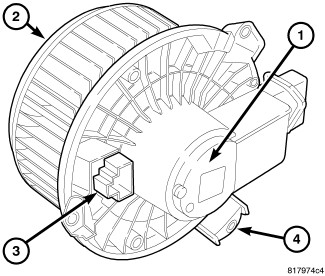 |
The blower motor (1) is used to control the velocity of air moving through the HVAC housing by spinning the blower wheel (2) within the HVAC air inlet housing at the selected speed.
The blower motor is a 12-volt, direct current (DC) motor mounted within a plastic housing with an integral wire harness connector (3) and three mounting tabs (4). The squirrel cage-type blower wheel is secured to the blower motor shaft and is positioned within the air inlet housing on the passenger side of the HVAC housing.
OPERATION
OPERATION
The blower motor controls the velocity of air moving through the HVAC housing by spinning the blower wheel within the HVAC air inlet housing at the selected speed.
Both the Manual Temperature Control (MTC) heating-A/C system and the Automatic Temperature Control (ATC) heating-A/C system have an electronic blower motor power module to control blower motor speed. The power module uses a Pulse Width Modulated (PWM) input from the A/C-heater control and a feedback signal from the blower motor to regulate the blower motor ground path. On both systems, the blower motor receives battery current through the Totally Integrated Power Module (TIPM) whenever the ignition switch is in the Run position, and the blower motor control is in any position except Off.
The blower motor can be accessed for service from underneath the instrument panel and is diagnosed using a scan tool (Refer to 28 - DTC-Based Diagnostics/HVAC - Diagnosis and Testing) .
The blower motor and blower motor wheel are factory balanced as an assembly and cannot be adjusted or repaired and must be replaced if inoperative or damaged.
DIAGNOSIS AND TESTING - BLOWER MOTOR
DIAGNOSIS AND TESTING - BLOWER MOTOR
Disable the airbag system before attempting any steering wheel, steering column or instrument panel component diagnosis or service. Disconnect and isolate the negative battery (ground) cable and wait two minutes for the airbag system capacitor to discharge before performing further diagnosis or service. This is the only sure way to disable the airbag system. Failure to follow these instructions may result in accidental airbag deployment and possible serious or fatal injury.
WARNING:
To determine if an open condition exists within the blower motor circuit wiring, it is necessary to disconnect the negative battery cable and check for continuity within the blower motor circuits using an ohmmeter. See Wiring Information for circuit descriptions and diagrams.
OPERATION
Possible causes of an inoperative blower motor include:
- Open fuse
- Inoperative blower motor power module
- Inoperative A/C-heater control
- Inoperative blower motor
- Inoperative blower motor circuit wiring or wire harness connectors
NOISE
To determine if the blower motor is the source of the noise, simply switch the blower motor from Off to On. To verify that the blower motor is the source of the noise, unplug the blower motor wire harness connector and operate the heater-A/C system. If the noise goes away, possible causes include:
- Foreign material on fresh air inlet screen
- Foreign material in blower wheel
- Foreign material in HVAC housing
- Improper blower motor mounting
- Deformed or damaged blower wheel
- Worn blower motor bearings or brushes
VIBRATION
Possible causes of a blower motor vibration include:
REMOVAL
REMOVAL
| NOTE: |
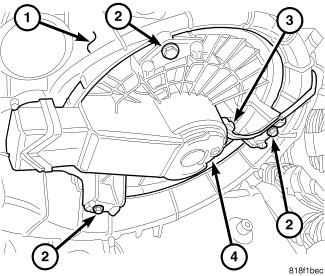
The blower motor is located on the bottom of the passenger side of the HVAC housing. The blower motor can be removed from the vehicle without having to remove the HVAC housing. |
 |
| NOTE: |
LHD model shown. RHD model similar. |
INSTALLATION
INSTALLATION
|
| NOTE: |
LHD model shown. RHD model similar. |
- Position the blower motor (4) into the bottom of the HVAC housing (1).
- Install the three screws (2) that secure the blower motor to the HVAC housing. Tighten the screws to 1.2 N·m (10 in. lbs.).
- Connect the instrument panel wire harness connector (3) to the blower motor.
-
Reconnect the negative battery cable.