VALVE, Positive Crankcase Ventilation (PCV)
DESCRIPTION
DESCRIPTION
The PCV valve contains a spring loaded plunger. The plunger meters the amount of crankcase vapors routed into the combustion chamber based on intake manifold vacuum.
OPERATION
OPERATION
The PCV system operates by engine intake manifold vacuum. Filtered air is routed into the left side valve cover from the left CCV hose which is attached to the air cleaner housing. The metered air, along with crankcase vapors, are drawn through the PCV valve on the right side of the engine and into a passage in the intake manifold. The PCV system manages crankcase pressure and meters blow by gases to the intake system, reducing engine sludge formation.
The PCV valve contains a spring loaded plunger. This plunger meters the amount of crankcase vapors routed into the combustion chamber based on intake manifold vacuum.
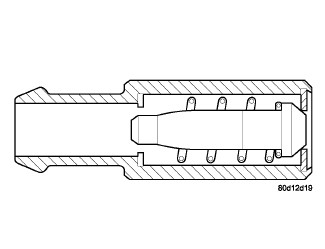 |
When the engine is not operating or during an engine pop-back, the spring forces the plunger back against the seat.
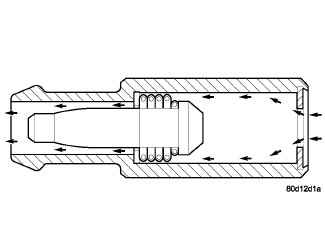 |
During periods of high manifold vacuum, such as idle or cruising speeds, vacuum is sufficient to completely compress spring. It will then pull the plunger to the top of the valve. In this position there is minimal vapor flow through the valve.
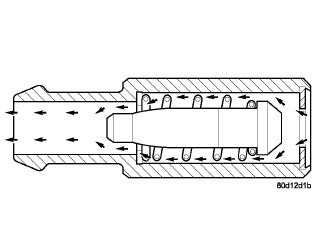 |
During periods of moderate manifold vacuum, the plunger is only pulled part way back from inlet. This results in maximum vapor flow through the valve.
DIAGNOSIS AND TESTING - PCV SYSTEM
DIAGNOSIS AND TESTING - PCV SYSTEM
apply parking brake and/or block wheels before performing any test or adjustment with the engine operating.
WARNING:
- Remove the make-up air hose from the air cleaner body. Hold a piece of stiff paper (parts tag) loosely over the end of the make-up air hose.
- After allowing approximately one minute for crankcase pressure to reduce, the paper should draw up against the hose with noticeable force. If the engine does not draw the paper against the hose end Inspect the PCV valve and hose for blockage.
- Turn the engine off. Remove the PCV valve. The valve should rattle when shaken.
-
Replace the PCV valve and retest the system if it does not operate as described in the preceding tests. Do not attempt to clean the old PCV valve.
REMOVAL
REMOVAL
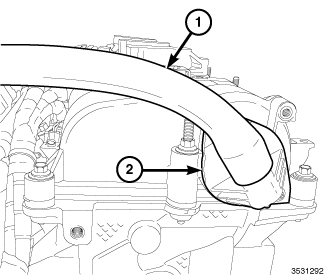 |
INSTALLATION
INSTALLATION
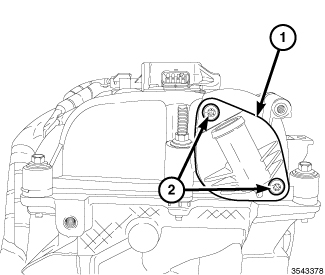 |
- Clean and inspect the sealing surfaces of the PCV valve and cylinder head cover. The seal can be reused provided it is free of cuts or tears.
- Install the PCV valve seal in the cylinder head cover.
-
Install the PCV valve (1) with screws (2). Tighten the screws to 4 N·m (35 in. lbs.).
-
Install the PCV hose (1) between the upper intake manifold and the PCV valve (2).