SHOCK ABSORBER, Suspension
DESCRIPTION
DESCRIPTION
The top of the shock absorbers are bolted to a frame bracket. The bottom of the shocks are bolted to the axle brackets.
OPERATION
OPERATION
The shock absorbers dampen jounce and rebound motion of the vehicle over various road conditions and limit suspension rebound travel.
DIAGNOSIS AND TESTING - SHOCK ABSORBER
DIAGNOSIS AND TESTING - SHOCK ABSORBER
A knocking or rattling noise from a shock absorber may be caused by movement between mounting bushings and metal brackets or attaching components. These noises can usually be stopped by tightening the attaching nuts. If the noise persists, inspect for damaged and worn bushings, and attaching components. Repair as necessary if any of these conditions exist.
A squeaking noise from the shock absorber may be caused by the hydraulic valving and may be intermittent. This condition is not repairable and the shock absorber must be replaced.
The shock absorbers are not refillable or adjustable. If a malfunction occurs, the shock absorber must be replaced. To test a shock absorber, hold it in an upright position and force the piston in and out of the cylinder four or five times. The action throughout each stroke should be smooth and even.
The shock absorber bushings do not require any type of lubrication. Do not attempt to stop bushing noise by lubricating them. Grease and mineral oil-base lubricants will deteriorate the bushing.
REMOVAL
REMOVAL
 |
INSTALLATION
INSTALLATION
|
-
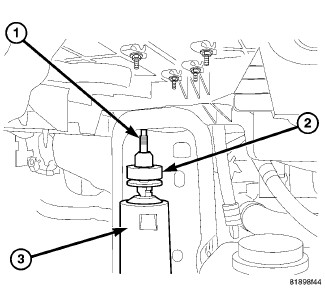
Position the retainer
and grommet (2) on the upper stud (1). Insert the shock absorber (3)
through the shock bracket hole and tighten to 27 N·m (20 ft. lbs.).
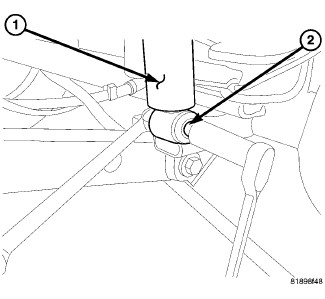
- Install the lower part of the shock (1) into the bracket.
- Install the lower bolt and nut (2). Tighten nuts to 88 N·m (65 ft. lbs.).
-
remove the support
and lower the vehicle.