FLUID
- DIAGNOSIS AND TESTING - BRAKE FLUID CONTAMINATION
- STANDARD PROCEDURE - BRAKE FLUID LEVEL
- SPECIFICATIONS
DIAGNOSIS AND TESTING - BRAKE FLUID CONTAMINATION
DIAGNOSIS AND TESTING - BRAKE FLUID CONTAMINATION
Indications of fluid contamination are swollen or deteriorated rubber parts.
Swollen rubber parts indicate the presence of petroleum in the brake fluid.
To test for contamination, put a small amount of drained brake fluid in clear glass jar. If fluid separates into layers, there is mineral oil or other fluid contamination of the brake fluid.
If brake fluid is contaminated, drain and thoroughly flush system. Replace master cylinder, caliper seals, Antilock Brakes hydraulic unit and all hydraulic fluid hoses.
STANDARD PROCEDURE - BRAKE FLUID LEVEL
STANDARD PROCEDURE - BRAKE FLUID LEVEL
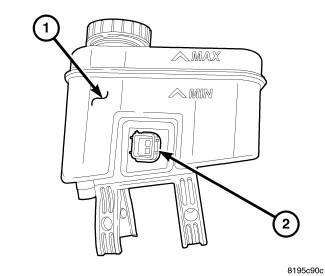 |
Always clean the master cylinder reservoir and caps before checking fluid level. If not cleaned, dirt could enter the fluid.
The fluid fill level is indicated on the side of the master cylinder reservoir (1).
The correct fluid level is to the MAX indicator on the side of the reservoir. If necessary, add fluid to the proper level.
SPECIFICATIONS
SPECIFICATIONS
The brake fluid used in this vehicle must conform to DOT 3 specifications and SAE J1703 standards. No other type of brake fluid is recommended or approved for usage in the vehicle brake system. Use only Mopar brake fluid or an equivalent from a tightly sealed container.
Never use reclaimed brake fluid
or fluid from an container which has been left open. An open container
of brake fluid will absorb moisture from the air and contaminate the
fluid.
CAUTION:
Never use any type of a petroleum-based
fluid in the brake hydraulic system. Use of such type fluids will
result in seal damage of the vehicle brake hydraulic system causing
a failure of the vehicle brake system. Petroleum based fluids would
be items such as engine oil, transmission fluid, power steering fluid,
etc.
CAUTION: