SERVICE AFTER A SUPPLEMENTAL RESTRAINT SYSTEM DEPLOYMENT
Any vehicle which is to be returned to use following a Supplemental Restraint System (SRS) component deployment must have the deployed restraints replaced. In addition, the following guidelines MUST be observed.
- Following ANY major vehicle impact damage in the vicinity of an impact sensor or the ORC - It is critical that the mounting surfaces and mounting brackets for the Occupant Restraint Controller (ORC), front impact sensors and side impact sensors located within the proximity of the impact damage be closely inspected and restored to their original conditions. Because the ORC and each impact sensor are used by the SRS to monitor or confirm the direction and severity of a vehicle impact, improper orientation or insecure fastening of these components may cause airbags not to deploy when required, or to deploy when not required.
- If the driver airbag is deployed - If the Driver AirBag (DAB) has been deployed, the clockspring and the steering column must be replaced.
- If the passenger airbag is deployed - If the Passenger AirBag (PAB) has been deployed, the PAB door must also be replaced.
- If a seat airbag is deployed - If a Seat AirBag (SAB) (also known as a pelvic and thoracic airbag) has been deployed, the seat back frame, the seat back foam and the seat back trim cover on the same side of the vehicle as the deployed airbag must also be replaced.
- If a seat belt tensioner is deployed - The seat belt tensioners are deployed in conjunction with the front airbags, but can also be deployed with a Seat AirBag (SAB) (also known as a pelvic and thoracic airbag). The seat belt tensioners must be replaced if either front airbag has been deployed, and must be inspected if either SAB has been deployed.
The components identified with the deployed SRS components in the preceding list are not intended for reuse and will be damaged or weakened as a result of an airbag deployment, which may or may not be obvious during a visual inspection. All other vehicle components should be closely inspected following any SRS component deployment, but are to be replaced only as required by the extent of the visible damage incurred.
SQUIB CIRCUIT DAMAGE
In addition to the preceding guidelines, be aware that the heat created by the initiator during an airbag or tensioner deployment will cause collateral damage to the connected wiring (squib circuits) and connector insulators. There are two methods by which an airbag or seat belt tensioner may be connected to the vehicle electrical system. The first method involves a short pigtail harness and connector insulator that are integral to the airbag or tensioner unit and are replaced as a unit with the service replacement airbag or seat belt tensioner. This connection method typically requires no additional wiring repair following a deployment.
However, the second connection method involves a wire harness takeout and connector insulator that are connected directly to the airbag or tensioner initiator or squib. These direct-connect type take outs and connector insulators MUST be repaired following an airbag or seat belt tensioner deployment using the approved Supplemental Restraint System Wiring Repairs procedure. (Refer to 10 - Restraints - Standard Procedure) .
AIRBAG SQUIB STATUS
Multistage airbags with multiple initiators (squibs) must be checked to determine that all squibs were used during the deployment event. The Driver AirBag (DAB) and Passenger AirBag (PAB) in this vehicle are deployed by electrical signals generated by the Occupant Restraint Controller (ORC) through the driver or passenger squib 1 and squib 2 circuits to the two initiators in the airbag inflators. Typically, both initiators are used and all potentially hazardous chemicals are burned during an airbag deployment event. However, it is possible for only one initiator to be used; therefore, it is always necessary to confirm that both initiators have been used in order to avoid the improper handling or disposal of potentially live pyrotechnic or hazardous materials. The following procedure should be performed using a diagnostic scan tool to verify the status of both airbag squibs before either deployed airbag is removed from the vehicle for disposal.
Deployed front airbags having two initiators (squibs) in the airbag inflator may or may not have live pyrotechnic material within the inflator. Do not dispose of these airbags unless you are certain of complete deployment. Refer to the Hazardous Substance Control System for information regarding the potentially hazardous properties of the subject component and the proper safe handling procedures. Then dispose of all non-deployed and deployed airbags and seat belt tensioners in a manner consistent with state, provincial, local and federal regulations.
CAUTION:
- Be certain that the diagnostic scan tool contains the latest version of the proper diagnostic software. Connect the scan tool to the 16-way Data Link Connector (DLC). The DLC is located on the driver side lower edge of the instrument panel, outboard of the steering column.
- Turn the ignition switch to the On position.
- Using the scan tool, read and record the active (current) Diagnostic Trouble Code (DTC) data.
Using the active DTC information, refer to the Airbag Squib Status table to determine the status of both DAB squibs and both PAB squibs.
| AIRBAG SQUIB STATUS | ||
|---|---|---|
| IF THE ACTIVE DTC IS: | CONDITIONS | SQUIB STATUS |
|
Driver or Passenger Squib 1 open |
AND the stored DTC minutes for both Driver or Passenger squibs are within 15 minutes of each other |
Both Squib 1 and 2 were used. |
|
Driver or Passenger Squib 2 open |
||
|
Driver or Passenger Squib 1 open |
AND the stored DTC minutes for Driver or Passenger Squib 2 open is GREATER than the stored DTC minutes for Driver or Passenger Squib 1 by 15 minutes or more |
Squib 1 was used; Squib 2 is live. |
|
Driver or Passenger Squib 2 open |
||
|
Driver or Passenger Squib 1 open |
AND the stored DTC minutes for Driver or Passenger Squib 1 open is GREATER than the stored DTC minutes for Driver or Passenger Squib 2 by 15 minutes or more |
Squib 1 is live; Squib 2 was used. |
|
Driver or Passenger Squib 2 open |
||
|
Driver or Passenger Squib 1 open |
AND Driver or Passenger Squib 2 open is NOT an active code |
Squib 1 was used; Squib 2 is live. |
|
Driver or Passenger Squib 2 open |
AND Driver or Passenger Squib 1 open is NOT an active code |
Squib 1 is live; Squib 2 was used. |
| NOTE: |
If none of the Driver or Passenger Squib 1 or 2 open are active codes, the status of the airbag squibs is unknown. In this case the airbag should be handled and disposed of as if the squibs were both live. |
CLEANUP PROCEDURE
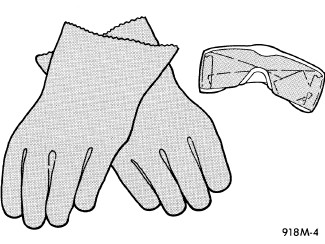 |
Following a Supplemental Restraint System (SRS) component deployment,
the vehicle interior will contain a powdery residue. This residue
consists primarily of harmless particulate by-products of the small
pyrotechnic charge that initiates the propellant used to deploy a
SRS component. However, this residue may also contain traces of sodium
hydroxide powder, a chemical by-product of the propellant material
that is used to generate the inert gas that inflates the airbag. Since
sodium hydroxide powder can irritate the skin, eyes, nose, or throat,
be certain to wear safety glasses, rubber gloves, and a long-sleeved
shirt during cleanup.
To avoid serious or fatal injury,
if you experience skin irritation during cleanup, run cool water over
the affected area. Also, if you experience irritation of the nose
or throat, exit the vehicle for fresh air until the irritation ceases.
If irritation continues, see a physician.
WARNING:
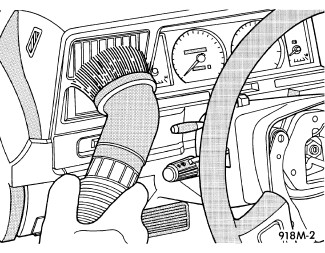 |
- Begin the cleanup by using a vacuum cleaner to remove any residual powder from the vehicle interior. Clean from outside the vehicle and work your way inside, so that you avoid kneeling or sitting on a non-cleaned area.
-
Be certain to vacuum
the heater and air conditioning outlets as well. Run the heater and
air conditioner blower on the lowest speed setting and vacuum any
powder expelled from the outlets.
CAUTION: Deployed front airbags having two initiators (squibs) in the airbag inflator may or may not have live pyrotechnic material within the inflator. Do not dispose of these airbags unless you are certain of complete deployment. Refer to the AIRBAG SQUIB STATUS heading within this information. All damaged, ineffective, or non-deployed Supplemental Restraint System (SRS) components which are replaced on vehicles are to be handled and disposed of properly. If an airbag or seat belt tensioner unit is ineffective or damaged and non-deployed, refer to the Hazardous Substance Control System for information regarding the potentially hazardous properties of the subject component and the proper safe handling procedures. Then dispose of all non-deployed and deployed airbags and seat belt tensioners in a manner consistent with state, provincial, local and federal regulations.
- Next, remove the deployed SRS components from the vehicle. Refer to the appropriate service removal procedures.
-
You may need to vacuum
the interior of the vehicle a second time to recover all of the powder.