2.
CHECK FOR PASSENGER SEAT BELT RETRACTOR TENSIONER CIRCUIT OPEN
WARNING:
Turn the ignition off disconnect
the 12-volt battery and wait two minutes before proceeding. Failure
to follow these instructions may result in possible serious or fatal
injury.
1.
Disconnect the Passenger Seat Belt Retractor Tensioner connector.
NOTE:
Check connectors - Clean and repair as necessary.
2.
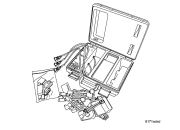
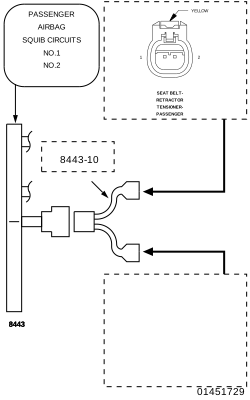
Connect the Supplemental Restraint System SRS Load Tool Kit
8443A
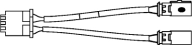
and SRS Load Tool Jumper
8443-10
to the Passenger Seat Belt Retractor Tensioner connector.
WARNING:
Turn the ignition on, then reconnect
the 12-volt battery and wait two minutes before proceeding. Failure
to follow these instructions may result in possible serious or fatal
injury.
3.
With the scan tool, read the active ORC DTC.
Does the scan tool display B1C49-1ST ROW PASSENGER RETRACTOR PRETENSIONER CIRCUIT OPEN?
3.
CHECK (R506) PASSENGER SEAT BELT RETRACTOR TENSIONER DATA CIRCUIT FOR AN OPEN
WARNING:
Turn the ignition off, disconnect
the 12-volt battery and wait two minutes before proceeding. Failure
to follow these instructions may result in possible serious or fatal
injury.
1.
Disconnect the SRS Load Tool Kit
8443A
and Jumper from the Passenger Seat Belt Retractor Tensioner connector.
2.
Disconnect the ORC connectors.
NOTE:
Check connectors - Clean and repair as necessary.
3.
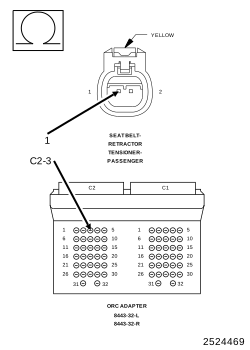
Connect the SRS Load Tool Adaptor
8443-32-L
to the ORC connectors.
4.
Measure the resistance of the (R506) Passenger Seat Belt Retractor Tensioner Line 1 circuit between the Passenger Seat Belt Retractor Tensioner connector cavity 1 and the SRS Load Tool Adaptor
8443-32-L
cavity C2-3.
4.
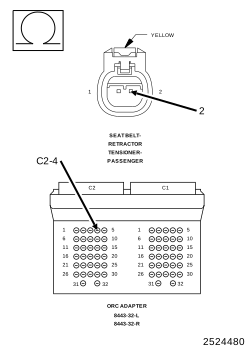
CHECK (R504) PASSENGER SEAT BELT RETRACTOR TENSIONER LINE 2 CIRCUIT FOR AN OPEN
1.
Measure the resistance of the (R504) Passenger Seat Belt Retractor Tensioner Line 2 circuit between the Passenger Seat Belt Retractor Tensioner connector cavity 2 and the SRS Load Tool Adaptor
8443-32-L
cavity C2-4.
Is the resistance below 1.0 Ohm?
Yes
WARNING:
If the Occupant Restraint Controller
(ORC) is dropped at any time, it must be replaced. Failure to follow
these instructions may result in possible serious or fatal injury.
Replace the ORC in accordance with Service Information.
With the scan tool, record and erase all DTC from all Airbag System Modules.
2.
If any ACTIVE codes are present they must be resolved before diagnosing any stored codes.
WARNING:
Turn the ignition off, disconnect
the 12-volt battery and wait two minutes before proceeding. Failure
to follow these instructions may result in possible serious or fatal
injury.
3.
Using the wiring diagram/schematic as a guide, inspect the wiring and connectors.
4.
Look for chafed, pierced, pinched, or partially broken wires and broken, bent, pushed out, spread, corroded, or contaminated terminals.
5.
The following additional checks may assist you in identifying a possible intermittent problem.
6.
Reconnect any disconnected components and harness connector.
WARNING:
Turn the ignition on, then reconnect
the 12-volt battery and wait two minutes before proceeding. Failure
to follow these instructions may result in possible serious or fatal
injury.
7.
With the scan tool monitor active codes as you work through the following steps.
8.
Wiggle the wiring harness and connectors of the related airbag circuit or component.
9.
If codes are related to the Driver Airbag circuits, rotate the steering wheel from stop to stop.
10.
If only stored codes return continue the test until the problem area has been isolated.
11.
In the previous steps you have attempted to recreate the conditions responsible for setting active DTC in question.