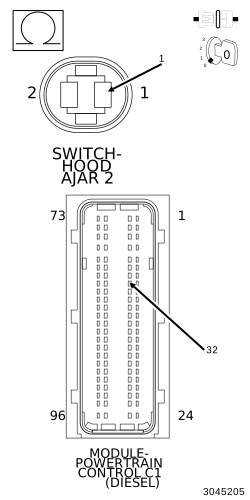
Home › 28 - DTC-Based Diagnostics › MODULE, Powertrain Control (PCM), 2.8L VM › P257F-ENGINE HOOD SWITCH CIRCUIT HIGHP257F-ENGINE HOOD SWITCH CIRCUIT HIGH
For a complete wiring diagram, refer to the Wiring Information .
Possible Causes
(K806) ENGINE HOOD SWITCH 2 SIGNAL CIRCUIT OPEN/HIGH RESISTANCE
ENGINE HOOD SWITCH
POWERTRAIN CONTROL MODULE (PCM)
Always perform the Pre-Diagnostic Troubleshooting procedure before proceeding. (Refer to 28 - DTC-Based Diagnostics/MODULE, Powertrain Control (PCM)
- Standard Procedure) .
1.
DTC IS ACTIVE
1.
Ignition on, engine not running.
2.
With the scan tool, clear DTCs in the PCM.
4.
Allow the engine to reach normal operating temperature.
5.
Monitor the scan tool for at least two minutes.
6.
With the scan tool, select View DTCs.
Is the status Active for this DTC? Yes
No
2.
CHECK THE (K806) ENGINE HOOD SWITCH 2 SIGNAL CIRCUIT FOR AN OPEN/HIGH RESISTANCE
1.
Turn the ignition off.
2.
Disconnect the Engine Hood Switch 2 harness connector.
3.
Disconnect the PCM C1 harness connector.
4.
Measure the resistance of the (K806) Engine Hood Switch 2 Signal circuit between the Engine Hood Switch 2 harness connector and the PCM C1 harness connector.
Is the resistance below 5.0 Ohms? Yes
No
3.
CHECK THE HOOD SWITCH
1.
Turn the ignition off.
3.
Using an Ohmmeter connected to ground, probe the Engine Hood Switch 2 terminal.
NOTE:
Observe the reading on the Ohmmeter.
4.
Press and hold the Engine Hood Switch down completely.
NOTE:
Observe the reading on the Ohmmeter.
NOTE:
The Engine Hood Switch should read below 5.0 Ohms with the Hood Switch released and change to OL with the Hood Switch pressed.
Does the Ohmmeter read as described above? Yes
No
4.
POWERTRAIN CONTROL MODULE
1.
Using the wiring diagram/schematic as a guide, inspect the wiring and connectors between the Engine Hood Switch 2 and the Powertrain Control Module.
2.
Look for any chafed, pierced, pinched, or partially broken wires.
3.
Look for broken, bent, pushed out or corroded terminals.
4.
Perform any Technical Service Bulletins that may apply.
Were any problems found? Yes
No